
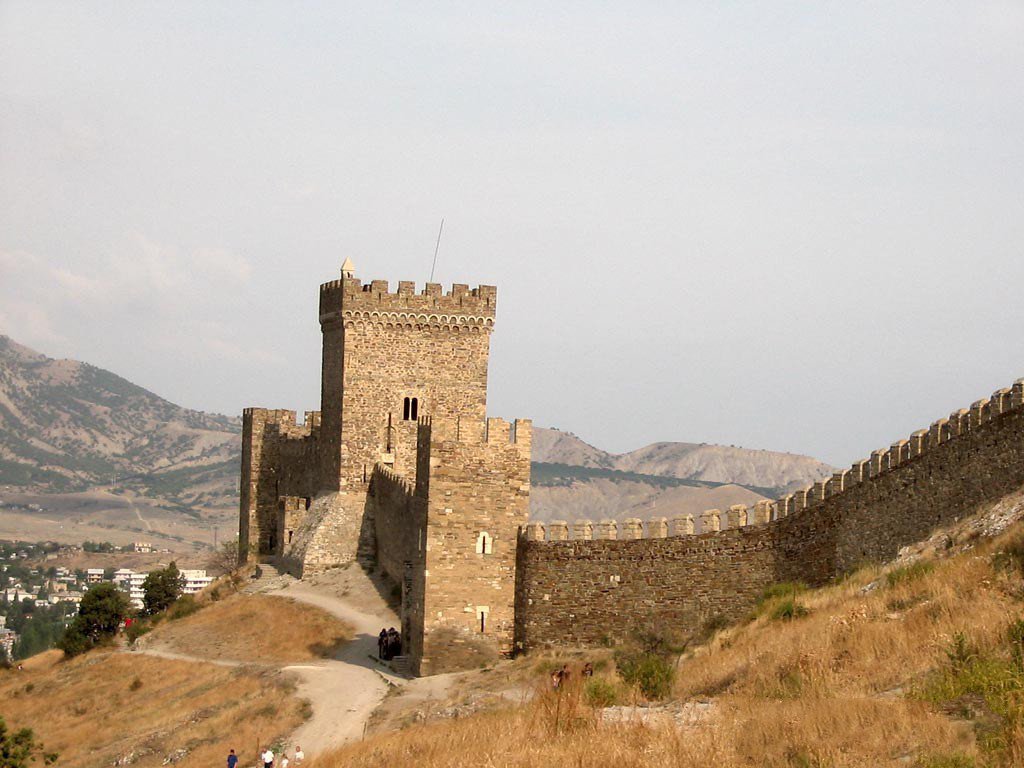
A ridge of stone above the Black Sea, raised by Genoese merchants who turned a Roman-era harbor town into a fortified trading post.
At a glance
The fortress spreads across 27.9 hectares on a coastal mountain in Sudak, its walls stepping down from a rocky summit to the shoreline. It is heritage-listed and has stood since the Genoese rebuilt it following Mongol destruction. Two tiers of defenses, an upper citadel and a lower town wall, still trace the site’s medieval outline.
History
Fortification here is old. Romans built the first defenses near Sudak in the 3rd and 4th centuries, and the Bosporan Kingdom later held its own works at Sougdaia. Genoese merchants began settling the town in the 13th century, raising stone walls around its center by the century’s end. Mongol forces then overran the city, destroying the original Genoese fortifications. After the death of Khan Berdi Beg, Genoa retook the town, renamed Soldaia, and built the fortress largely visible today, an episode documented unusually well through inscriptions the builders left on the walls; the fortress’s inception is dated to 1371. Ottoman forces took Sudak in 1475. The Russian Empire occupied it in 1771, after which the fortress lost military purpose. Imperial administrators dismantled Genoese buildings and reused the stone elsewhere. A historical and archaeological museum opened on the grounds in 1925, absorbed the following year into the Moscow State Historical Museum. Crimea’s 1958 transfer to the Ukrainian SSR placed the fortress under the National Reserve “Sophia of Kyiv,” and restoration has continued since 1959.
What you see
The fortress sits between sea and moat, the Black Sea guarding its southern flank and an artificial ditch closing off the north. Two tiers organize the defenses. The lower tier, forming the northern half, carries a wall 6 to 8 meters tall and 1.5 to 2 meters thick, punctuated by fourteen towers rising 15 meters and pierced by the main gate. The upper tier climbs toward the sea and holds the Consul’s Castle along with several named towers, among them the Watch Tower, the Corner Tower, and George’s Tower. Inside the walls and beyond them stand storage buildings, a water cistern, the Padişah Cami Mosque, the Church of the Twelve Apostles, and traces of barracks the Russian imperial army later added.
Cultural significance
The fortress records centuries of shifting control over a single stretch of coast. Roman, Bosporan, Genoese, Ottoman and Russian layers overlap within its perimeter. Its walls carry Genoese inscriptions that historians rely on for dating and detail, making the site a rare readable archive as much as a ruin. It was nominated among the Seven Wonders of Ukraine. Since 2007 it has held Tentative World Heritage status, joined in 2010 to a wider transnational nomination of Genoese fortresses along the Black and Mediterranean seas.
Key facts
- Location: Sudak, Crimea
- Area: 27.9 hectares
- Inception: 1371 (rebuilding after Mongol destruction)
- Builders: Republic of Genoa, on earlier Roman and Bosporan fortifications
- Structure: lower tier wall with fourteen towers; upper tier with the Consul’s Castle
- Status: heritage-listed; UNESCO Tentative List since 2007
Practical information & getting there
The fortress stands on the coastal mountain above Sudak, on Crimea’s southeastern shore, with the sea forming its natural southern boundary. You reach the site through the town of Sudak itself. The article gives no visiting hours or admission details, so check current local sources before planning a visit.
Sources & resources
Find it on the map
See this place and what’s around it →📷 Become a Cultural Heritage Online photographer
Share your photos of places: they stay published under your name as the author. The more they're seen, the more you get noticed — and soon a contest will reward the most appreciated photos.
Log in or sign up free to add a photoIs this page about you?
This page is read by travellers and heritage enthusiasts who find it on Google. Tell us how you are connected to this place and we will take it from there.