
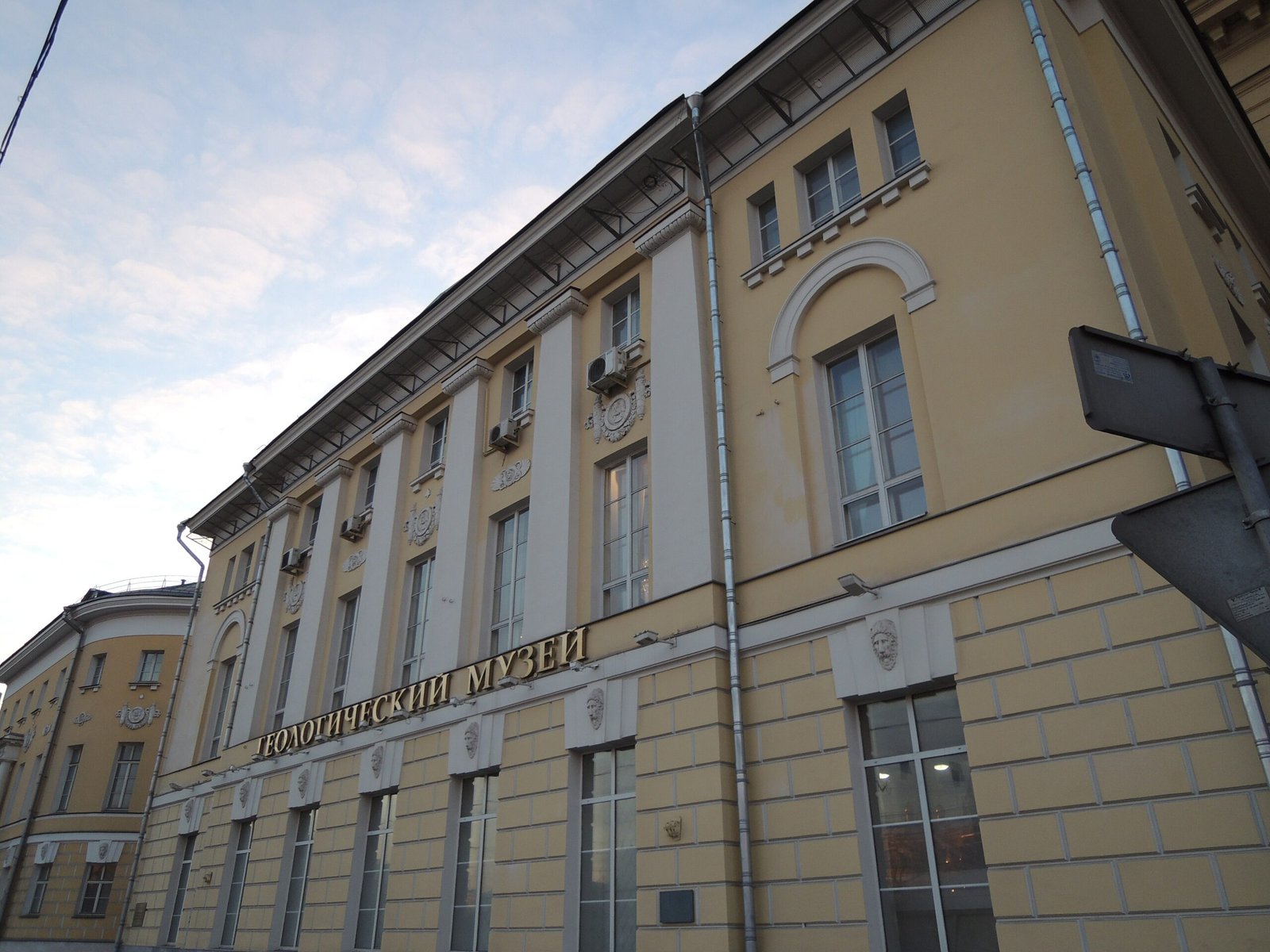
A collection of rocks and minerals begun under Mikhail Lomonosov has grown into one of Moscow’s principal earth-science institutions, still run under the Russian Academy of Sciences.
At a glance
The Vernadsky State Geological Museum holds mineralogical and geological material assembled over more than two and a half centuries. Its roots lie in the founding charter of Moscow Imperial University. Today it functions as both a research resource and a public educational centre.
History
Mikhail Lomonosov studied mining in Germany. He returned convinced that scholars needed “not only books, but objects of Nature” to understand the earth. That conviction shaped the charter he helped write for Moscow Imperial University, established in January 1755. The mineralogical collection founded alongside the university that year forms the museum’s earliest layer. Wikidata records the institution’s formal inception as 1988, marking a later stage in its organisational history under the Academy of Sciences, though the specimens it holds reach back to Lomonosov’s founding vision.
What you see
Visitors encounter cases of minerals, ores and rock formations arranged for study as much as display. The collection reads like a cabinet of curiosities scaled up into a working scientific archive. Specimens range from common building stone to rarer crystalline forms. Labels favour classification over spectacle. It rewards slow looking rather than a quick pass through the halls.
Cultural significance
The museum carries the name of Vladimir Vernadsky, a founder of modern geochemistry and biogeochemistry, linking the collection to a wider tradition of Russian earth science. Its lineage to Lomonosov ties it directly to the birth of Russian university learning. As part of the Russian Academy of Sciences, it continues to serve researchers alongside the public. Few Moscow institutions can claim a teaching collection with origins this old.
Key facts
- Location: Moscow, Russia
- Mineralogical collection founded: 1755
- Affiliated with: Russian Academy of Sciences
- Institutional inception (Wikidata): 1988
- Heritage status: officially listed
Practical information & getting there
The museum sits in central Moscow, reachable by the city’s metro network. Check the official website before visiting for current opening hours and admission details, since these are not fixed here. Give yourself time; the collection is dense and best absorbed without rushing.
Sources & resources
Find it on the map
See this place and what’s around it →📷 Become a Cultural Heritage Online photographer
Share your photos of places: they stay published under your name as the author. The more they're seen, the more you get noticed — and soon a contest will reward the most appreciated photos.
Log in or sign up free to add a photoIs this page about you?
This page is read by travellers and heritage enthusiasts who find it on Google. Tell us how you are connected to this place and we will take it from there.