
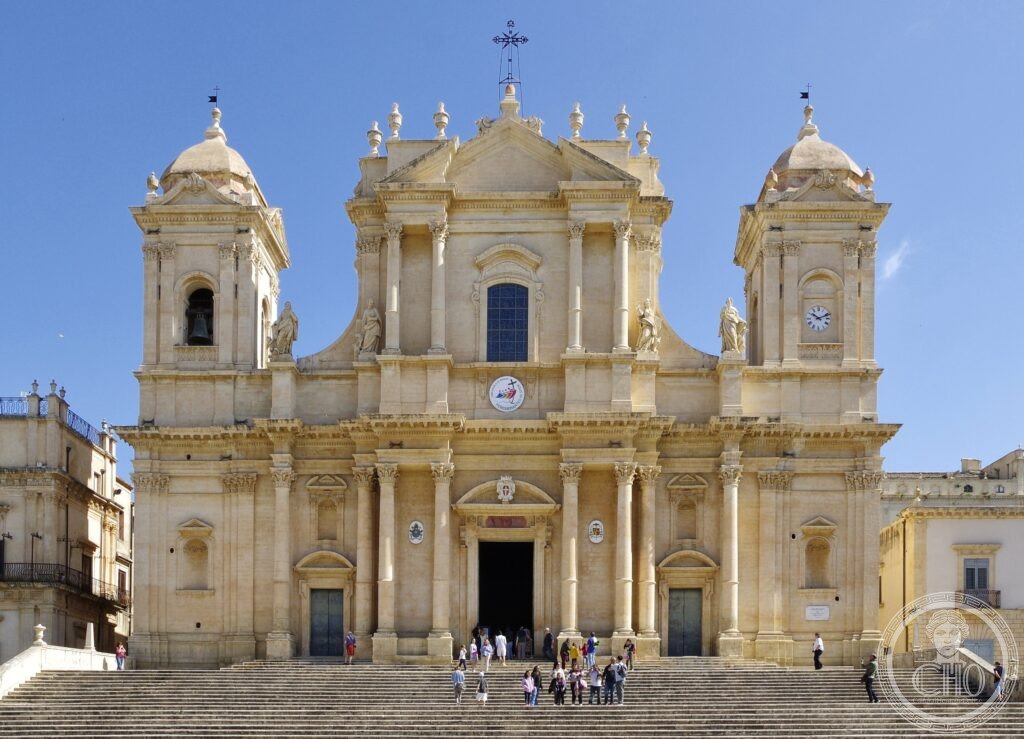
Eight towns in south-eastern Sicily were rebuilt almost from nothing after the earthquake of 1693, in a single sweep of Late Baroque design carved from the golden limestone of the Iblean plateau. Noto is the showcase, its cathedral and its curving stone façades still glowing amber at the end of the day.
At a glance
The Val di Noto group brings together eight towns rebuilt after the earthquake of January 1693: Caltagirone, Militello in Val di Catania, Catania, Modica, Noto, Palazzolo Acreide, Ragusa and Scicli. All were reconstructed in the Late Baroque style then current, using the same warm golden Iblean limestone quarried locally, which gives the towns an unusually unified appearance.
Rosario Gagliardi was the most prolific architect of the reconstruction, working on churches in Noto, Modica and Ragusa. Giovanni Battista Vaccarini worked mainly in Catania. The wider streets laid out after 1693 were an early example of earthquake-conscious town planning, designed to give people room to escape and to stop collapsing buildings blocking the way.
Key facts
- Group: Late Baroque Towns of the Val di Noto, south-eastern Sicily
- Towns: Caltagirone, Militello in Val di Catania, Catania, Modica, Noto, Palazzolo Acreide, Ragusa, Scicli
- Trigger event: the Val di Noto earthquake of 11 January 1693
- Principal architects: Rosario Gagliardi (c.1698–1762) and Giovanni Battista Vaccarini (1702–1768)
- Material: Iblean limestone, a golden-amber stone quarried from the plateau on which the towns stand
- Status: inscribed on the UNESCO World Heritage List in 2002
History
The earthquake of 11 January 1693 followed a smaller shock two days earlier and devastated the whole of south-eastern Sicily, with the heaviest loss of life concentrated in the zone between Catania and Syracuse. Towns including Noto Antica, Ragusa Ibla, Catania, Scicli and Modica were largely destroyed. In the case of Noto, the Flemish military engineer Carlos de Grunenbergh argued for abandoning the old hilltop site altogether; local nobles wanted to rebuild where the town had always stood. The compromise was to build the new Noto some distance away on lower, flatter ground, a rare case in Italy of an entire city being relocated after a disaster.
The new towns were laid out with straight main axes and grid streets, and their principal civic buildings were positioned to create planned visual sequences along them. No single architect designed any of these towns as a whole; instead, several generations of architects worked within a shared Late Baroque idiom and a shared material over roughly sixty years, and it is this coherence of style rather than a single masterplan that UNESCO recognised when it inscribed the group in 2002.
Modica’s chocolate, made by a cold-working method without added cocoa butter that gives it a grainy texture, was recognised by the European Union as a protected geographical indication in 2009. The technique is said to have reached Sicily by way of Spain from earlier Aztec practice.
What you see
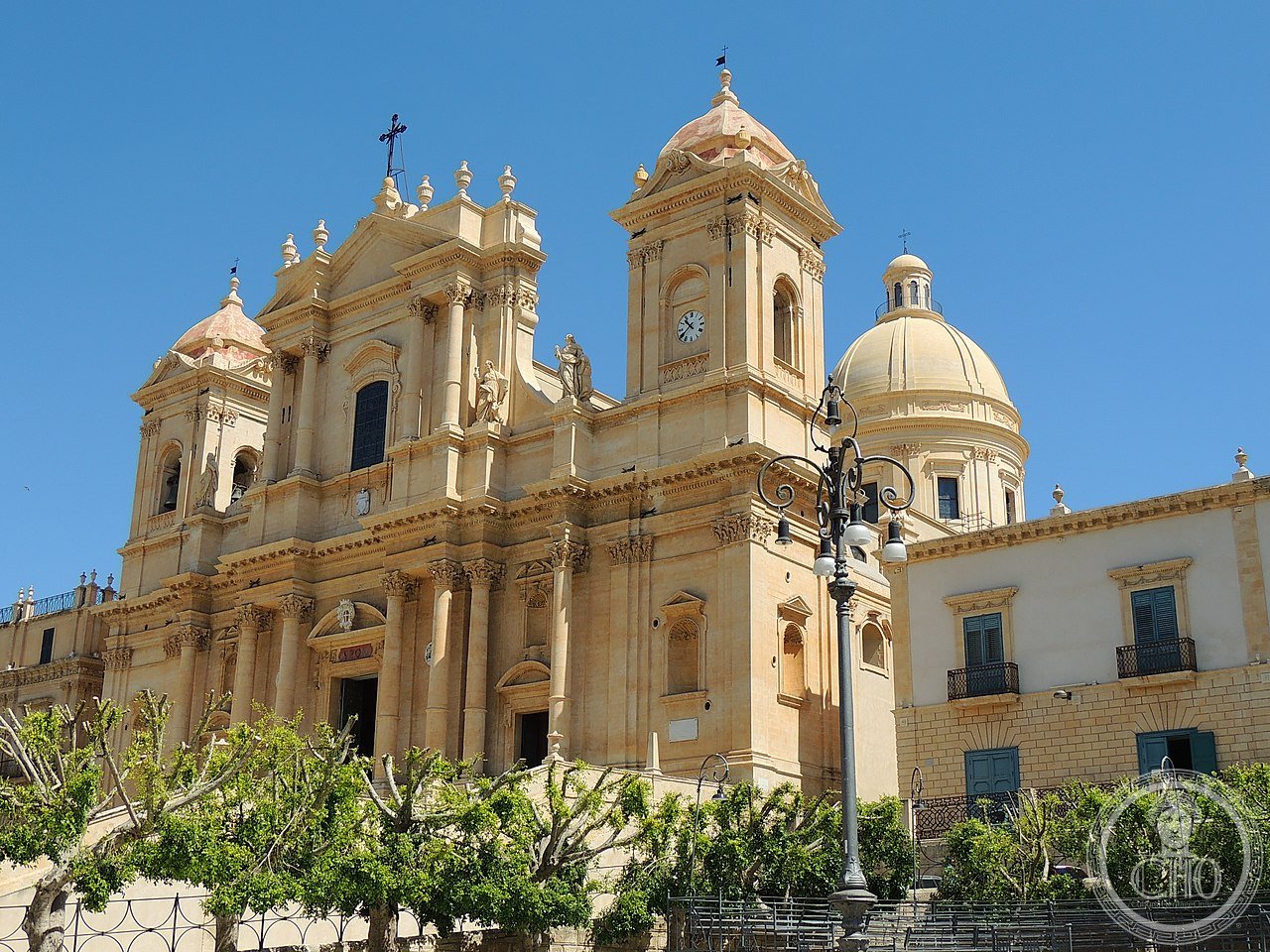
In Noto, the Corso Vittorio Emanuele forms the spine of the town, with the Cathedral of San Nicolò, Palazzo Ducezio and the Church of San Francesco arranged along it. The cathedral’s three-tier façade, by Gagliardi and Vincenzo Sinatra, uses a curving concave-convex movement in warm golden stone, reached by a broad flight of steps in the same material. Nearby, the Church of San Domenico, also by Gagliardi, compresses three different column orders into a single narrow façade.
Ragusa is really two towns: Ragusa Ibla, the medieval quarter rebuilt in Baroque style on its original hilltop after residents refused to relocate, and Ragusa Superiore on the neighbouring ridge. Ibla’s Duomo di San Giorgio, by Gagliardi, is generally considered his grandest church, its tiered façade rising above the surrounding rooftops and best seen from the staircase below in Piazza della Repubblica.
Modica sits above a V-shaped valley where two streams once met, and its skyline is dominated by two Baroque churches, San Giorgio and San Pietro. Its old centre, Corso Umberto I, is also the centre of the town’s artisan chocolate trade. Scicli, the quietest of the four main towns, has three Baroque churches on its hillside and façades that face west, catching the evening light directly; its streets have also served as a filming location for the television series Il Commissario Montalbano.
Practical information
- Best time of day: the golden limestone changes markedly in colour between midday and late afternoon, and the towns’ Baroque façades are usually seen at their best towards sunset.
- Opening times and access: visiting hours for the cathedral and other churches vary and are best checked with the relevant parish or local tourist office before travelling.
- How much time to allow: Noto alone rewards a full day if the Corso and its main churches are to be seen properly; visiting several of the eight towns in one trip requires careful planning given the distances between them.
Getting there
The towns of the Val di Noto group lie across south-eastern Sicily, broadly between Catania and Syracuse and further south towards Ragusa and Modica. Noto acts as a natural hub for visiting the group, with Ragusa Ibla, Modica and Scicli forming a loop to the south-west.
Nearby
- Ragusa Ibla — part of the same UNESCO group, with Gagliardi’s Duomo di San Giorgio as its centrepiece.
- Modica — known for its Baroque churches and its distinctive cold-processed chocolate.
- Scicli — the quietest of the four main towns, with west-facing Baroque façades and links to the Montalbano television series.
- Palazzolo Acreide, Militello in Val di Catania and Caltagirone — the remaining towns of the same reconstruction group.
Sources
- UNESCO
- Tobriner, Stephen, The Genesis of Noto, 1982
Gallery
Find it on the map
See this place and what’s around it →📷 Become a Cultural Heritage Online photographer
Share your photos of places: they stay published under your name as the author. The more they're seen, the more you get noticed — and soon a contest will reward the most appreciated photos.
Log in or sign up free to add a photo