
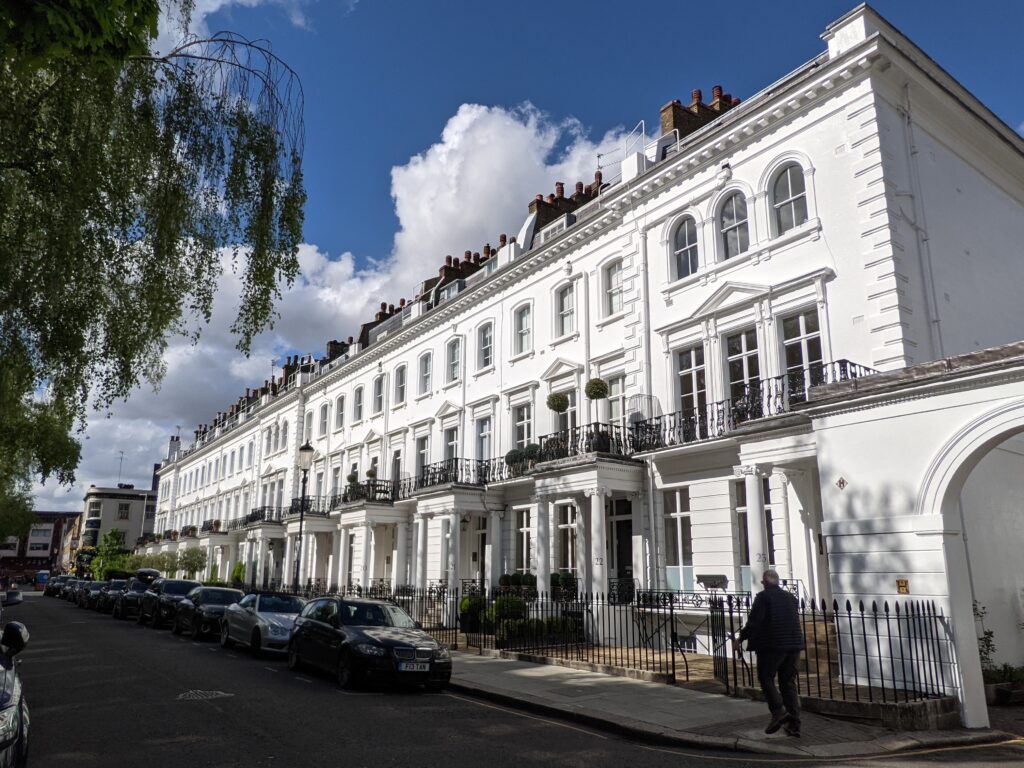

A short, white terrace built on the Smith’s Charity estate when South Kensington was still being laid out. The builder who developed the whole district lived in it for three years, and one of its houses is now the hotel called Number Sixteen.
At a glance
Sumner Place is a quiet street between Old Brompton Road and Onslow Square, a few minutes from South Kensington station. Nos. 13–23 form a balanced stucco terrace, three storeys over a basement, with columned porches and a cast-iron balcony running along the first floor. Historic England lists the terrace at Grade II. It belongs to the development carried out from the 1840s by the builder Charles James Freake on land owned by the Smith’s Charity, and the Survey of London singles out Sumner Place as the street where Freake’s smaller houses kept “much of the calm elegance” they had in the nineteenth century. No. 16 is today the Number Sixteen hotel.
Key facts
- Where: 13–23 Sumner Place, South Kensington, London SW7, Royal Borough of Kensington and Chelsea
- Built: mid-19th century; Sumner Place was developed by Freake from 1849 onwards
- Developer: Charles James Freake, builder, on the Smith’s Charity estate
- Protection: listed Grade II, National Heritage List for England entry 1226839, first listed 15 April 1969
- Current use: private houses and flats; No. 16 is the Number Sixteen hotel
- Coordinates: 51.493145, -0.175468 · open in Google Maps
History
The land south of Old Brompton Road belonged to the Smith’s Charity, a trust whose estate was built over in the nineteenth century. Charles James Freake signed his first building agreement with the trustees in 1844 and began with Sydney Place, finished by 1846. Onslow Square followed from 1845. The streets leading off the square came next, and the trustees’ names were used for them: Sumner Terrace, now Nos. 25–34 Sumner Place, took its name from George and William Holme Sumner, two of the trustees. The Survey of London records that it was begun in 1849 and completed by 1851, and that the northern arm of the street was begun in 1851.
The houses did not all sell quickly. The Survey notes that some in the northern arm seem to have stood unoccupied for around ten years, that directories suggest Freake had trouble disposing of houses here, and that he even considered allowing shops in the street. Houses in Sumner Place sold for less than those in Onslow Square. Freake himself appears to have lived at No. 19 Sumner Place from 1857 to 1860, inside the listed terrace, before moving to Cromwell Road.
Other residents left a mark: Joseph Aloysius Hansom, founder of the journal The Builder and inventor of the Hansom cab, lived at No. 27 from about 1873 to 1877, and a plaque records him there. Nos. 1 and 2 at the other end of the street were destroyed by bombing in the Second World War. Nos. 13–23 survived and were listed in 1969.
What you see
The photograph looks along the terrace from its southern end. The whole front is painted white stucco, with the ground floor scored in horizontal bands to imitate masonry. Each house has a columned porch, Ionic in the listing’s description, standing on steps behind black iron railings, and above the porches a continuous cast-iron balcony runs the length of the first floor. The first-floor windows carry bracketed cornices, some with small pediments.
The end house nearest the camera, No. 23, steps forward from the line and is treated differently: tall three-light windows on the first floor, and on the second floor a group of three round-arched windows under the eaves. The listing describes the same arrangement for the centre and end houses, Nos. 13, 18 and 23. Above the cornice, set back, is a roof storey with rows of chimney stacks. To the right, a stucco arch closes the corner of the street.
Practical information
- The terrace is in private use; the fronts can be seen from the street at any time.
- No. 16 operates as Number Sixteen, a hotel of the Firmdale group with a private garden behind the house.
- A few minutes is enough to walk the length of the street; the Hansom plaque is on No. 27, further along the street.
Getting there
South Kensington Underground station (Piccadilly, District and Circle lines) is a short walk away: follow Old Brompton Road west and turn south into Sumner Place. Buses on Old Brompton Road and Fulham Road stop close by.
Nearby
- Natural History Museum, about five minutes north, across Cromwell Road.
- Holy Trinity Brompton, behind Brompton Road.
- Michelin House, on Fulham Road, about ten minutes east.
- Onslow Square, Freake’s larger square, immediately south of Sumner Place.
Sources
- Historic England, National Heritage List for England, entry 1226839, 13-23, Sumner Place SW7: Grade II, listed 15 April 1969; “balanced terrace of houses, mid C19”, stucco, Ionic porches, continuous first-floor balcony, centre and end houses set forward.
- Survey of London, vol. 41, The Smith’s Charity Estate: Charles James Freake and Onslow Square Gardens: chronology of Freake’s building from 1844, Sumner Terrace 1849–51, the northern arm begun 1851, houses slow to sell, Freake at No. 19 in 1857–60, Hansom at No. 27, bomb damage to Nos. 1–2.
- Firmdale Hotels, Number Sixteen: current use of No. 16 as a hotel with a private garden.
- OpenStreetMap / Nominatim: position, returned as Number Sixteen, 16, Sumner Place, Brompton, Royal Borough of Kensington and Chelsea, SW7 3EG.
Find it on the map
See this place and what’s around it →📷 Become a Cultural Heritage Online photographer
Share your photos of places: they stay published under your name as the author. The more they're seen, the more you get noticed — and soon a contest will reward the most appreciated photos.
Log in or sign up free to add a photoIs this page about you?
This page is read by travellers and heritage enthusiasts who find it on Google. Tell us how you are connected to this place and we will take it from there.