
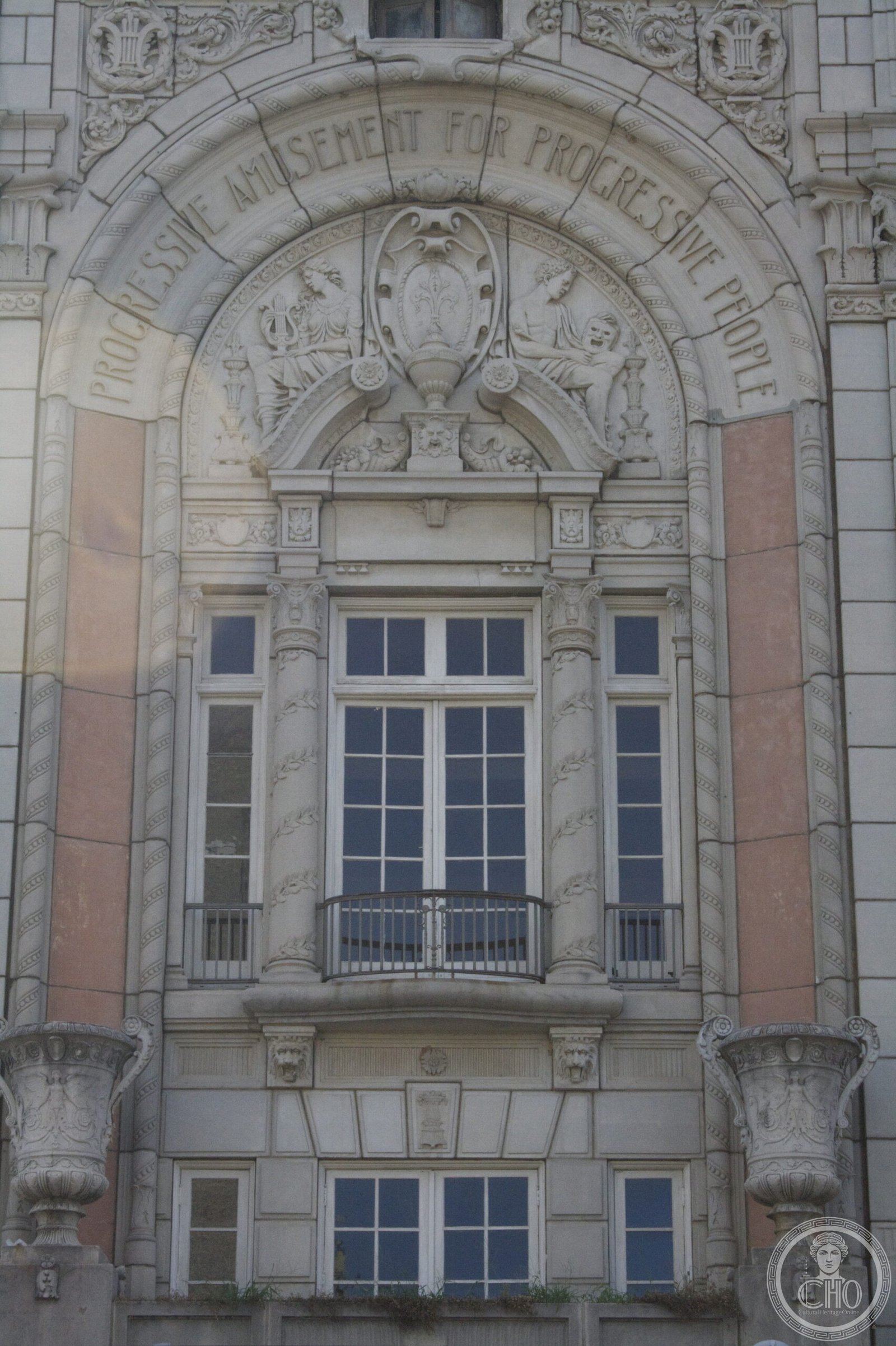
The Strand opened in 1925 as one of the grandest movie palaces in Louisiana — an Art Deco exterior of terracotta ornament and glazed tilework leading into an interior of gilded plasterwork, painted ceilings, and the polished luxury that American cinema-going had come to expect in the years before the Depression.
At a glance
The Strand Theatre stands on Louisiana Avenue in downtown Shreveport as one of the finest surviving examples of the American movie palace tradition in the Deep South. Built in 1925 at the height of cinema’s architectural ambitions, the building presents an elaborate Art Deco facade and an interior of considerable decorative richness — gilded ornamental plasterwork, painted ceilings, a grand chandelier, and the spatial sequence from lobby to auditorium that made movie-going a full theatrical experience in itself. Listed on the National Register of Historic Places, the Strand has been preserved and operates today as a performing arts venue and cinema under nonprofit management.
Key facts
- Address: 619 Louisiana Avenue NW, Shreveport, LA 71101
- Opened: 1925
- Style: Art Deco movie palace — terracotta ornament, gilded plasterwork interior
- Designation: National Register of Historic Places
- Current use: Performing arts centre, cinema, private events
History
The Strand was built in 1925 for the Saenger Theatre chain, which operated a network of ornate cinemas across Louisiana and neighbouring Southern states. The Saenger organisation — founded by the Saenger brothers of New Orleans — commissioned architects and decorators to build to a standard that would draw audiences through luxury and spectacle as well as by the films themselves; the Strand in Shreveport was among their most ambitious projects outside New Orleans.
Like most major American movie palaces, the Strand faced commercial pressure in the 1950s and 1960s as suburban multiplex cinemas drew audiences from the downtown market. The building survived threatened demolition through the advocacy of preservation groups and Shreveport’s civic community, and was listed on the National Register of Historic Places as recognition of its architectural and cultural significance. The subsequent restoration programme addressed the interior’s decorative programme — the plasterwork, painted surfaces, and auditorium finishes — while bringing the building’s mechanical systems into the condition needed for performing arts use.
Today the Strand operates as a multi-purpose venue presenting touring Broadway productions, concerts, film festivals, and community events. The Saenger name — synonymous with Louisiana movie palace culture — is still associated with the building in popular memory even as it operates under new management.
What you see
The facade on Louisiana Avenue presents a compressed version of the Art Deco ornamental programme: terracotta panels with geometric ornament, glazed tile insets in jewel-like colours, and a vertical marquee that still carries electric lettering above the main entrance. The facade’s geometry — setback piers, horizontal banding, compressed ornamental zones between the functional elements — is characteristic of commercial Art Deco design in the mid-1920s.
Inside, the lobby leads through a sequence of ornamental spaces toward the main auditorium, whose ceiling carries painted decoration and ornamental plasterwork of considerable delicacy. The chandelier in the auditorium — a feature that the major movie palace architects considered essential to the experience — hangs above the stalls in the centre of a painted ceiling coffer. The auditorium side walls carry ornamental niches, pilasters, and carved detail in the Spanish and Italian manner common to Southern movie palaces of the period. The overall effect is of a building designed to immerse its audience in luxury before the film even begins.
Practical information
- Hours: Varies by programming — check the venue’s schedule for performances and events
- Tickets: Available at the box office and online; the Strand produces its own programming season
- Tours: Building tours may be available; contact the venue directly for current availability
- Accessibility: The building has been modified for accessibility in the course of restoration works; contact the venue for specific arrangements
Getting there
The Strand Theatre stands on Louisiana Avenue in the downtown commercial district of Shreveport, one block from Texas Street — the city’s main commercial artery. Shreveport Regional Airport is approximately five miles south-west of downtown; SporTran bus service connects the airport area to downtown Shreveport. The theatre is within walking distance of the Shreveport riverfront and the casinos that line the Red River waterfront. Street and garage parking are available throughout the downtown core.
Nearby
- Shreveport Municipal Auditorium (1929) — an Art Deco civic auditorium three blocks north on Crockett Street, famous as the original venue for the Louisiana Hayride radio broadcast; National Historic Landmark
- R.W. Norton Art Gallery — a major collection of Western and American art, approximately three miles north-west
- Barnwell Garden and Art Center — public garden and cultural venue, approximately two miles north-west
- Red River waterfront — the casinos and riverfront promenade, two blocks west of Louisiana Avenue
Sources
- National Register of Historic Places nomination, Strand Theatre, Shreveport
- Strand Theatre — institutional history and programming archive
- David Naylor, American Picture Palaces: The Architecture of Fantasy (1981)
- Louisiana Office of Cultural Development, Division of Historic Preservation — property records
- Shreveport Metropolitan Planning Commission — architectural survey
Find it on the map
See this place and what’s around it →📷 Become a Cultural Heritage Online photographer
Share your photos of places: they stay published under your name as the author. The more they're seen, the more you get noticed — and soon a contest will reward the most appreciated photos.
Log in or sign up free to add a photoIs this page about you?
This page is read by travellers and heritage enthusiasts who find it on Google. Tell us how you are connected to this place and we will take it from there.