
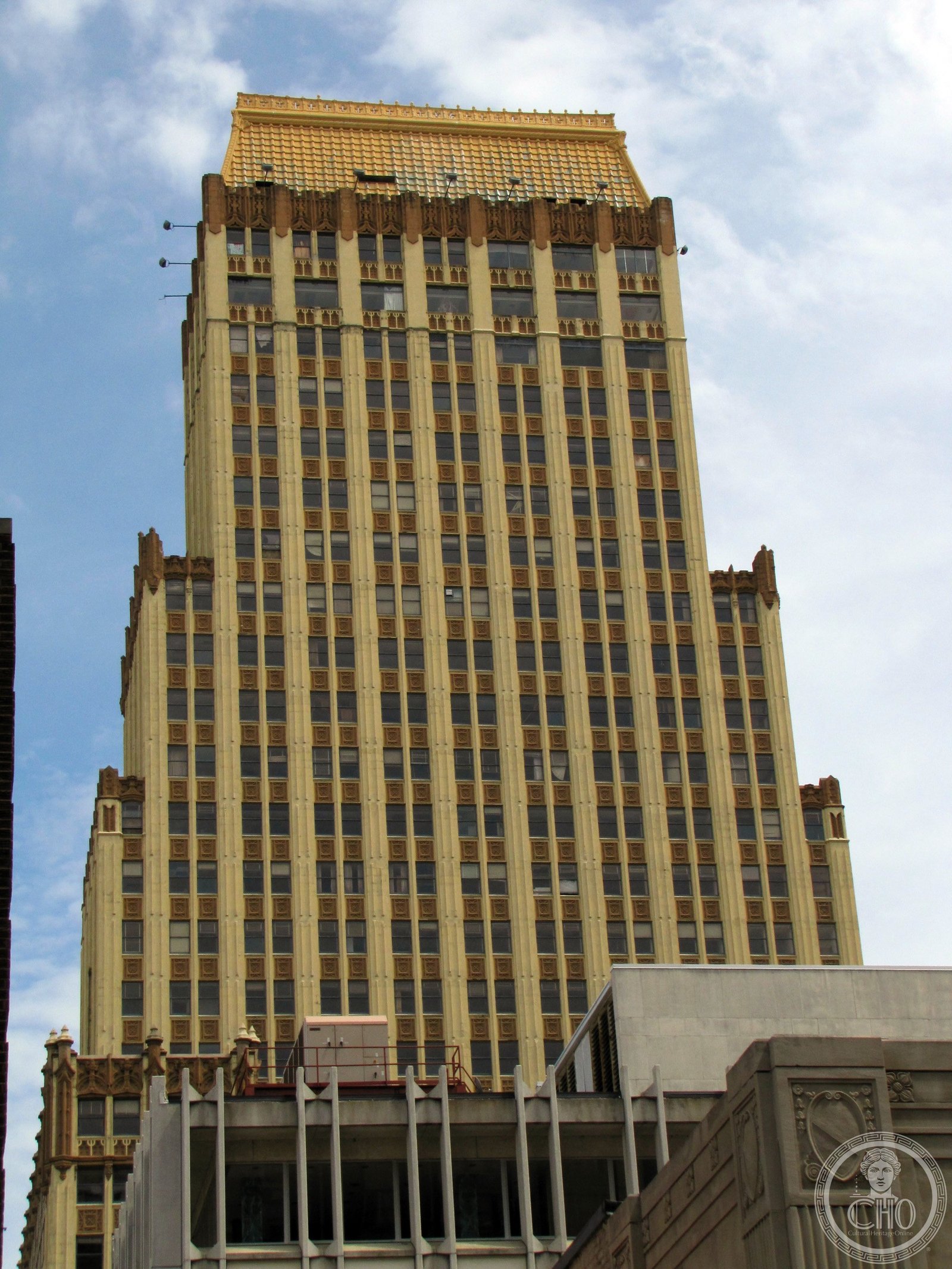
For decades the tallest building in Tennessee, the Sterick Building rose 29 stories above downtown Memphis in 1930 — its Art Deco shaft and Gothic-inflected crown a skyline landmark that has outlasted the commercial cycles of the century that followed.
At a glance
The Sterick Building at 8 North Third Street in downtown Memphis was completed in 1930 as the headquarters of the Sterrick Development Company. Designed by architect William Martin Aiken, the 29-story tower combined the setback massing of Art Deco with Gothic ornamental elements at the crown — a characteristic approach of the late 1920s skyscraper, which often capped a modern commercial building with the pointed spires and carved stone of medieval ecclesiastical architecture. At 365 feet the Sterick Building was the tallest structure in Tennessee for many years. It is listed on the National Register of Historic Places.
Key facts
- Address: 8 North Third Street, Memphis, TN 38103
- Height: 29 stories, 365 ft (111 m)
- Completed: 1930
- Architect: William Martin Aiken
- Style: Art Deco with Gothic Revival crown
- NRHP: Yes
- Status: Vacant (as of 2020s)
History
The Sterick Building was developed during the late 1920s economic boom. Architect William Martin Aiken, who had established his reputation with residential and commercial work in the Memphis area, designed a tower that was ambitious in its height and conventional in its formal approach — the setback shaft that rose to a pointed Gothic crown was a formula that had been successfully employed across the country, from Chicago to New York, and Aiken applied it with confidence to the Memphis skyline.
Upon completion the Sterick Building was immediately the most prominent structure in Memphis, its 365-foot height making it visible across the Mississippi River lowlands and from the bluffs to the east. It attracted law firms, corporate offices, and financial institutions as tenants and served as the city’s most prestigious office address for much of the mid-20th century.
The building has been vacant for many years, a casualty of downtown Memphis’s commercial decline in the latter half of the 20th century. Various redevelopment proposals have been advanced over the decades, and the building’s listing on the National Register of Historic Places provides a framework for preservation. It remains a significant architectural landmark and a visual anchor for the downtown skyline.
What you see
The Sterick Building’s facade is faced in white limestone and terracotta, its surface organized into vertical bays that run from the base to the setbacks near the crown. The ornamental detail — concentrated at the entrance portal, the spandrel panels, and the crown — combines Art Deco geometric abstraction with Gothic-derived pointed forms. The transition from the commercial lower floors to the more explicitly Gothic upper stories is handled through a series of setbacks that narrow the building’s profile as it rises, creating the characteristic wedding-cake silhouette of the American Art Deco tower.
At the crown, the building breaks into a cluster of pointed spires that project against the Memphis sky — the building’s most Gothic gesture and its primary skyline identifier. The effect is particularly dramatic at dusk, when the white limestone catches the last light and the crown reads as a silhouette against the darkening sky to the west.
Practical information
- Status: The building is currently vacant and not open to the public
- Exterior: Viewable at all times from Third Street; the full facade is visible from Court Square across the street
- Photography: Best shot from Court Square looking east; the Gothic crown is most dramatic at dusk or twilight
- Downtown Memphis: Court Square and Beale Street (music district) are within easy walking distance
Getting there
The Sterick Building is in downtown Memphis at Third Street and Madison Avenue, across Court Square. Memphis International Airport (MEM) is about 10 miles south-east via I-240. Downtown Memphis is compact; the Sterick Building is a 10-minute walk from Beale Street and the Mississippi Riverfront. The Memphis Area Transit Authority (MATA) trolley routes serve the downtown core.
Nearby
- Court Square — historic downtown park directly opposite the Sterick Building on Third Street
- Beale Street — the birthplace of the blues, three blocks south; historic entertainment district
- Peabody Hotel (1925) — Memphis’s most famous historic hotel, four blocks east on Union Avenue
- National Civil Rights Museum — Lorraine Motel, four blocks south on Mulberry Street
Sources
- Wikipedia, “Sterick Building” — architect, height, NRHP designation, vacancy status
- National Register of Historic Places nomination — architectural and historical significance
- Memphis Heritage — preservation history and redevelopment timeline
- Tennessee Historical Commission — architectural survey records
Find it on the map
See this place and what’s around it →Record researched and written by Luigi De Marchi for Cultural Heritage Online, 2026.
📷 Become a Cultural Heritage Online photographer
Share your photos of places: they stay published under your name as the author. The more they're seen, the more you get noticed — and soon a contest will reward the most appreciated photos.
Log in or sign up free to add a photoIs this page about you?
This page is read by travellers and heritage enthusiasts who find it on Google. Tell us how you are connected to this place and we will take it from there.