

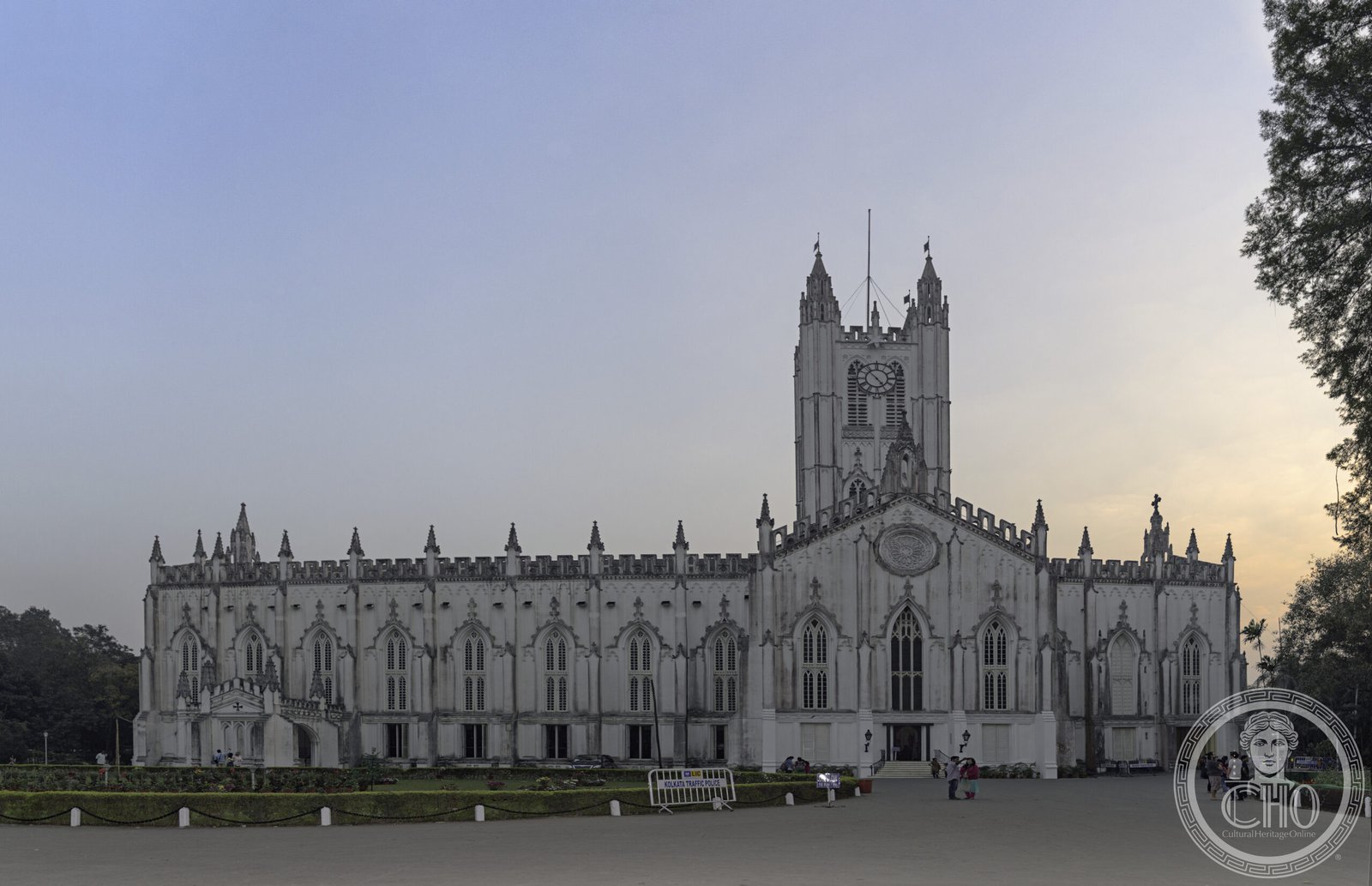
At 1A Cathedral Road, in Kolkata, formerly Calcutta, the cathedral of Saint Paul is the seat of the Anglican diocese of Calcutta. The first stone was laid on 8 October 1839 by Bishop Daniel Wilson, fifth bishop of Calcutta, and the building was completed and consecrated exactly eight years later, on 8 October 1847. The design was by Major William Nairn Forbes, of the Bengal Engineers, in an Indo-Gothic style drawn from English Perpendicular Gothic, with a load-bearing iron structure unusually modern for the time, local brick, facings of Chunar sandstone and a finish of polished chunam stucco. The sources differ as to which English cathedral, Norwich, Canterbury or York, actually inspired the original spire. Bishop Wilson wrote personally to Queen Victoria on the occasion of the consecration, receiving as a gift ten pieces of gilded communion plate, according to a source not fully corroborated elsewhere. An earthquake on 12 June 1897 damaged the upper part of the original bell tower, later restored, but it was the earthquake of 1934 that brought the tower down completely. It was rebuilt afterwards, according to some sources between 1934 and 1938, a figure not fully confirmed, after the Bell Harry Tower of Canterbury cathedral. Inside is the great west window, designed by Sir Edward Burne-Jones and made by the firm Morris & Co., dated by the sources variously between 1873-75 and 1880, dedicated to the memory of Richard Southwell Bourke, sixth Earl of Mayo, viceroy of India, murdered on 8 February 1872 in the Andaman Islands. There is also a reredos of alabaster and mosaic of 1879, the work of the architect Arthur Blomfield, showing the Annunciation, the Adoration of the Magi and the Flight into Egypt, and wall panels of 1886 on the life of Saint Paul, which the sources describe interchangeably as frescoes or mosaics. The cathedral is often described as the first Anglican cathedral in Asia built as such from the start, a claim widely repeated but not independently verified, and it should in any case be kept distinct from the nearby church of Saint John in Calcutta, built in 1784-87 as a simple parish church and a bishop’s seat only from 1815 to 1847. It is not correct, contrary to what is sometimes claimed, to call it the first Anglican cathedral built outside the British Isles altogether: that distinction belongs to the cathedral of the Holy Trinity in Quebec, in Canada, consecrated as early as 1804, more than forty years earlier. The cathedral stands about four hundred and fifty metres, a walk of nine minutes, from the Victoria Memorial, with which it has, however, no direct administrative or architectural link.
About the Cathedral
St. Paul’s Cathedral, on Cathedral Road in Kolkata, India, is the seat of the Anglican Diocese of Calcutta, built 1839–1847 under Bishop Daniel Wilson in Indo-Gothic style. It is commonly, though not independently verifiably, described as the first purpose-built Anglican cathedral in Asia.
Key facts
- 8 October 1839 – 8 October 1847: built under Bishop Daniel Wilson, architect William Nairn Forbes.
- 1897 / 1934: the original tower is damaged by earthquake, then completely destroyed in 1934.
- The rebuilt tower is modeled on Canterbury Cathedral’s Bell Harry Tower.
- Its west stained-glass window was designed by Sir Edward Burne-Jones, executed by Morris & Co.
- Not the first Anglican cathedral built outside Britain and Ireland worldwide — that distinction belongs to Holy Trinity Cathedral, Quebec, consecrated 1804.
- Distinct from St John’s Church, Calcutta (1784–87), which served as the bishop’s seat from 1815 to 1847 but was built as an ordinary parish church.
History
Commissioned by Bishop Daniel Wilson and completed in 1847, St. Paul’s became the working cathedral of British India’s Anglican establishment, succeeding an earlier parish church that had served the role informally since 1815. Twice struck by earthquakes — its steeple damaged in 1897 and then destroyed outright in 1934 — the cathedral was rebuilt with a new tower deliberately modeled on Canterbury Cathedral’s famous Bell Harry Tower, giving the building its present silhouette.
What you see
A long Indo-Gothic nave with buttresses and lancet windows, a rose window on the facade, and a tall bell tower rebuilt after 1934 in the style of Canterbury Cathedral’s Bell Harry Tower, its interior holding Burne-Jones stained glass and a Victorian alabaster-and-mosaic reredos.
Practical information
- Opening hours: generally open daily outside services; check current hours before visiting.
- Address: 1A, Cathedral Road, Kolkata 700071, West Bengal, India.
Getting there
The cathedral stands on the southern edge of Kolkata’s Maidan, about 450 metres from the Victoria Memorial. GPS: 22.5442°N, 88.3467°E.
Nearby
- Victoria Memorial — the large marble museum and monument, a short walk away, with no direct link to the cathedral itself.
- St John’s Church, Calcutta — the earlier parish church that served as the bishop’s seat before St Paul’s was built.
Sources
- Wikipedia — “St. Paul’s Cathedral, Kolkata,” “St John’s Church, Kolkata,” “Cathedral of the Holy Trinity, Quebec City”
- St Paul’s Cathedral Kolkata (official site).
- VictorianWeb — construction history and Burne-Jones West Window catalogue entry.
Find it on the map
See this place and what’s around it →📷 Become a Cultural Heritage Online photographer
Share your photos of places: they stay published under your name as the author. The more they're seen, the more you get noticed — and soon a contest will reward the most appreciated photos.
Log in or sign up free to add a photo