
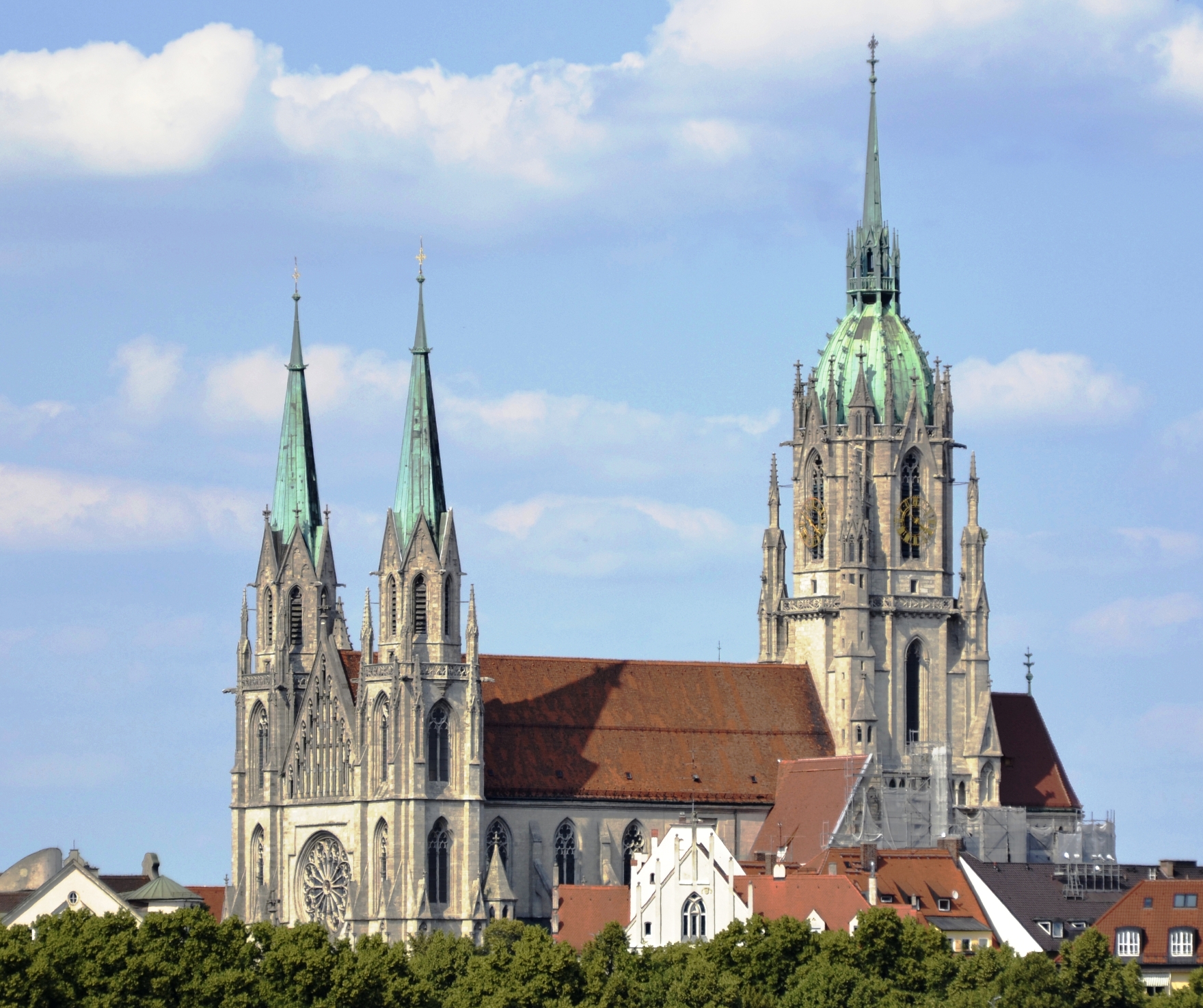
A monumental Gothic Revival cathedral rising above Munich’s Ludwigsvorstadt district, St. Paul’s Church stands as a testament to late-19th-century German Catholic ambition and architectural vision.
At a glance
St. Paul’s Church is a large Catholic church completed in the early 20th century. Built in the Gothic Revival style, it dominates the neighborhood north of the Theresienwiese, Munich’s historic festival grounds.
History
Construction began in 1892 and was completed in 1906. The church was designed by Austrian architect Georg von Hauberrisser, a leading figure in 19th-century religious architecture. The project represented the growing confidence of Munich’s Catholic community during a period of urban expansion and modernization.
What you see
The building exemplifies the Gothic Revival style, with its characteristic pointed arches, soaring verticality, and ornamental detailing. Its prominent spire can be seen across much of the surrounding district, serving as a navigational landmark and visual anchor for the neighborhood.
Cultural significance
St. Paul’s represents the confidence of Bavarian Catholicism at the turn of the 20th century. Hauberrisser’s design synthesizes medieval Gothic principles with modern construction techniques, making it an important example of how historical styles were reinterpreted during the Industrial Age.
Key facts
- Country: Germany
- City: Munich
- Designed by: Georg von Hauberrisser (Austrian architect)
- Built: 1892–1906
- Style: Gothic Revival
- Coordinates: 48.1364°N, 11.5522°E
Practical information & getting there
St. Paul’s Church is located in the Ludwigsvorstadt-Isarvorstadt quarter, north of Theresienwiese. The area is well-served by Munich’s public transport network, making the church accessible from the city center.
Sources & resources
Find it on the map
See this place and what’s around it →📷 Become a Cultural Heritage Online photographer
Share your photos of places: they stay published under your name as the author. The more they're seen, the more you get noticed — and soon a contest will reward the most appreciated photos.
Log in or sign up free to add a photoIs this page about you?
This page is read by travellers and heritage enthusiasts who find it on Google. Tell us how you are connected to this place and we will take it from there.