
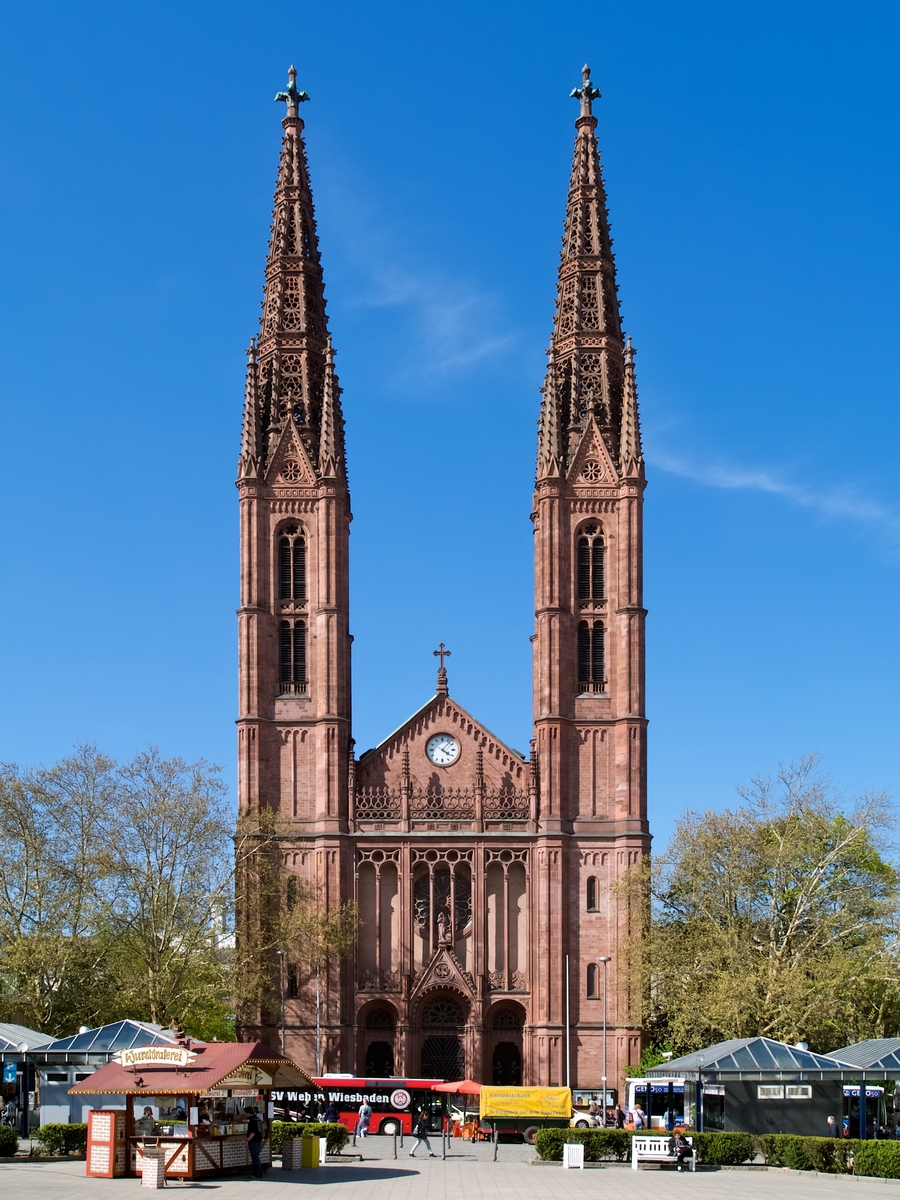
The principal Catholic church of Hesse’s capital, defined by twin spires that rise 68 metres above Luisenplatz. Built in Gothic Revival style, it remains the spiritual heart of Wiesbaden’s Catholic community.
At a glance
St. Bonifatius serves as the central Catholic parish church of Wiesbaden. Its striking twin steeples, each 68 metres tall, form one of the city’s most recognisable silhouettes. The building exemplifies 19th-century German Gothic Revival architecture.
History
Designed by architect Philipp Hoffmann, the church was constructed between 1844 and 1849. It was built to serve as the principal Catholic place of worship in Wiesbaden, the capital of the German state of Hesse. Today, the parish remains part of the Diocese of Limburg.
What you see
The church is executed in Gothic Revival style, a romantic reinterpretation of medieval Gothic forms popular across 19th-century Europe. Twin spires of equal height—each rising to 68 metres (223 feet)—dominate the surrounding Luisenplatz. These towers are the building’s defining feature and an unmistakable landmark across the cityscape.
Cultural significance
St. Bonifatius represents the confidence and piety of 19th-century Wiesbaden, when the city was flourishing as both a spa resort and administrative centre. The church’s prominence in the urban fabric reflects the importance of Catholic identity in the region and the ambitions of Hoffmann’s architectural vision.
Key facts
- Country: Germany
- City: Wiesbaden (Mitte district)
- Coordinates: 50.0794°N, 8.2394°E
- Architect: Philipp Hoffmann
- Style: Gothic Revival
- Built: 1844–1849
- Spire height: 68 metres (223 feet)
- Diocese: Diocese of Limburg
Practical information & getting there
St. Bonifatius is located on Luisenplatz in central Wiesbaden. The church is open to visitors; service times and visiting hours are best confirmed through the Diocese of Limburg or local tourism information.
Sources & resources
Find it on the map
See this place and what’s around it →📷 Become a Cultural Heritage Online photographer
Share your photos of places: they stay published under your name as the author. The more they're seen, the more you get noticed — and soon a contest will reward the most appreciated photos.
Log in or sign up free to add a photoIs this page about you?
This page is read by travellers and heritage enthusiasts who find it on Google. Tell us how you are connected to this place and we will take it from there.