

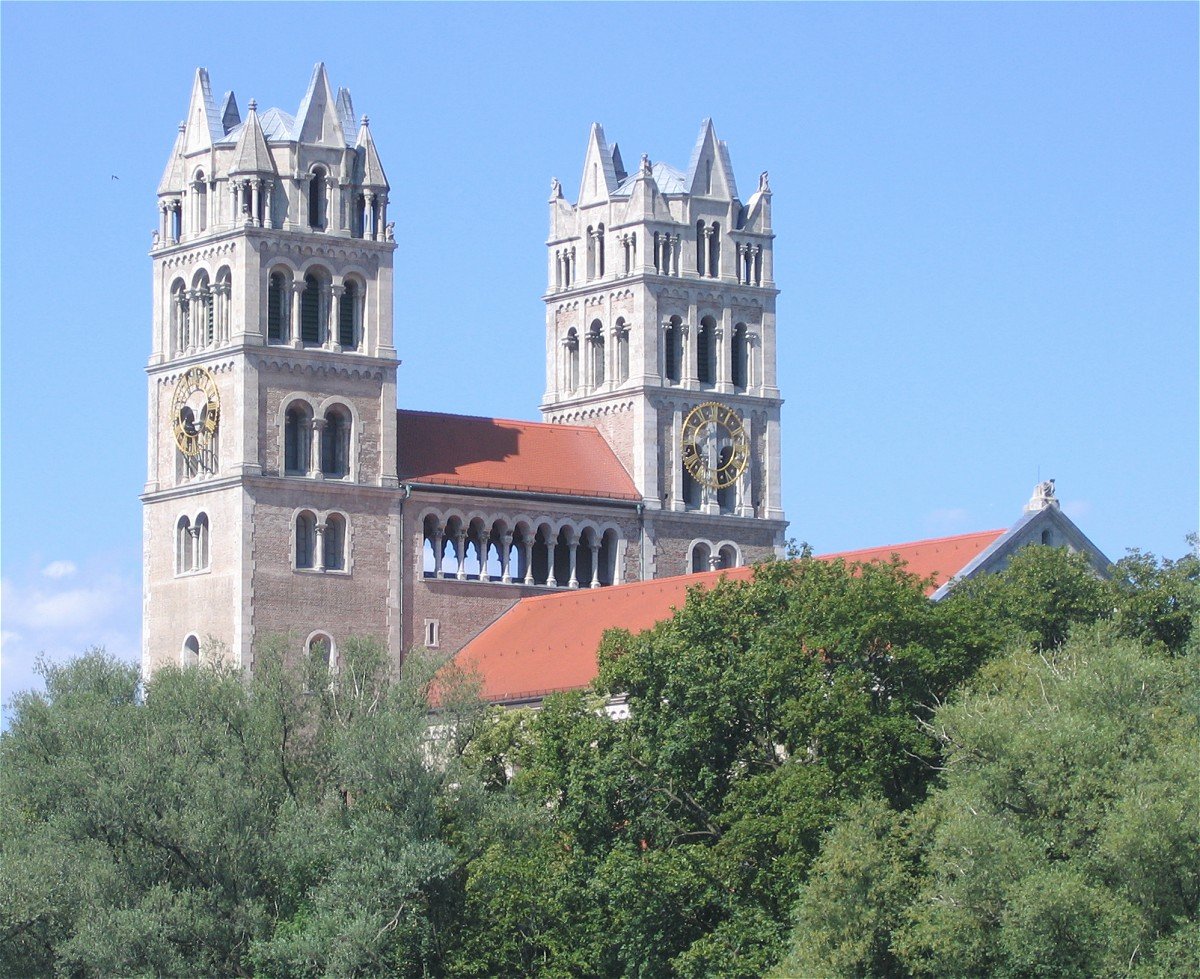
A Romanesque Revival parish church on the Isar’s banks, designed by Heinrich von Schmidt and completed in the early twentieth century.
At a glance
St. Maximilian serves the Isar suburb of Munich as a Roman Catholic parish church. Built over sixteen years, the church exemplifies the Romanesque Revival aesthetic favored in late-nineteenth-century Bavaria. Its prominent riverbank location makes it a landmark for the district.
History
Construction began in 1892 under the architectural direction of Heinrich von Schmidt and continued until 1908. The extended building period reflects both the ambition of the design and the resources required to complete a church of this scale. The structure has served the local Catholic community for over a century.
What you see
St. Maximilian employs Romanesque Revival vocabulary—rounded arches, sturdy proportions, and traditional massing. The church occupies a commanding position on the Isar’s banks, its form visible across the river toward the tower of the Deutsches Museum. Von Schmidt’s design balances ecclesiastical dignity with the intimate scale of parish worship.
Cultural significance
The church represents an important moment in Munich’s expansion beyond its medieval core. Its Romanesque Revival style links it to broader European architectural movements of the Gilded Age, while its riverside setting defines the character of the Isar district.
Key facts
- Country: Germany
- City: Munich
- Coordinates: 48.127°N, 11.574°E
- Construction: 1892–1908
- Architect: Heinrich von Schmidt
- Style: Romanesque Revival
Practical information & getting there
St. Maximilian stands on the banks of the Isar in Munich’s Isar suburb, facing the Deutsches Museum tower. As an active parish church, visiting hours may vary. Check locally for Mass times and public access.
Sources & resources
Find it on the map
See this place and what’s around it →📷 Become a Cultural Heritage Online photographer
Share your photos of places: they stay published under your name as the author. The more they're seen, the more you get noticed — and soon a contest will reward the most appreciated photos.
Log in or sign up free to add a photoIs this page about you?
This page is read by travellers and heritage enthusiasts who find it on Google. Tell us how you are connected to this place and we will take it from there.