
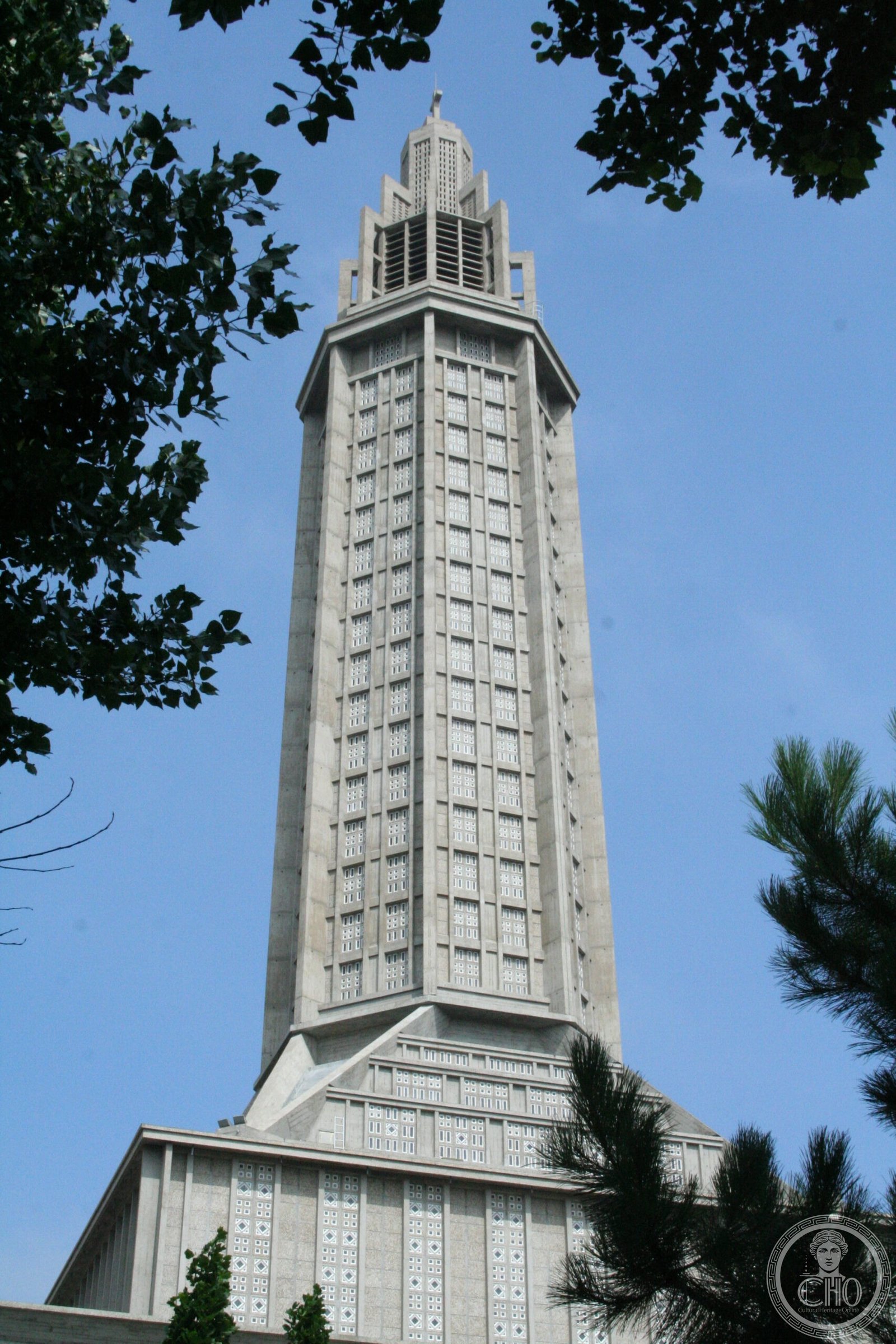
A soaring concrete beacon rising 107 metres above the French port city, Auguste Perret’s modernist masterpiece stands as both sanctuary and memorial to the five thousand civilians lost in World War II’s destruction of Le Havre.
At a glance
St. Joseph’s Church dominates Le Havre’s skyline with its single, central tower—a concrete lantern visible from the port and illuminated at night like a lighthouse. Built between 1951 and 1957–58, it formed part of the comprehensive post-war reconstruction of the entire city commissioned between 1945 and 1964.
History
Le Havre was completely destroyed by British bombing during World War II. In the aftermath, the city commissioned Auguste Perret, the pioneering concrete architect who had mentored Le Corbusier, to lead a comprehensive urban reconstruction spanning nearly two decades. St. Joseph’s Church rose as the spiritual centrepiece of this ambitious project, dedicating itself both to the city’s patron saint and to the thousands who perished in the war.
What you see
The church is a centrally-planned structure of reinforced concrete—a material that defines post-war French modernism. Its defining feature is the soaring tower, 107 metres tall, which acts as the building’s lantern. Perret conceived the entire structure as a beacon for the city: its form resembles a great lantern, earning it the affectionate designation of the “lantern tower” or “lighthouse at the heart of the city”. The tower remains a dominant presence in the port’s visual landscape, particularly striking when illuminated after dark.
Cultural significance
St. Joseph’s Church embodies the optimism and technical innovation of European reconstruction. As chief architect of Le Havre’s renewal, Perret created a building that serves dual purposes: sanctuary and memorial. The choice of Saint Joseph—patron of workers, fathers, travellers, immigrants, and a happy death—speaks to the resilience and hope of a community rebuilding itself from total destruction.
Key facts
- Location: Le Havre, France (49.49°N, 0.10°E)
- Architect: Auguste Perret
- Construction: 1951–1957/58
- Tower height: 107 metres
- Material: Reinforced concrete
- Purpose: Church, war memorial, and spiritual beacon
Practical information & getting there
St. Joseph’s Church stands prominently in central Le Havre and is easily located from the port area. Its distinctive tower serves as an unmissable landmark. For detailed visiting hours and current information, contact the Le Havre tourism office or the church directly.
Sources & resources
Find it on the map
See this place and what’s around it →📷 Become a Cultural Heritage Online photographer
Share your photos of places: they stay published under your name as the author. The more they're seen, the more you get noticed — and soon a contest will reward the most appreciated photos.
Log in or sign up free to add a photoIs this page about you?
This page is read by travellers and heritage enthusiasts who find it on Google. Tell us how you are connected to this place and we will take it from there.