
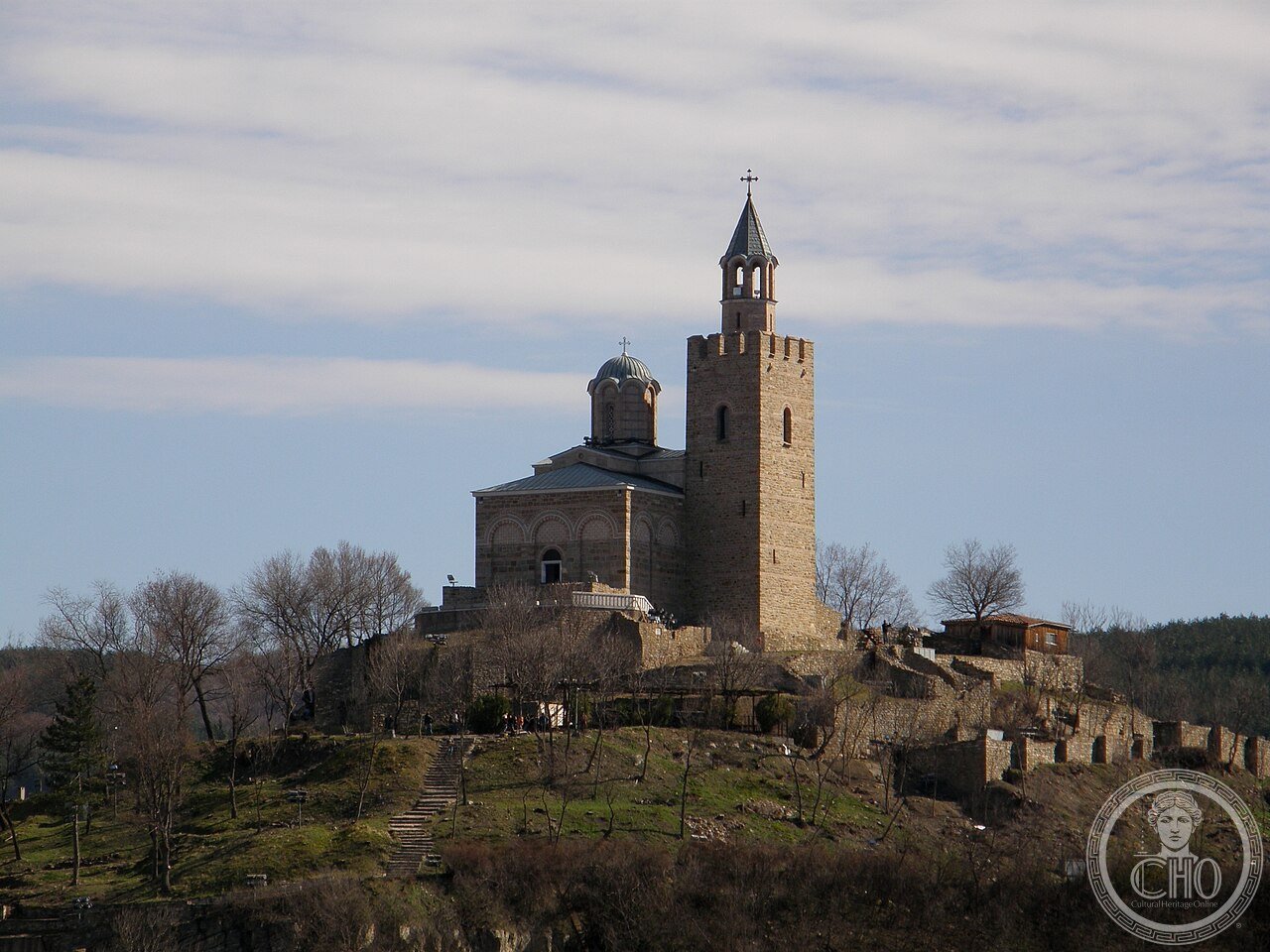
On the summit of the fortress of Tsarevets, at Veliko Tarnovo, the patriarchal cathedral stood from the 11th-12th century, the seat of the Bulgarian patriarch until its destruction. That came on 17 July 1393, when the Ottomans took Tarnovo, then the capital of the Second Bulgarian Empire. The ruins stayed as they were for almost six centuries, until a team led by the architect Boyan Kuzupov rebuilt the church between 1978 and 1981, for the 1300th anniversary of the founding of the Bulgarian state. The building reopened to the public only in November 1985, when the interior murals were finished, the work of the artist Teofan Sokerov. They are not traditional Orthodox icons, but frescoes that tell chapters of Bulgarian history in a modern, expressive style. Those very murals, held by some to be disrespectful in a building once sacred, have prevented the cathedral’s reconsecration as an active church to this day: a national monument, more than a place of worship.
About the Patriarchal Cathedral, Tsarevets
The Patriarchal Cathedral of the Holy Ascension of God, standing atop Tsarevets Hill in Veliko Tarnovo, served as the seat of the Bulgarian Patriarch from its original construction in the 11th to 12th century until its destruction in 1393. The cathedral fell along with the rest of the fortress of Tsarevets when Ottoman forces captured Tarnovo, then capital of the Second Bulgarian Empire, following the Siege of Tarnovo on 17 July 1393 — a pivotal and traumatic date in Bulgarian history marking the effective end of Bulgarian medieval statehood under Ottoman conquest. The cathedral’s ruins stood largely as they had been left for nearly six centuries, until a team led by architect Boyan Kuzupov undertook a full reconstruction between 1978 and 1981, timed to mark the 1,300th anniversary of the founding of the Bulgarian state in 681. The rebuilt cathedral, constructed on a cross-domed plan with a bell tower and triple apse standing directly above the remains of an even earlier late Roman church, was not reopened to the public until November 1985, when its interior decoration was finally completed. Rather than reconstructing traditional Orthodox iconography, the cathedral’s interior was filled with contemporary murals by the artist Teofan Sokerov, depicting episodes and chapters from Bulgarian history in a modern, expressive style entirely distinct from conventional Byzantine or Bulgarian ecclesiastical fresco painting. These murals have proven deeply controversial ever since: regarded by some critics and religious observers as disrespectful within a building historically consecrated as a place of worship, their continued presence has been cited as a direct obstacle preventing the cathedral’s formal reconsecration as an active church, leaving the rebuilt structure to function primarily as a national historical monument rather than a functioning religious institution.
Key facts
- 11th-12th century: original cathedral built, seat of the Bulgarian Patriarch.
- 17 July 1393: cathedral destroyed as Ottomans capture Tarnovo.
- 1978-1981: full reconstruction under architect Boyan Kuzupov, for Bulgaria’s 1300th anniversary.
- November 1985: cathedral reopened, following completion of modern murals.
- Murals: by artist Teofan Sokerov, depicting Bulgarian history rather than traditional icons.
- Status: never reconsecrated as a functioning church, due to controversy over the murals.
History
The 1393 destruction of the Patriarchal Cathedral alongside the fall of Tarnovo marks one of the defining catastrophes of medieval Bulgarian history, effectively ending the Second Bulgarian Empire and beginning nearly five centuries of Ottoman rule over Bulgarian lands. Its reconstruction in 1978-1981 under Bulgaria’s communist government, deliberately timed to the 1,300th anniversary of Bulgarian statehood, reflects the era’s characteristic use of medieval historical monuments as vehicles for secular national commemoration rather than strict religious restoration.
The decision to fill the rebuilt cathedral with modern historical murals rather than traditional Orthodox iconography, and the ongoing controversy this has generated, situates the building within a distinctive category of 20th-century reconstructed religious monuments that function primarily as national historical symbols — its unresolved status, neither fully a church nor simply a museum, continuing to generate genuine debate among religious authorities, art critics, and the Bulgarian public alike.
What you see
The reconstructed cathedral’s cross-domed exterior, with its prominent bell tower and triple apse, crowns the summit of Tsarevets Hill, forming the dominant visual landmark of the entire fortress complex overlooking Veliko Tarnovo. Inside, Teofan Sokerov’s large-scale modern murals depicting scenes from Bulgarian history cover the walls in place of conventional religious iconography, creating an interior experience markedly different from any functioning Orthodox cathedral elsewhere in the country.
Practical information
- Opening hours: generally open daily with seasonal variation as part of the Tsarevets Fortress complex; admission fee applies; check current hours before visiting.
- Address: Tsarevets Fortress, 5003 Veliko Tarnovo, Bulgaria.
Getting there
The Patriarchal Cathedral stands at the summit of Tsarevets Hill within the fortress of the same name, in Veliko Tarnovo, north-central Bulgaria, reachable on foot via the fortress’s main entrance. GPS: 43.0836° N, 25.6524° E.
Nearby
- Tsarevets Fortress — the wider medieval fortress complex surrounding the cathedral.
- Baldwin’s Tower — historic tower within the fortress, associated with the imprisoned Latin Emperor Baldwin I.
- Veliko Tarnovo Old Town — the historic city centre, overlooked by Tsarevets Hill.
Sources
- Wikipedia — “Ascension Cathedral, Veliko Tarnovo” (en.wikipedia.org).
- Castles in the World — “Tsarevets Fortress in Veliko Tarnovo” (castlesintheworld.com).
- Religiana — “Ascension Cathedral, Veliko Tarnovo” (religiana.com).
Find it on the map
See this place and what’s around it →📷 Become a Cultural Heritage Online photographer
Share your photos of places: they stay published under your name as the author. The more they're seen, the more you get noticed — and soon a contest will reward the most appreciated photos.
Log in or sign up free to add a photo