
On the Largo de São Domingos, in the heart of Macau, the church of Saint Dominic was founded in 1587 by Spanish Dominican friars. They reached Macau after a journey from Spain that, according to some sources, took them through Acapulco, in Mexico, while others say they came by way of the Philippines first: the sources do not fully agree on the exact route. The first building was of wood, which gave it its traditional Chinese name, rendered variously as «Pan Cheong Miu», the temple of the wooden boards. The present church replaced the original one after at least one rebuilding, but the sources disagree on the date: according to an academic study devoted to the building, the structure seen today dates from, or was radically renewed in, 1721, while other more general sources place it as early as the beginning of the seventeenth century. Contrary to what is sometimes reported, no fire is confirmed as the cause behind the rebuilding. On 12 September 1822 «A Abelha da China», the Bee of China, was proclaimed in the church, regarded as the first Portuguese-language newspaper published in China. In 1834, when Portugal dissolved the religious orders, the church was closed and expropriated, and reopened only in the second half of the nineteenth century. Since 1929 the church has taken into its devotional calendar the cult of Our Lady of Fátima, with an annual procession on 13 May. A complete restoration, finished in 1997, led to the opening, on 23 November of that year, of a Museum of Sacred Art in the three-storey bell tower of the building, which holds about three hundred liturgical and devotional objects dating between the seventeenth and the nineteenth century, among them a seventeenth-century painting of Saint Augustine and two bells of the nineteenth century. The building is named individually within the Historic Centre of Macau, inscribed on the UNESCO World Heritage List on 15 July 2005.
About the Church
St. Dominic’s Church, on Largo de São Domingos near Senado Square in Macau, was founded in 1587 by Spanish Dominican friars. Site of the 1822 proclamation of China’s first Portuguese-language newspaper, it stands today as an individually named monument within the UNESCO-listed Historic Centre of Macau.
Key facts
- 1587: the church founded by Spanish Dominican friars, originally built in wood.
- Current building: rebuilt at least once after the original wooden structure, with sources differing on whether it dates from the early 17th century or from 1721.
- 12 September 1822: “A Abelha da China” (“The China Bee”), the first Portuguese-language newspaper in China, proclaimed at the church.
- 1834: the church closed and expropriated when Portugal dissolved religious orders, reopening only later in the 19th century.
- 23 November 1997: a Museum of Sacred Art opens in the church’s bell tower after a full restoration.
- 15 July 2005: individually named within the UNESCO World Heritage-listed Historic Centre of Macau.
History
Founded in 1587 by Spanish Dominican friars and originally built entirely in wood, the church was rebuilt at least once into the baroque structure seen today, though sources disagree on exactly when. It became a landmark of Macau’s print culture in 1822, when China’s first Portuguese-language newspaper was proclaimed here, survived a 19th-century closure under Portugal’s dissolution of religious orders, and was fully restored in 1997, when its bell tower became home to a museum of sacred art.
What you see
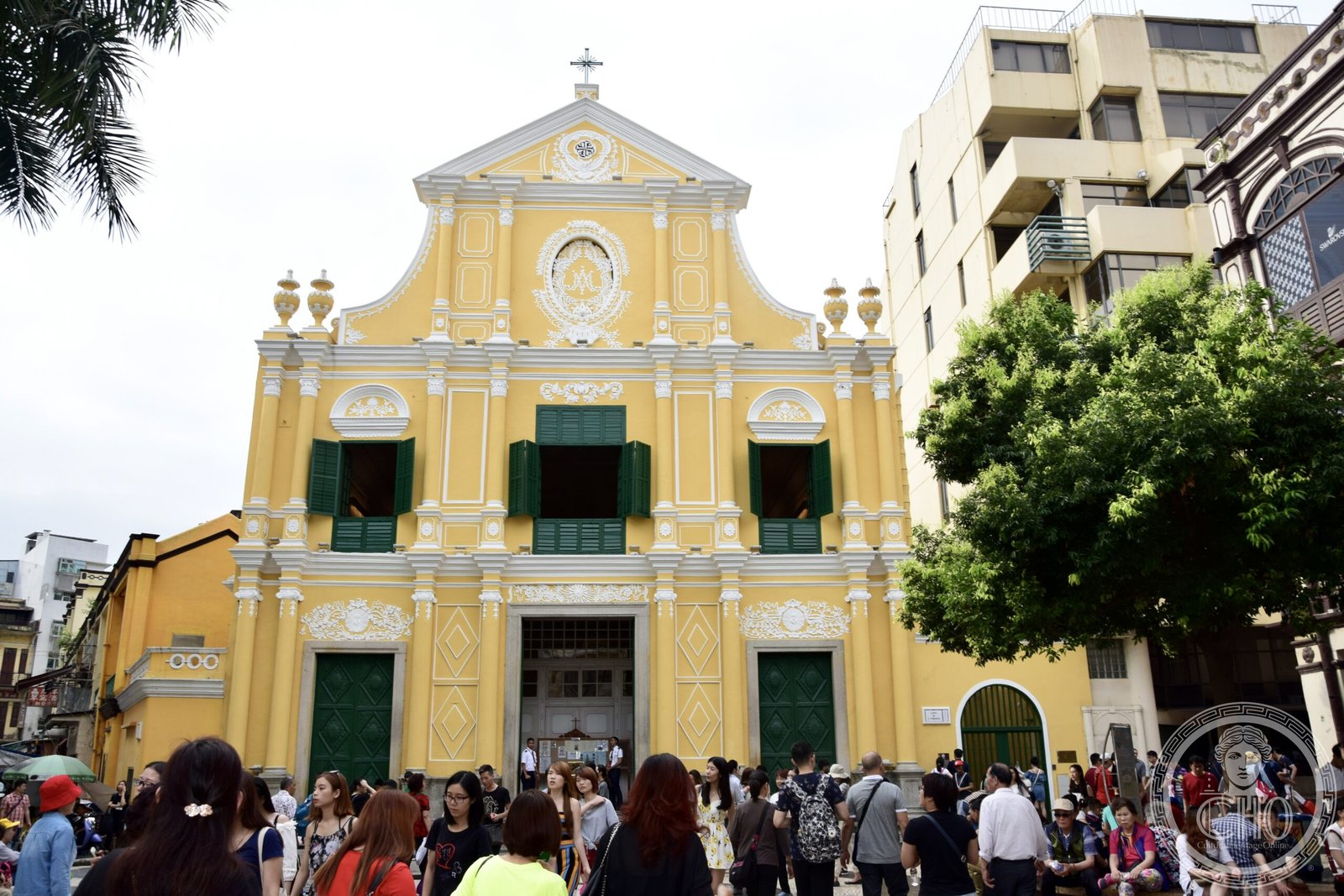
A pale-yellow, three-story baroque facade with finely worked white stucco friezes, green-shuttered windows, and three superimposed orders of paired Corinthian columns beneath a triangular pediment with a large oculus; inside, three naves and six bays are carried on white-and-yellow stucco pillars with locally carved capitals, leading to a gilt altar centered on a Madonna and Child flanked by wood- and ivory-carved saints.
Practical information
- Opening hours: generally open daily outside services; the attached Museum of Sacred Art has separate opening hours and occasional closures for maintenance, so check current hours before visiting.
- Address: Largo de São Domingos, Sé, Macau, China.
Getting there
The church stands on Largo de São Domingos, a short walk from Senado Square in central Macau. GPS: 22.1947°N, 113.5406°E.
Nearby
- Senado Square — the historic center’s main civic square, a short walk away.
- Ruins of St. Paul’s — the facade of a former Jesuit church, another key monument of the Historic Centre of Macau.
Sources
- Macao Cultural Affairs Bureau (culturalheritage.mo) — official heritage listing MM003.
- Heritage of Portuguese Influence Portal (HPIP, Fundação Calouste Gulbenkian) — scholarly entry by art historian Pedro Dias.
- Macau Museum of Art (macaumuseum.gov.mo) — Museum of Sacred Art records.
- Wikipedia — “St. Dominic’s Church, Macau”
Find it on the map
See this place and what’s around it →📷 Become a Cultural Heritage Online photographer
Share your photos of places: they stay published under your name as the author. The more they're seen, the more you get noticed — and soon a contest will reward the most appreciated photos.
Log in or sign up free to add a photo