
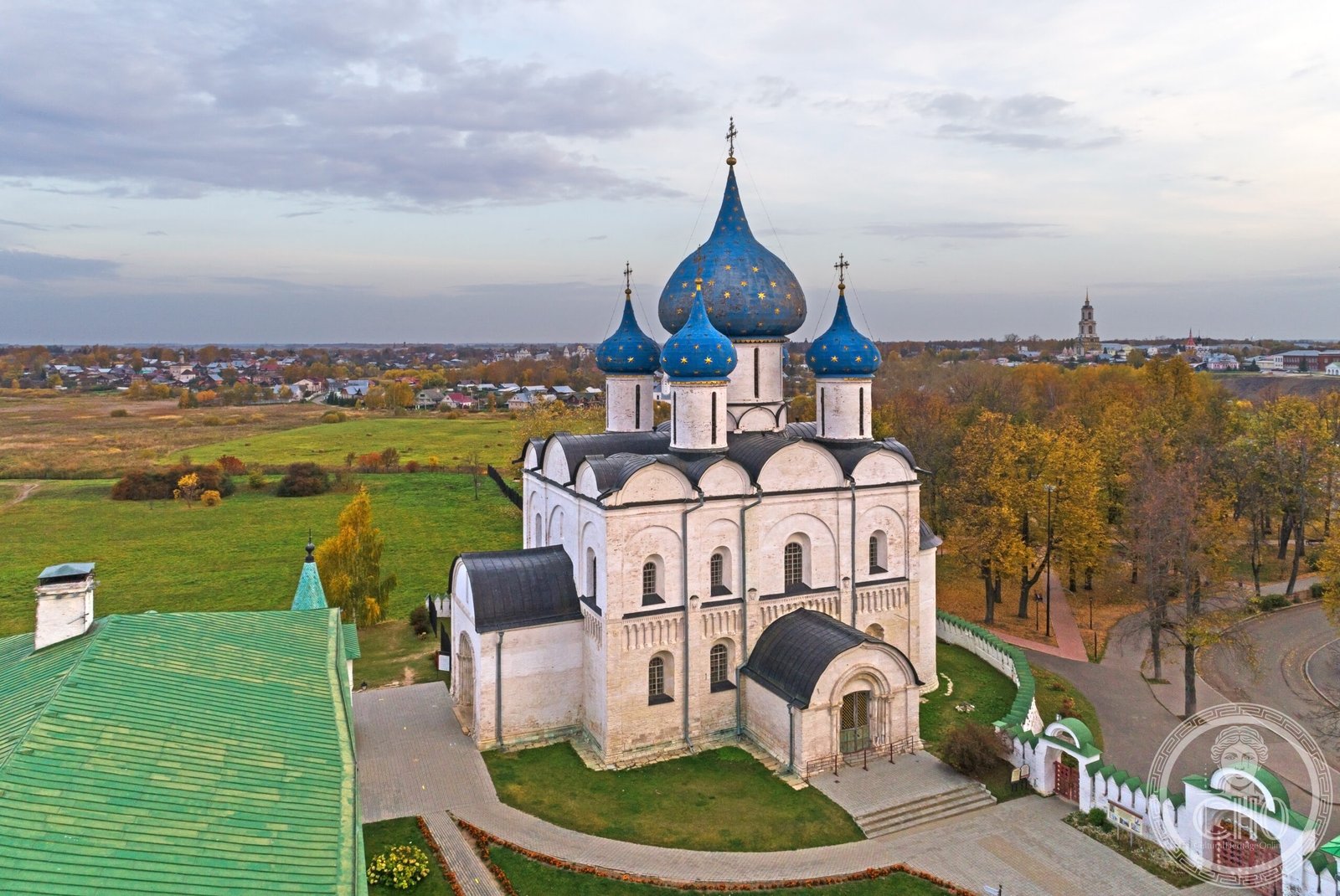
At the centre of the Suzdal Kremlin, in Russia, a cathedral already stood around 1096-1102. Most sources say it was raised by Prince Vladimir II Monomakh, although the original dedication of that building remains uncertain, and some sources give it to the Dormition rather than to the Nativity. In 1222 Prince Yuri II of Vladimir ordered the demolition of the by then decayed structure and the building of a new cathedral in white stone, dedicated to the Nativity of the Mother of God, completed in 1225 with blind arches and carved decoration, including masks and lions. The famous «Golden Gates», copper panels gilded by the fire technique and decorated in niello with biblical scenes, belong to this period, datable to between about 1230 and 1240, with the western portal generally held to be earlier than the southern one, although the precise dates of the two portals, sometimes given as 1233 and 1248, are not confirmed by fully independent sources. A fire, attributed to a Tatar raid, destroyed the roof and the upper part of the building in 1445. The rebuilding, carried out between 1528 and 1530 under Grand Prince Basil III, kept the white stone walls of the thirteenth century up to the height of the arcades, completing the upper part in brick and turning the roof from three domes into five: the building seen today is therefore a hybrid of a thirteenth-century base and a sixteenth-century top. Inside, fragments of frescoes survive from the 30s of the thirteenth century, together with later layers of the fifteenth and the seventeenth centuries, the latter commissioned by Bishop Serapion in the 30s of the seventeenth century. The sources do not agree on the dating of the present iconostasis, given by some to a seventeenth-century arrangement and by others to a Soviet restoration of the 60s of the twentieth century. The cathedral is the focus of the Suzdal Kremlin, beside the Archiepiscopal Chambers, enlarged between the 15th and the 18th centuries, and a tent-roofed octagonal bell tower added in 1635. After closure in the Soviet period, the first religious services resumed in 1991, followed in February 1992 by a formal agreement of shared use between the Russian Orthodox Church and the Vladimir-Suzdal state museum reserve. The building is part of the serial UNESCO site «White Monuments of Vladimir and Suzdal», inscribed in 1992, although it was not possible to check directly on the official text of the nomination whether the cathedral appears there named individually or only as part of the complex of the Suzdal Kremlin.
About the Cathedral
The Cathedral of the Nativity of the Theotokos, at the center of the Suzdal Kremlin in Russia, was rebuilt in white stone in 1222-1225 on the site of an earlier cathedral, then rebuilt again in 1528-1530 after a 1445 fire, giving it its present hybrid form: 13th-century stone walls beneath a 16th-century brick, five-domed upper structure. It is part of the UNESCO World Heritage property “White Monuments of Vladimir and Suzdal.”
Key facts
- c. 1096–1102: an earlier cathedral built on the site, traditionally attributed to Prince Vladimir II Monomakh.
- 1222–1225: rebuilt in white stone under Prince Yuri II of Vladimir, dedicated to the Nativity of the Theotokos.
- c. 1230s–1240s: the bronze “Golden Gates” made, fire-gilded and decorated with niello biblical scenes.
- 1445: a fire destroys the roof and upper structure; rebuilt 1528–1530 under Grand Prince Vasily III, raising the dome count from three to five.
- 1991–1992: religious services resume after the Soviet period, followed by a joint-use agreement between the Russian Orthodox Church and the Vladimir-Suzdal Museum-Reserve.
- 1992: inscribed as part of the UNESCO World Heritage property “White Monuments of Vladimir and Suzdal”
History
Standing at the heart of the Suzdal Kremlin since the turn of the 12th century, the cathedral was rebuilt in white stone in the 1220s, damaged in the Mongol invasions, and destroyed by fire in 1445, before being rebuilt again in the 1520s with a brick upper section and five domes replacing its earlier three. Its 13th-century bronze doors, fire-gilded and decorated with niello, survive as one of the most celebrated works of medieval Russian metalwork. Closed under Soviet rule, it returned to religious use in 1991 and today stands under joint stewardship of the Orthodox Church and the regional museum authority.
What you see
White stone walls from the 13th-century rebuild, carved with blind arcading and lion and mask motifs, rising to a 16th-century brick upper structure crowned by five deep-blue, gold-star-studded onion domes; the bronze west and south portal doors, blackened with age, still show fire-gilded biblical scenes in fine relief.
Practical information
- Opening hours: generally open daily as part of the Suzdal Kremlin museum complex; check current hours before visiting.
- Location: Suzdal Kremlin, Kremlyovskaya ulitsa, Suzdal, Vladimir Oblast, Russia.
Getting there
The cathedral stands within the walls of the Suzdal Kremlin. GPS: 56.4167°N, 40.4425°E.
Nearby
- Archbishop’s Chambers — the adjoining 15th-18th century bishop’s residence, now housing museum exhibits.
- Suzdal Kremlin bell tower — an octagonal tented tower added in 1635.
Sources
- Wikipedia — “Cathedral of the Nativity of the Theotokos (Suzdal)”
- Russia Beyond and ermakvagus.com — construction and restoration history.
- tourism33.ru (Vladimir Oblast regional tourism authority).
Find it on the map
See this place and what’s around it →📷 Become a Cultural Heritage Online photographer
Share your photos of places: they stay published under your name as the author. The more they're seen, the more you get noticed — and soon a contest will reward the most appreciated photos.
Log in or sign up free to add a photo