
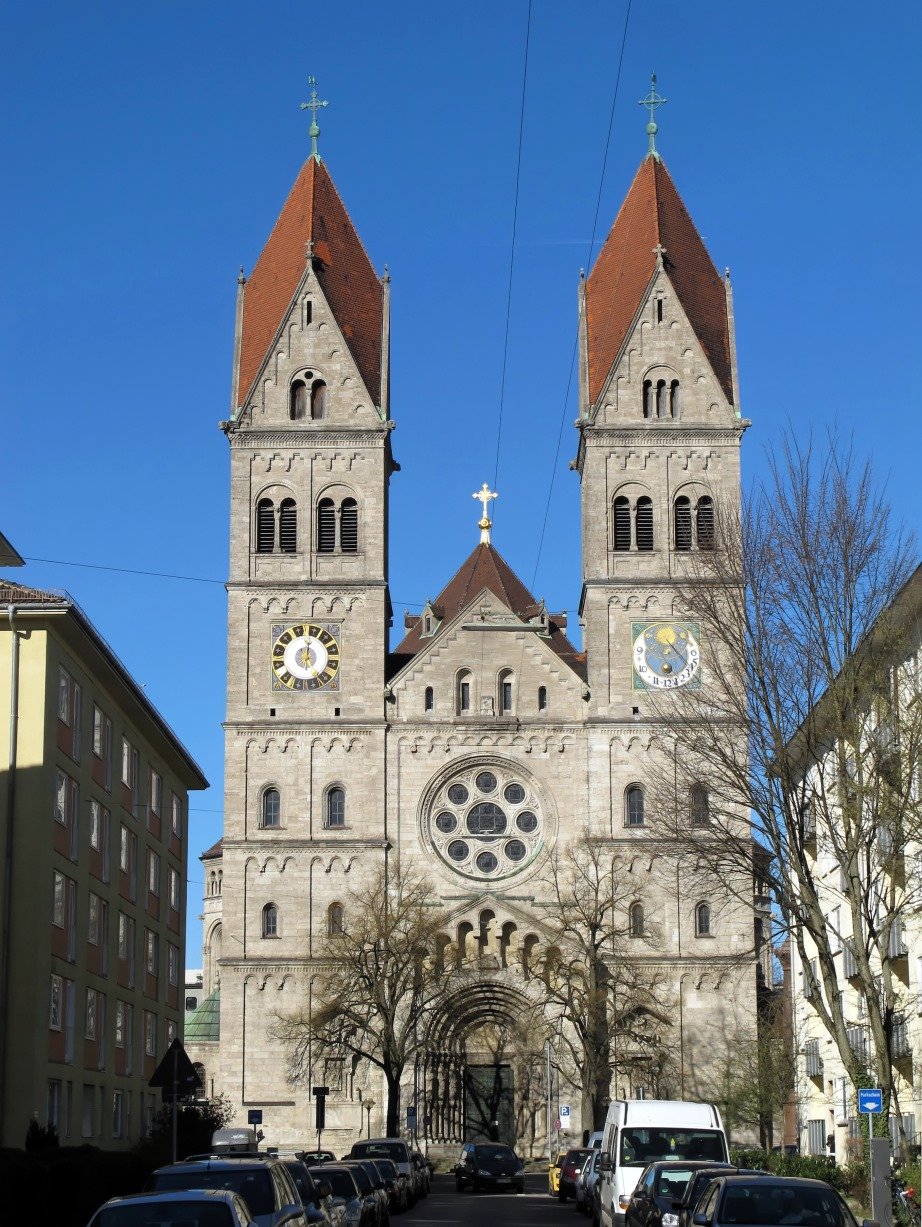
A landmark neo-Romanesque church in Munich’s Maxvorstadt district, built in the late 19th century and celebrated as one of the city’s finest sacred buildings of its era.
At a glance
St. Benno is a Catholic parish church dedicated to Benno of Meissen. Its twin spires define the Maxvorstadt skyline. The building exemplifies Romanesque Revival architecture and stands among Munich’s most accomplished 19th-century religious structures.
History
Construction began in 1888 and was completed in 1895. Leonhard Romeis designed the church, responding to the spiritual and architectural needs of Munich’s growing Maxvorstadt neighborhood during the city’s expansion in the late 19th century.
What you see
The church presents a commanding silhouette with two distinctive spires. Romeis’s design draws from Romanesque traditions while employing 19th-century building techniques and materials. The exterior and interior exemplify the principles of Romanesque Revival, with careful attention to proportional harmony and structural clarity.
Cultural significance
St. Benno ranks among Munich’s most convincing neo-Romanesque sacred buildings, alongside St. Anna im Lehel. The church represents the era’s engagement with medieval aesthetics, demonstrating how 19th-century architects reinterpreted historical styles for contemporary devotional and community purposes.
Key facts
- Country: Germany
- City: Munich
- District: Maxvorstadt
- Built: 1888–1895
- Architect: Leonhard Romeis
- Style: Romanesque Revival
- Coordinates: 48.15222222, 11.55277778
Practical information & getting there
St. Benno is located in Maxvorstadt, a central Munich district accessible by public transport and on foot from the city center. As an active Catholic parish church, visiting hours and services vary; check locally before your visit.
Sources & resources
Find it on the map
See this place and what’s around it →📷 Become a Cultural Heritage Online photographer
Share your photos of places: they stay published under your name as the author. The more they're seen, the more you get noticed — and soon a contest will reward the most appreciated photos.
Log in or sign up free to add a photoIs this page about you?
This page is read by travellers and heritage enthusiasts who find it on Google. Tell us how you are connected to this place and we will take it from there.