
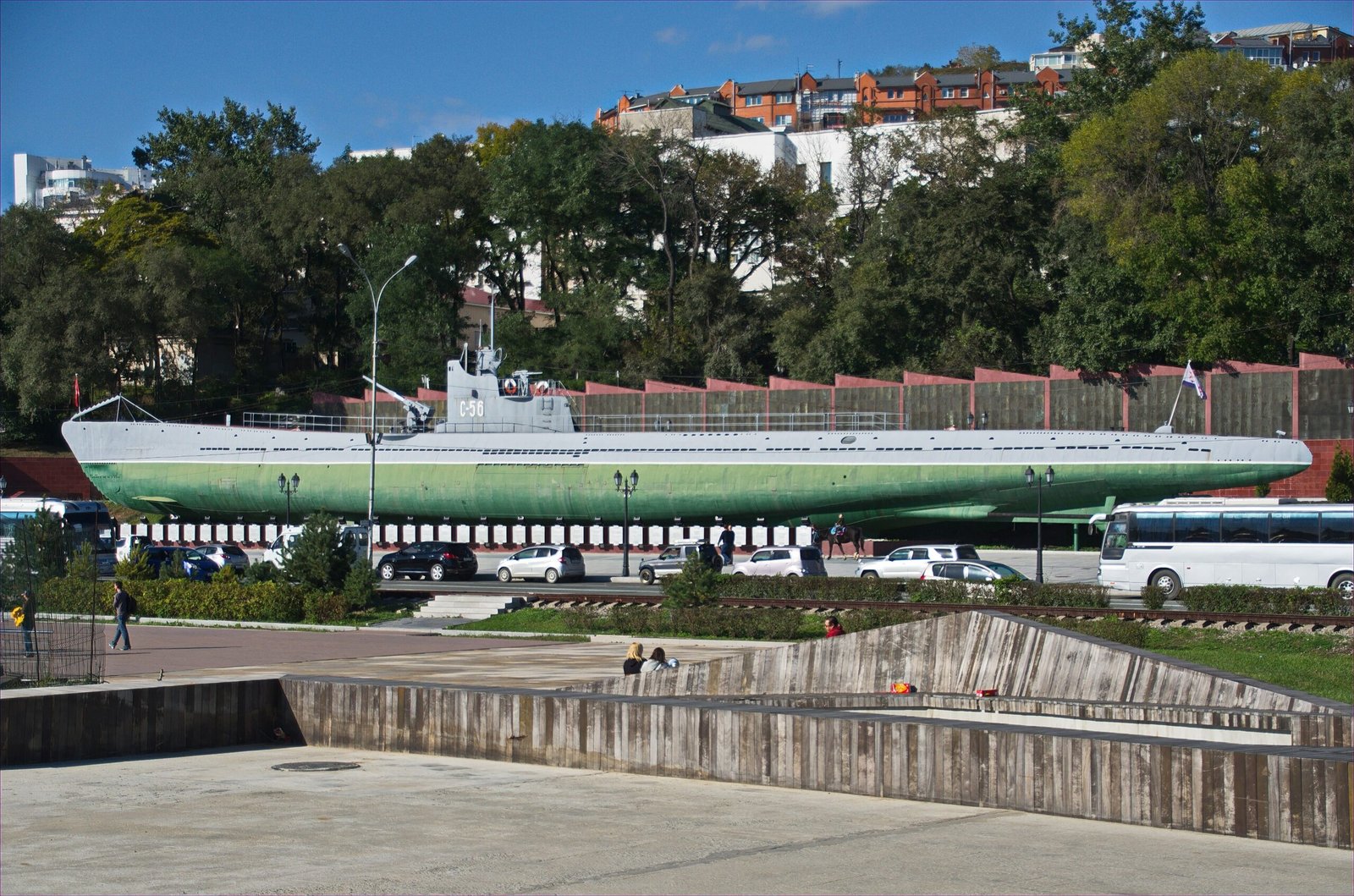
A Stalin-era attack submarine that crossed two oceans to fight in the Arctic, now resting as a museum ship on the shore where it was built.
At a glance
S-56 is a Series IX-bis “Stalinets” class submarine, laid down in Leningrad in 1936 and reassembled at Dalzavod in Vladivostok. Commissioned in October 1941, it served through the war and was later preserved as a museum vessel. It sits near the Golden Horn Bay, a squat steel hull open to visitors today.
History
Work began far from the sea. Shipyard No. 194 in Leningrad laid the keel on 24 November 1936, then cut the hull into sections for a rail journey across the Soviet Union to Vladivostok. Dalzavod workers welded it back together on the Pacific coast. Launched on 25 December 1939, the boat entered service on 20 October 1941 under Captain Grigory Shchedrin, joining the Pacific Fleet. During the war it made an extraordinary transfer, sailing from the Pacific to the Northern Fleet across both the Pacific and Atlantic Oceans by way of the Panama Canal. In northern waters it fought against German shipping, at one point damaging the freighter Wartheland, though a defective torpedo spared the ship. For its wartime record S-56 received the Order of the Red Banner and the Guards badge, honors rarely given together. Decommissioning followed years of service, after which the submarine was converted into a museum ship rather than scrapped.
What you see
The hull is long and narrow, 77.8 metres end to end, with a beam of just 6.4 metres. Seven compartments once housed crew, diesels, and electric motors behind riveted steel plating. Two diesel engines drove it on the surface at nearly 19 knots; submerged, electric motors cut that pace to under 9. Six torpedo tubes faced forward and aft, backed by a 100 mm deck gun and a smaller 45 mm gun mounted topside. Walking the deck, visitors sense how tightly built the vessel was for a crew that had to live, work, and fight within it for weeks at sea.
Cultural significance
S-56 stands for the industrial improvisation of Soviet naval building, where German-derived designs were reworked with domestic parts to keep yards running. Its transfer between fleets, spanning two oceans and a canal built by another nation, remains one of the more unusual voyages of the Soviet submarine service. Preserving it as a museum ship keeps that story visible on the same coast where the hull was first joined together.
Key facts
- Class: Series IX-bis (Stalinets/S-class) diesel-electric submarine
- Laid down: 24 November 1936, Leningrad; reassembled in Vladivostok
- Launched: 25 December 1939
- Commissioned: 20 October 1941
- Length: 77.8 m; beam: 6.4 m; displacement 856 t surfaced / 1,090 t submerged
- Awards: Order of the Red Banner, Guards badge
- Status: heritage-listed museum ship
Practical information & getting there
The submarine is moored in Vladivostok, close to the city’s harbor front. You can walk there easily from the central waterfront area. No architect firm or precise visiting hours are given in current sources, so check local listings before planning a trip. The site rewards those interested in naval history and Cold War-era engineering.
Sources & resources
Find it on the map
See this place and what’s around it →📷 Become a Cultural Heritage Online photographer
Share your photos of places: they stay published under your name as the author. The more they're seen, the more you get noticed — and soon a contest will reward the most appreciated photos.
Log in or sign up free to add a photoIs this page about you?
This page is read by travellers and heritage enthusiasts who find it on Google. Tell us how you are connected to this place and we will take it from there.