
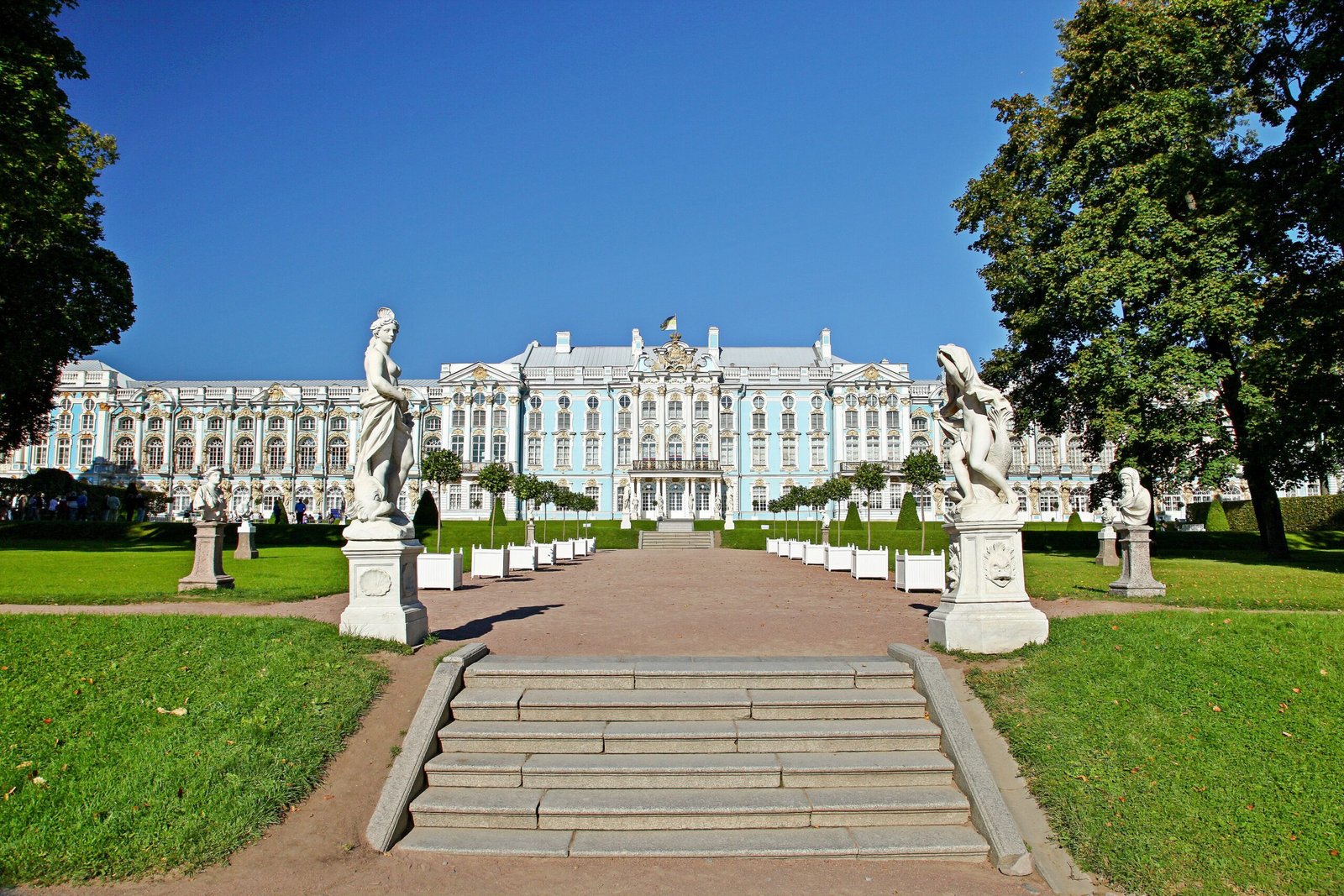
A village built for empresses, Tsarskoye Selo turned an unassuming Finnish settlement into the ceremonial heart of Russian autocracy, its palaces and parks still standing 24 kilometers south of Saint Petersburg.
At a glance
Once known as Saari-mois, this patch of former Swedish Ingria became a royal gift, an imperial residence, and finally a Soviet-era town renamed for Alexander Pushkin. Today it forms part of the UNESCO World Heritage Site covering Saint Petersburg and its related monument groups. Baroque architecture, most associated with Francesco Bartolomeo Rastrelli, defines much of its grandest surviving fabric.
History
Peter the Great presented the estate to his wife, later Empress Catherine I, giving the site its name and its purpose. Empress Elizabeth embellished it further in the mid-18th century. Catherine II built a neighboring town, Sophia, whose residents were later absorbed into Tsarskoye Selo under Alexander I. In 1838 the first railway line in Russia connected the town to the capital, cementing its place as a functioning extension of court life rather than a remote retreat.
The Alexander Palace, begun in 1792, first housed the future Alexander I as Catherine the Great’s grandson. More than a century later it became the site of Nicholas II’s house arrest, holding the last imperial family under revolutionary guard until August 1917. The Bolsheviks renamed the town Detskoye Selo in 1918; Stalin’s government renamed it Pushkin in 1937, honoring the poet who had studied there.
What you see
Historian Robert K. Massie described an “isolated, miniature world” inside the park, with obelisks, triumphal arches, and eight hundred acres of manicured lawn. An artificial lake once could be drained and refilled like a tub. A pink Turkish bath and a red-and-gold Chinese pagoda punctuate the grounds, giving the landscape a theatrical, collected quality. The Catherine Palace and the Alexander Palace stand roughly five hundred yards apart within the same Imperial Park, each with distinct baroque and neoclassical character. The famed Amber Room, part of the Catherine Palace complex, remains one of the site’s most celebrated interior spaces.
Beyond the palace gates, the town itself kept a provincial elegance: wide, tree-shaded boulevards lined with aristocratic mansions led from the railway station to the park gates.
Cultural significance
Tsarskoye Selo functioned as a stage for Russian autocracy, a place where architecture and landscape were arranged to project imperial permanence. Its role reversed sharply in 1917, when the same palace grounds confined the last tsar’s family under guard. During the Soviet period, the phrase “the Tsar’s village” resurfaced informally, applied to privileged nomenklatura neighborhoods with better housing and stocked shops. The nickname carried the site’s old association with concentrated, visible privilege into a new political era.
Key facts
- Location: Pushkin, 24 km south of Saint Petersburg, Russia
- Architect: Francesco Bartolomeo Rastrelli (baroque style)
- Founded as imperial estate: early 18th century, gift to Empress Catherine I
- Renamed Detskoye Selo, 1918; renamed Pushkin, 1937
- Site of Nicholas II’s house arrest until 13 August 1917
- Part of the World Heritage Site: Saint Petersburg and Related Groups of Monuments
Practical information & getting there
You can reach Pushkin from central Saint Petersburg by suburban train or bus, following the same rail corridor first opened in 1838. Once there, the Catherine Palace, Alexander Palace, and surrounding park are within walking distance of each other. Expect crowds at the Amber Room, so plan visiting hours with some flexibility.
Sources & resources
Find it on the map
See this place and what’s around it →Events here — now on & upcoming
- Anniversary: The Tsarskoye Selo Lyceum Opens — October 19, 181119 Oct 2027See the event →
📷 Become a Cultural Heritage Online photographer
Share your photos of places: they stay published under your name as the author. The more they're seen, the more you get noticed — and soon a contest will reward the most appreciated photos.
Log in or sign up free to add a photoIs this page about you?
This page is read by travellers and heritage enthusiasts who find it on Google. Tell us how you are connected to this place and we will take it from there.