

The most famous relief of the west front tells the legend of Theophilus of Adana: a disappointed cleric, dismissed by a vindictive bishop, who sold his soul to the devil, renouncing Christ and the Virgin, before repenting and obtaining, through prayer to Mary, the return of the pact. When the Wars of Religion (1562–1573) devastated the abbey, that relief and the dancing statue of the prophet Isaiah were saved by moving them inside the church, onto the west wall — one of the great acts of artistic preservation in history.
About Souillac Abbey
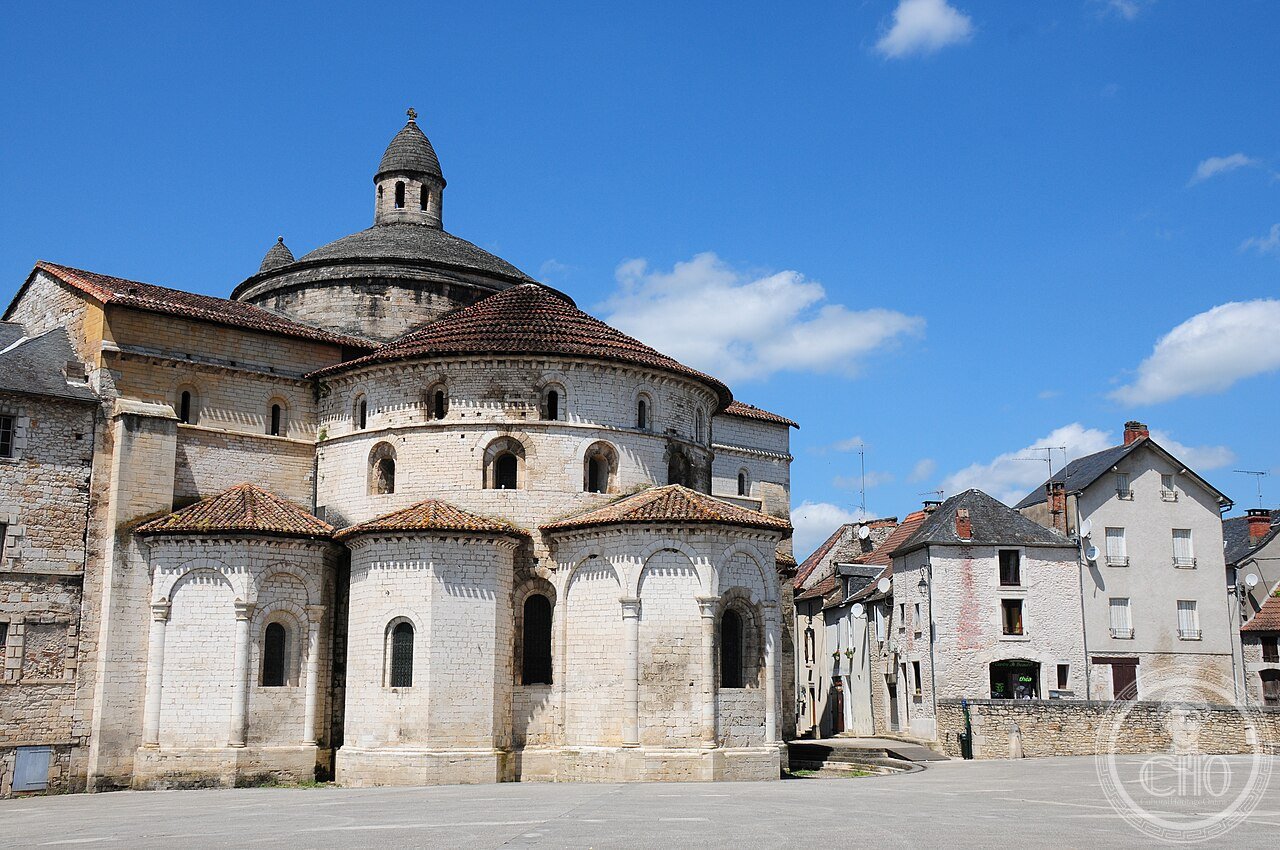
Souillac grew up around an abbey dependent on the Benedictine monastery of Aurillac, its community established with support from Count Géraud, Abbot of Aurillac, and Viscount Frotard in 909; the Benedictines settled in the plain of Souillès — named from a local word, “souilh,” meaning a muddy, marshy place where wild boars once wallowed — replacing an earlier community reportedly founded there by Saint Eloi, and draining and transforming the swamp into a productive estate. The stone abbey church, the Abbatiale Sainte-Marie, was built between roughly 1075 and 1150, completed around 1145, ranking among the finest examples of Romanesque and Byzantine-influenced architecture in southwestern France, distinguished by its striking sequence of three domes — two along the nave and the largest at the transept crossing — and a chevet with five apsidioles. The church’s most celebrated sculptural works are a large statue of the prophet Isaiah, captured mid-dance in a swirl of robes and considered the most important depiction of a prophet anywhere in Romanesque art, and a tympanum from around 1130 depicting the legend of Theophilus of Adana — a disappointed cleric, removed from his post by a vengeful bishop, who sold his soul to the Devil and renounced Christ and the Virgin Mary, before repenting and being rescued through prayer to the Virgin Mary herself. During the French Wars of Religion, Protestant forces ransacked the town and abbey between 1562 and 1573, destroying the parish church of Saint-Martin, burning the monastery buildings, and attempting to blow up the abbey church’s walls — but in one of history’s more remarkable acts of artistic preservation, the western portal’s sculptures, including the Isaiah figure and the Theophilus tympanum, were salvaged and relocated inside the church onto its western wall, where they survive today. Restoration of the abbey church and monastery buildings began in 1632 under lord-abbot Henry de la Mothe Houdancourt and was completed by 1712.
Key facts
- Foundation: 909, dependent on Aurillac Abbey, supported by Count Géraud of Aurillac and Viscount Frotard
- Church construction: c. 1075-1150, completed c. 1145
- Architecture: Romanesque-Byzantine, three domes, five-apsidiole chevet
- Isaiah pillar: a dancing prophet figure, the most important Romanesque depiction of a prophet
- Theophilus tympanum: c. 1130, depicting the legend of a cleric who sold his soul to the Devil and was saved by the Virgin Mary
- Wars of Religion (1562-1573): abbey and town ransacked; sculptures salvaged and moved inside for protection
- Restoration: 1632-1712, under lord-abbot Henry de la Mothe Houdancourt
History
The Theophilus legend depicted on Souillac’s tympanum represents one of medieval Christianity’s most theologically significant precursor narratives to the later Faust legend — a cleric’s pact with the Devil, subsequent remorse, and eventual salvation through Marian intercession — making Souillac’s c. 1130 sculptural treatment one of the earliest and most artistically accomplished visual representations of this influential story anywhere in medieval European art, predating the German Faust tradition by centuries. The Isaiah pillar’s celebrated dynamism, capturing the prophet mid-movement in swirling robes, represents a genuinely exceptional achievement within Romanesque sculpture’s generally more static figurative tradition, its unusual sense of motion earning it recognition as one of the period’s most important surviving prophet depictions.
The deliberate wartime relocation of these sculptures from the exposed western portal to the church’s protected interior western wall, undertaken specifically to save them from the Wars of Religion’s destructive Protestant-Catholic violence, represents a remarkably foresighted act of proactive heritage preservation for its period — most comparable medieval sculptural programmes elsewhere in France were simply destroyed outright during this same conflict rather than deliberately saved through relocation. This specific preservation decision ensured that Souillac’s Isaiah and Theophilus sculptures survive today in exceptional condition, despite the wider abbey and town suffering severe destruction during the same conflict.
What you see
The Isaiah pillar and the Theophilus tympanum, both relocated to the church’s western interior wall during the Wars of Religion, are the abbey’s essential single destination, offering direct access to two of Romanesque sculpture’s most historically and artistically significant works. The church’s distinctive sequence of three domes, a hallmark of the region’s Romanesque-Byzantine architectural tradition, gives the building its striking silhouette. The chevet’s five apsidioles complete the building’s harmonious overall proportions.
Practical information
- Opening hours: generally open daily, check current hours before visiting; free admission
- Address: Place Pierre Betz, 46200 Souillac, France
Getting there
Souillac has direct rail connections from Toulouse (approximately 2 hours) and Brive-la-Gaillarde (approximately 30 minutes). By car, Souillac sits on the A20 motorway in the Lot department, Occitanie. GPS: 44.8936° N, 1.4775° E.
Nearby
- Rocamadour — a dramatic cliffside pilgrimage village, within reach
- Padirac Chasm — a major underground cave and river system nearby
- Sarlat-la-Canéda — a well-preserved medieval town in the Dordogne, within reach
Sources
- French Moments — “Sainte-Marie Abbey Church, Souillac” (frenchmoments.eu)
- Via Lucis — “The Sculpted Miracles of Souillac” (vialucispress.wordpress.com)
- Wikipedia — “Souillac, Lot” (en.wikipedia.org)
Find it on the map
See this place and what’s around it →📷 Become a Cultural Heritage Online photographer
Share your photos of places: they stay published under your name as the author. The more they're seen, the more you get noticed — and soon a contest will reward the most appreciated photos.
Log in or sign up free to add a photo