

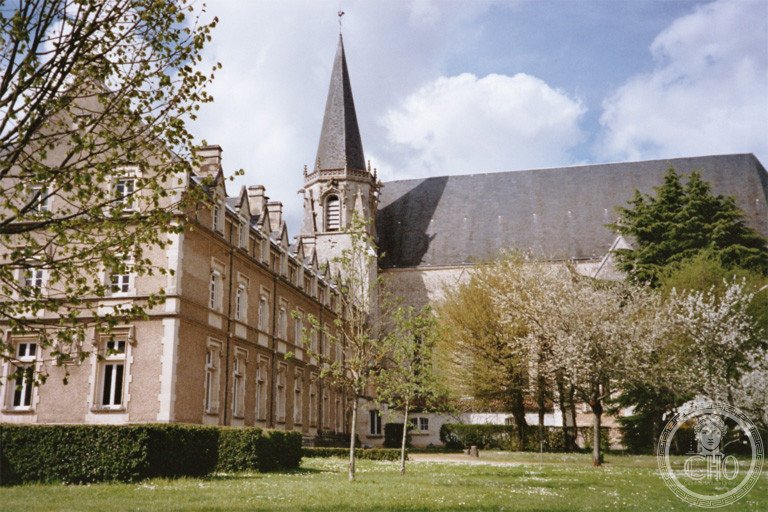
In 361 Bishop Hilary of Poitiers offered a piece of land to his protégé Martin of Tours, who founded a hermitage there: the monks each lived in a small hut called a “locaciacum”, the name from which Ligugé derives. Within a few years the hermitage had become a community of some sixty men — the oldest monastery in Western Europe, surviving (with one revolutionary interruption) to this day.
About Ligugé Abbey
Ligugé Abbey, founded in 361, is recognised as the oldest monastery known in Western Europe. The original foundation arose on a site offered by Bishop Hilary of Poitiers to his protégé, Martin of Tours, to whom the abbey would later be dedicated. The monks initially lived following the pattern of the Desert Fathers of Egypt, each occupying his own small hut, or “locaciacum” — a name that would gradually evolve into “Ligugé” itself. What began as a simple hermitage quickly grew into a convent of around sixty men, whom Martin served as abbot until 370. The community’s fame declined considerably once Martin became Bishop of Tours and established a new, more prominent monastery at Marmoutier just outside that city. A subsequent series of disasters — Saracen invasion, the wars between the Dukes of Aquitaine and the early Carolingians, and finally Norman raids — nearly destroyed the monastery entirely, and by the 11th century it had sunk to the reduced status of a dependent priory attached to Maillezais Abbey. The original medieval abbey was ultimately destroyed during the French Revolution, and the current monastic community dates only from 1853, when it was refounded and joined to the Solesmes Congregation. Today, Saint-Martin de Ligugé Abbey stands as the oldest active monastery in the West, its founding by Martin of Tours in 361 giving it an unbroken claim to primacy among Western European monastic institutions, despite the long medieval interruptions and eventual Revolutionary-era destruction and rebirth.
Key facts
- Foundation: 361, by Martin of Tours, on land offered by Bishop Hilary of Poitiers
- Significance: the oldest monastery known in Western Europe
- Name origin: “locaciacum,” the individual huts of the earliest hermit-monks, evolving into “Ligugé”
- Early growth: around 60 monks under Martin’s abbacy, until 370
- Decline: Saracen invasions, Carolingian-era wars, Norman raids; reduced to a priory of Maillezais by the 11th century
- French Revolution: the medieval abbey destroyed
- 1853: refounded, joining the Solesmes Congregation
- Today: the oldest active monastery in the West
History
Martin of Tours’s foundation at Ligugé, predating his own later and more historically prominent monastery at Marmoutier, situates Ligugé as the genuine originating point of Western European monasticism as a formally organised institution, its 361 date giving it chronological priority over virtually every other surviving Western monastic foundation. The community’s early organisation around individual hermit huts, directly modelled on the Desert Fathers of Egypt, reflects how thoroughly early Western monasticism drew its foundational inspiration from the earlier eremitic traditions of Egyptian and Near Eastern Christianity, adapted to a Gallic rural setting under Martin’s specific leadership.
Ligugé’s long medieval decline — reduced by successive military and political disasters to a mere dependent priory by the 11th century — illustrates how even history’s oldest and most prestigious monastic foundation could suffer near-total institutional eclipse without permanent destruction, its underlying sacred site and founding memory surviving centuries of reduced status before eventual Revolutionary-era destruction and 1853 refoundation. The abbey’s modern affiliation with the Solesmes Congregation, itself renowned for its scholarly restoration of Gregorian chant and Benedictine liturgical tradition, connects Ligugé’s ancient founding memory to a specifically 19th-century French movement of Benedictine monastic revival and reform.
What you see
The abbey gardens and grounds, viewed in the historic photograph associated with the site, connect visitors to the pastoral, hermitage-rooted origins of Martin of Tours’s original 361 foundation. The rebuilt 19th-century monastic buildings give the abbey its present visible architectural character, following the medieval structure’s destruction during the Revolution. The abbey’s continuing status as an active Benedictine community, affiliated with the Solesmes Congregation, situates Ligugé as a genuinely living institution with an unbroken claim to being the oldest monastery in the West.
Practical information
- Opening hours: generally open daily, check current hours before visiting; free admission to the church
- Address: Place du Révérend Père Lambert, 86240 Ligugé, France
Getting there
Ligugé is reachable by car or bus from Poitiers (approximately 15 minutes) in the Vienne department, Nouvelle-Aquitaine. GPS: 46.5172° N, 0.3306° E.
Nearby
- Poitiers — approximately 15 minutes away; a historic city with major Romanesque churches
- Futuroscope — a major theme park near Poitiers
- Saint-Savin-sur-Gartempe Abbey — a UNESCO-listed abbey with celebrated Romanesque frescoes, within the same region
Sources
- Wikipedia — “Ligugé Abbey” (en.wikipedia.org)
- Catholic Answers Encyclopedia — “Abbey of Liguge” (catholic.com)
- France Voyage — “Abbey Saint-Martin” (france-voyage.com)
Find it on the map
See this place and what’s around it →📷 Become a Cultural Heritage Online photographer
Share your photos of places: they stay published under your name as the author. The more they're seen, the more you get noticed — and soon a contest will reward the most appreciated photos.
Log in or sign up free to add a photo