
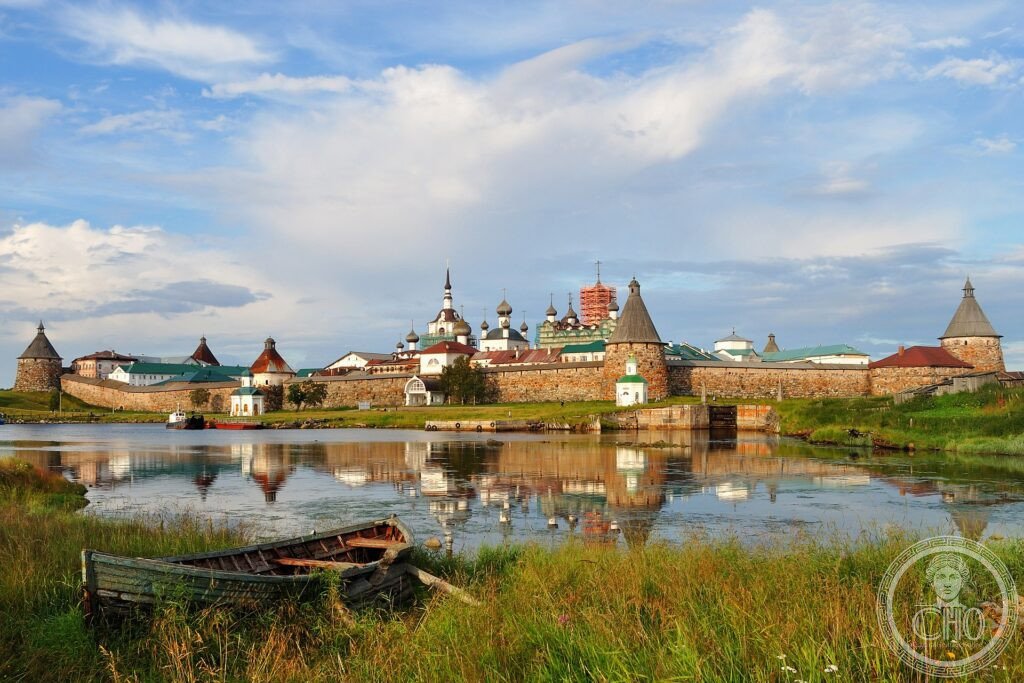
On a remote archipelago in the White Sea, hermit monks founded in the fifteenth century one of Russia’s most powerful monasteries: cyclopean walls of boulders, churches and canals between lakes. A place of faith and, later, in the twentieth century, the first Soviet labour camp: its history joins sanctity and tragedy.
At a glance
The Solovetsky Islands lie in the White Sea, near the Arctic Circle, and have been inhabited since prehistoric times, leaving Neolithic stone labyrinths. From the 15th century monks founded here a monastery that grew into one of the most powerful in Russia, ringed by colossal walls of boulders and linked by a network of canals between the islands’ lakes. In the 20th century the same buildings became the first camp of the Soviet Gulag. This layered cultural and historic ensemble was inscribed by UNESCO in 1992.
Key facts
- UNESCO: World Heritage since 1992 (Cultural and Historic Ensemble of the Solovetsky Islands)
- Monastery from the 15th century: founded by the monks Zosima and Savvaty
- Boulder walls: massive 16th-century fortress walls of glacial stones
- Engineering: a system of canals linking the islands’ many lakes
- Prehistory: Neolithic stone labyrinths on the islands
- 20th century: the site of the first Soviet labour camp (SLON)
History
Hermits settled on the remote islands in the 1430s, founding a monastery that, despite the harsh sub-Arctic climate, became a great spiritual and economic power, colonising the northern shores. In the 16th century, under the abbot Philip, monks raised the immense walls of rough granite boulders and built churches, mills and a remarkable network of canals to link the lakes.
A fortress as much as a monastery, it endured sieges and exile alike. After the Revolution it was closed and, from 1923, turned into the prototype of the Gulag, the Solovetsky Special Purpose Camp, where thousands suffered and died. The monastery was revived in the 1990s, and the islands now hold both a working monastery and a memorial to the camp’s victims.
What you see
The monastery rises straight from the water, its walls of huge rounded boulders enclosing white churches and towers, an extraordinary sight in the northern light. Within stand the cathedrals and the refectory; beyond, the canals thread between forest lakes, and on a neighbouring island lie the ancient stone labyrinths.
Across the site, exhibitions recall both the monastic centuries and the tragedy of the Gulag.
Practical information
- Access: by boat from Kem or by small plane; weather-dependent
- Time needed: at least a full day, ideally an overnight stay
- Note: a remote site; arrange transport and lodging ahead
- Respect: both an active monastery and a place of remembrance
Getting there
The Solovetsky Islands are in the White Sea, off the coast of northern Russia. Access is by boat from Kem or Belomorsk (reached by the Murmansk railway) or by light aircraft from Arkhangelsk. GPS: 65.025° N, 35.71° E.
Nearby
- Kem — the mainland port for boats to the islands
- Karelia — the lakes and forests of the northern mainland
- Kizhi — the wooden churches of Lake Onega, also UNESCO-listed
Sources
- UNESCO World Heritage Centre — “Cultural and Historic Ensemble of the Solovetsky Islands” (ref. 632)
- Solovetsky State Museum-Reserve — official body
- Encyclopaedia Britannica — Solovetsky Islands
Find it on the map
See this place and what’s around it →📷 Become a Cultural Heritage Online photographer
Share your photos of places: they stay published under your name as the author. The more they're seen, the more you get noticed — and soon a contest will reward the most appreciated photos.
Log in or sign up free to add a photo