
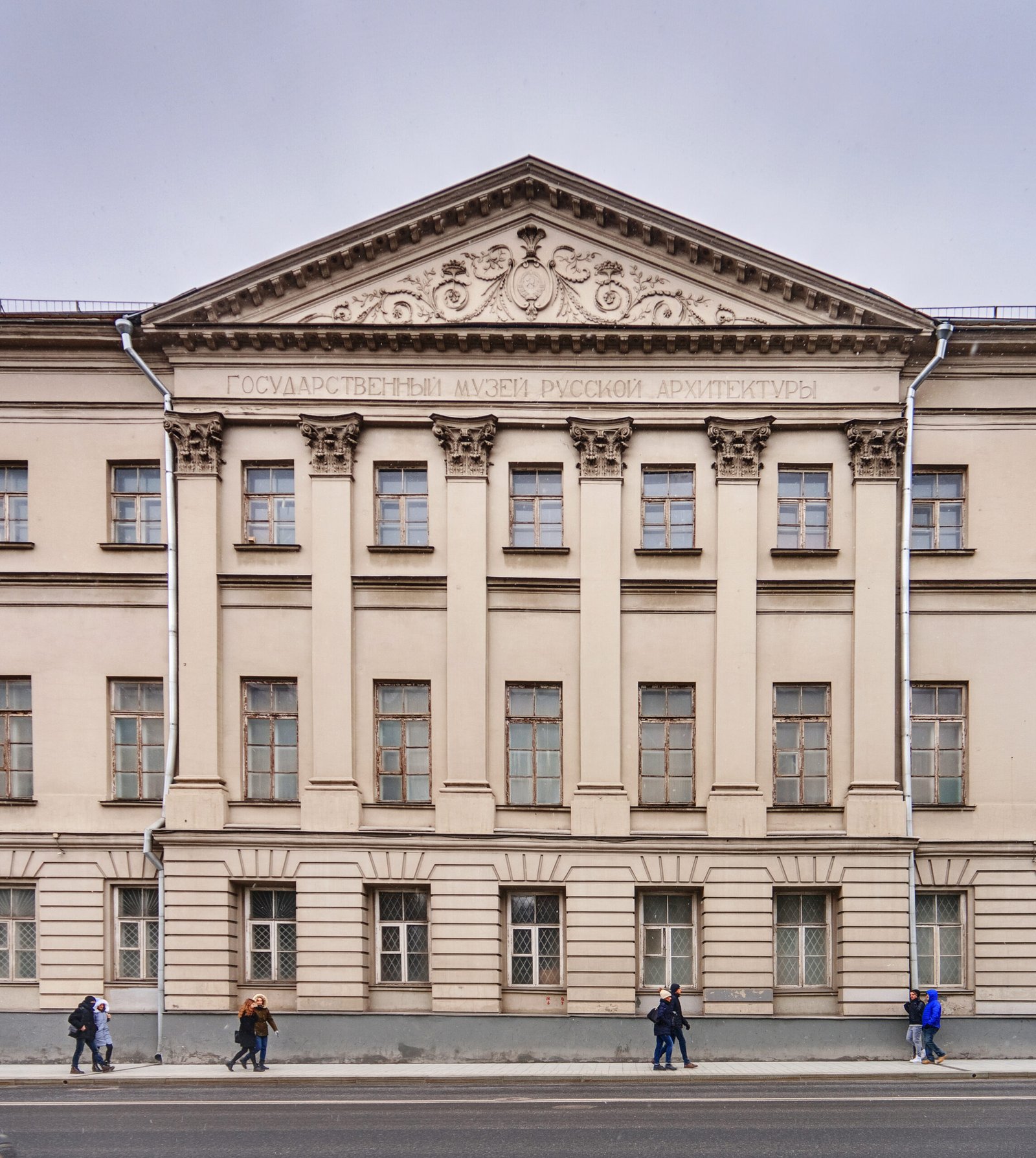
A national archive of Russian building traditions, born from war-time loss and housed in a former merchant mansion on Vozdvizhenka Street.
At a glance
The Shchusev Museum of Architecture is Russia’s principal research institution devoted to the country’s built heritage. Founded in 1934, it now holds more than 800,000 items spanning drawings, models, photographs and salvaged fragments. Its main campus sits on Vozdvizhenka Street, close to the Kremlin, spread across several historic buildings rather than a single monumental hall.
History
The story begins in the Donskoy Monastery, secularized and repurposed in 1934 to hold the fledgling Academy of Architecture’s collection. Fragments rescued from demolished buildings filled its fortified courtyards. Officially the scope was global; in practice, the holdings were overwhelmingly Russian.
Everything changed after 1945. Alexey Shchusev, already a celebrated architect, pushed for a dedicated museum of Russian national architecture. He chose the Talyzin House himself, then occupied by the NKVD, and used his standing within that agency to secure the building. Under his direction the museum quietly sheltered Jewish scholars, among them David Arkin, Abram Efros and Alexander Gabrichevsky, during the anti-cosmopolitan purges. In 1948 the Baldin Collection of German art was deposited there in secret, with Shchusev’s knowledge. For its first decade the institution worked mainly as an archive, recording buildings damaged or destroyed in the war; the first public exhibition did not open until 1957.
Khrushchev’s dissolution of the Academy of Architecture in 1964 merged the two collections under Shchusev’s name. Donskoy Monastery kept the pre-revolutionary material, Talyzin House the Soviet-era exhibits. Expulsion from the monastery came in 1991, scattering the collection again. Talyzin House itself, worn down by decades of neglect and subway vibration, required a long restoration before reopening.
What you see
Visitors today encounter a cluster of buildings rather than one grand facade. The reconstructed Talyzin House anchors the site. Beside it stands the so-called “Ruin,” a deliberately unrestored structure used for contemporary exhibitions. A third building, the 17th-century former Medicinal Prikaz, adds an older architectural layer to the ensemble. Since 2018 the museum has also administered the Melnikov House, the constructivist residence-studio designed by Konstantin Melnikov, extending its reach into the Arbat district.
Cultural significance
Few institutions carry the weight of Soviet-era rescue archaeology as directly as this one. Its founding mission was to document what war had already destroyed. That archival instinct still shapes its identity. The museum’s quiet role in protecting persecuted scholars, and its custody of a smuggled German art collection, mark it as more than a repository of blueprints; it became, briefly, a place of refuge.
Key facts
- Founded: 1934, originally at Donskoy Monastery
- Renamed and reorganized under Alexey Shchusev from 1945–1946
- Merged into its current form in 1964
- Collection size: over 800,000 items
- Sites: Talyzin House, the “Ruin,” former Medicinal Prikaz, and (since 2018) Melnikov House
Practical information & getting there
The museum sits on Vozdvizhenka Street, within easy walking distance of the Kremlin and Arbatskaya metro station. Check the official website before visiting, since exhibition sites and opening hours vary across the museum’s separate buildings.
Sources & resources
Find it on the map
See this place and what’s around it →📷 Become a Cultural Heritage Online photographer
Share your photos of places: they stay published under your name as the author. The more they're seen, the more you get noticed — and soon a contest will reward the most appreciated photos.
Log in or sign up free to add a photoIs this page about you?
This page is read by travellers and heritage enthusiasts who find it on Google. Tell us how you are connected to this place and we will take it from there.