
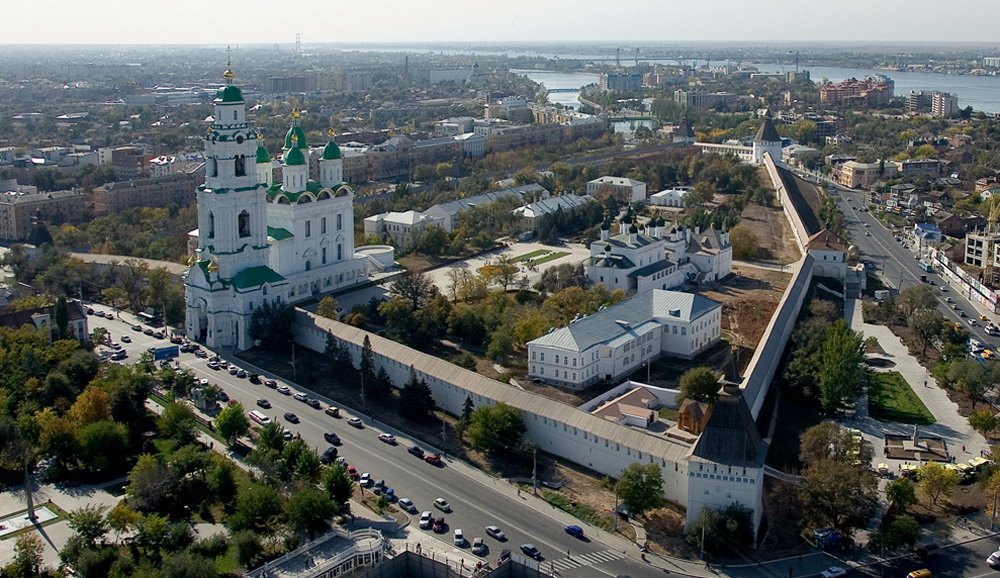
On a low hill in the Volga Delta, walls of pale Tatar stone still trace the shape of a frontier fortress that once guarded Russia’s gateway to the Caspian.
At a glance
The Astrakhan Kremlin sits on “Rabbit Hill,” an island formed by the Volga, the Kutum, and the Tsarev rivers. Building began in 1582, and the site is heritage-protected today. It functions as a museum-reserve, holding cathedrals, towers, gates, and garrison buildings within a single walled complex.
History
After Ivan IV conquered the Kazan Khanate in 1552, Russian troops took Astrakhan four years later, opening access to the Caspian Sea. The first fortress here was wooden, laid out in 1587–1588 by the sapper I.G. Vorodkov. Under Ivan IV and Boris Godunov it was rebuilt in stone, using old Tatar plinths salvaged from ruined Golden Horde cities. Master builders Mikhail Ivanovich Veliyaminov, Grigorii Ovcin, and Dei Gubastii oversaw the work, modelling the citadel on the Moscow Kremlin. The fortress witnessed Crimean Tatar incursions, the Time of Troubles, and Stenka Razin’s uprising. It changed again under Peter the Great, as Russia pushed its borders toward the Caucasus and Central Asia. In 1918, Astrakhan Cossacks and Red Army supporters fought around its walls, causing serious damage; the temples inside, remarkably, survived.
What you see
The Kremlin’s walls carry firing slots for handguns and machicolations once used to pour boiling water or tar on attackers. Its fire-fighting system ranked among the most advanced in Russia at the time. The Cathedral of the Assumption, begun in 1699 under the bondman architect Dorotheos Myakisheva, took nearly twelve years to finish. It rises as a cubic form crowned by five domes, its brick facades molded and carved, windows framed by Corinthian columns. Inside, the upper church is tall and bright, reserved for warm-season ceremony; the lower church stays dim, ringed by a columned gallery. A bell tower, added in 1710 under Myakisheva’s direction, once carried a working clock alongside its bells. Towers bear working names still — Zhitnyaya, Crimean, Archbishop’s — each marking a stretch of wall raised between 1582 and 1589.
Cultural significance
For centuries this was Russia’s inapproachable stronghold on its southeastern edge. It anchored the empire’s hold on the Volga and its ambitions toward the Caspian navy. Under Soviet rule the Kremlin lost its religious and civic life, serving instead as a military post nicknamed “The Town of Trotsky.” Only after World War II did it reopen to the public. Since becoming a museum in 1974, and joining the Astrakhan State United Historical-Architectural Museum-Reserve in 1980, it has told a longer story: of garrison life, popular uprisings, and the punishments once meted out within its walls.
Key facts
- Location: Astrakhan, Russia, on an island in the Volga Delta
- Construction began: 1582 (stone fortress); earlier wooden fort from 1587–1588
- Cathedral of the Assumption: built 1699–1710/1711, architect Dorotheos Myakisheva
- Bell tower: added 1710
- Museum status: since 1974; heritage-listed
- 2011: restored Guardhouse exposition opened to visitors
Practical information & getting there
The Kremlin stands within walking distance of central Astrakhan, on the hill overlooking the Volga’s channels. You can explore the walls, towers, and cathedral interiors as part of the museum-reserve’s grounds. Exhibits cover the Astrakhan Garrison, archers’ uniforms, weapons, and the history of local uprisings. Check current opening times and ticket details through the official museum channels before visiting.
Sources & resources
Find it on the map
See this place and what’s around it →📷 Become a Cultural Heritage Online photographer
Share your photos of places: they stay published under your name as the author. The more they're seen, the more you get noticed — and soon a contest will reward the most appreciated photos.
Log in or sign up free to add a photoIs this page about you?
This page is read by travellers and heritage enthusiasts who find it on Google. Tell us how you are connected to this place and we will take it from there.