
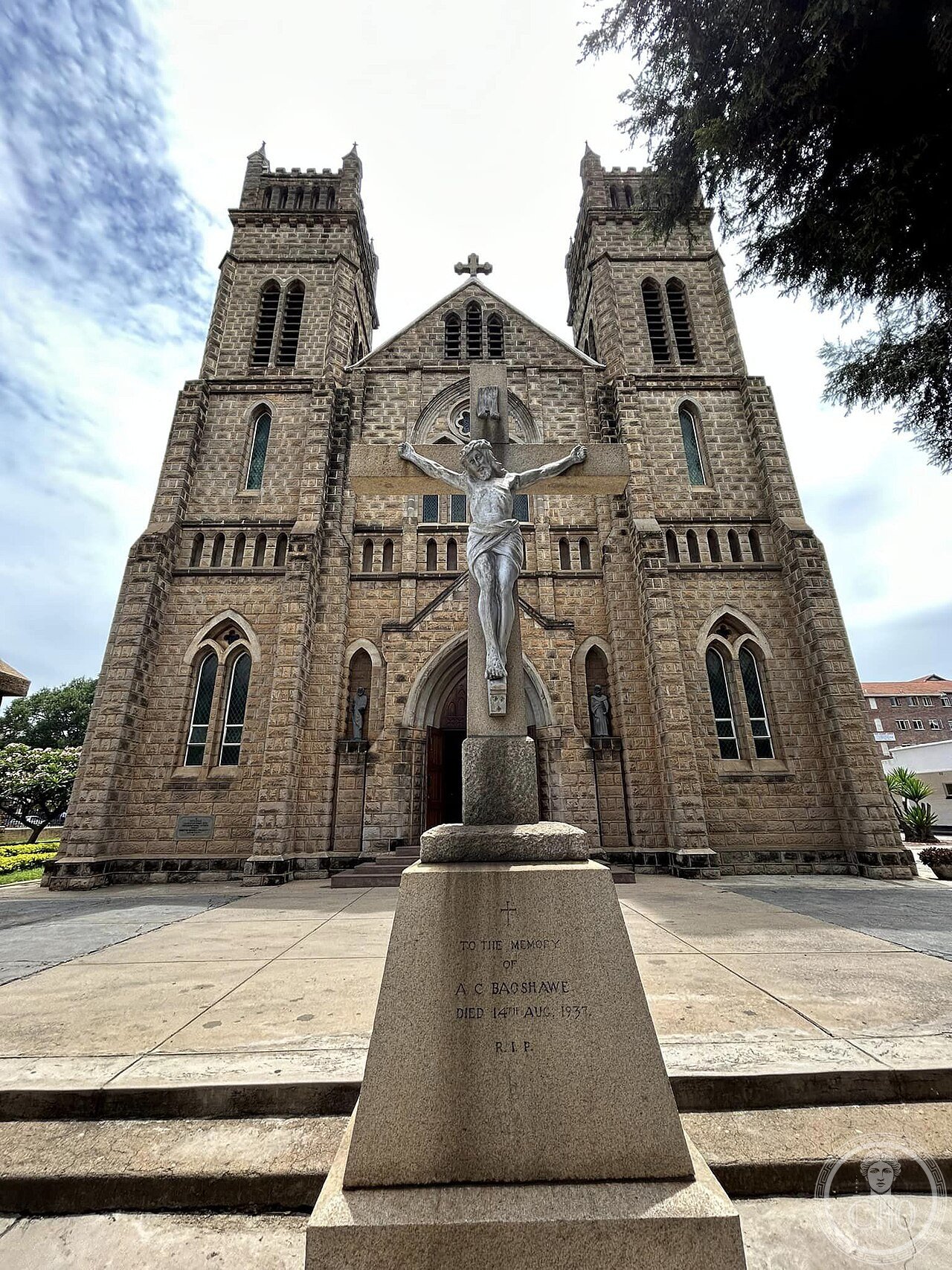
In Harare, the capital of Zimbabwe, then Salisbury, in colonial Rhodesia, Jesuit missionaries opened a small chapel for 40 people in 1893, at the Dominican convent of the city. A larger church, designed by Father Aloysius Leboeuf, opened on the day of the Annunciation in 1900. The first stone of the present cathedral was laid by Monsignor Brown, on 28 June 1924 according to Wikipedia, although another source gives a date inconsistent in itself, «Saint Patrick’s Day, in May 1924», since Saint Patrick falls on 17 March. The building was completed and opened on Sunday 2 August 1925. The design is attributed to Father Leboeuf himself, with no separate professional architect documented in the sources. The construction was carried out by French and German Jesuit and Mariannhill missionary brothers, with the help of African builders, an unusual circumstance, since the skilled building trades in colonial Rhodesia remained dominated by European labour until the Fifties. In Gothic Revival style, the cathedral is 40 metres long and 19.5 wide, with two towers flanking the west entrance and a choir gallery above it. The walls are of brick faced with artificial stone, while the windows and the pointed Gothic arches were made of concrete, an innovative choice for the time and the place, with fine woods imported from Beira, in Mozambique, and saligna timber from the Driefontein mission. The craftsmanship includes the wrought iron of Brother Schönbrod, the soapstone carvings of Brother Krechel, the carved wooden elements of Brother Göll and stained glass imported from Austria; in 1970 extensions were added on the south and east sides. The diocese, whose origins go back to the mission sui iuris of the Zambesi established on 2 July 1879, became the apostolic prefecture of the Zambesi in 1915, was renamed the apostolic prefecture of Salisbury in 1927, raised to an apostolic vicariate in 1931 and finally to the metropolitan archdiocese of Salisbury on 1 January 1955, renamed the archdiocese of Harare on 25 June 1982, after the independence of the country. The Jesuits administered the cathedral parish until 31 December 2008, when it was entrusted to the diocesan clergy. Pope John Paul II visited the cathedral on 11 September 1988, in the course of an apostolic journey that also took in Botswana, Lesotho, Eswatini and Mozambique, praising on that occasion the century of Jesuit contribution to the Church in Zimbabwe. The year 2025 marked the centenary of the opening of the building. The present archbishop of Harare is Monsignor Robert Christopher Ndlovu, installed in 2004; the sources differ on the exact date, giving variously 10 June or 21 August. In the sources consulted there is no record of the cathedral being listed in the register of national monuments of Zimbabwe.
About Cathedral of the Sacred Heart
In Harare, the capital of Zimbabwe (then Salisbury, in colonial Rhodesia), Jesuit missionaries opened a small chapel for 40 people in 1893 on the grounds of the city’s Dominican Convent; a larger church, designed by Father Aloysius Leboeuf, opened on the Feast of the Annunciation in 1900. The foundation stone of the present cathedral was laid by Monsignor Brown, per Wikipedia on 28 June 1924, though another source gives an internally inconsistent date (“St Patrick’s Day, in May 1924” — St Patrick’s Day actually falls on 17 March); the building was completed and opened on Sunday, 2 August 1925.
Key facts
- 1893: the first small Jesuit mission chapel opens in Salisbury.
- 1924-1925: the present cathedral built, designed by Father Aloysius Leboeuf.
- 1 January 1955: the see elevated to the Metropolitan Archdiocese of Salisbury, later Harare.
- 11 September 1988: visited by Pope John Paul II.
- 31 December 2008: parish administration transferred from Jesuits to diocesan clergy.
- 2025: the cathedral’s centenary.
History
Built by Jesuit and Marianhill missionary brothers working alongside African builders, at a time when skilled construction trades in colonial Rhodesia remained largely closed to Black tradesmen, the Cathedral of the Sacred Heart’s own construction history quietly complicates the segregated society it rose within. Its subsequent century — from Jesuit administration through a 1988 papal visit to its 2008 handover to diocesan clergy and 2025 centenary — traces the transition from a colonial mission church to the seat of an independent Zimbabwe’s Catholic archdiocese.
What you see
Twin Gothic Revival towers flank the west entrance of a cast-stone-clad brick building whose pointed arches and windows were built in concrete, an innovative material choice for 1920s Rhodesia. Inside, ironwork by Brother Schönbrod, soapstone carving by Brother Krechel, carved timber by Brother Göll and stained glass imported from Austria reflect the missionary brothers who built and furnished the cathedral by hand.
Practical information
- Opening hours: generally open daily outside services; check current hours before visiting.
- Address: Fourth Street at Herbert Chitepo Avenue, Harare, Zimbabwe.
Getting there
The cathedral stands in central Harare at the corner of Fourth Street and Herbert Chitepo Avenue, easily reached on foot from the city center. GPS: 17°49′16″S, 31°03′12″E.
Nearby
- Central Harare — the city’s main commercial and administrative district.
Sources
- Wikipedia — “Sacred Heart Cathedral, Harare” and “Roman Catholic Archdiocese of Harare” (en.wikipedia.org).
- Open Council — “Historic Buildings: Cathedral of the Sacred Heart” (opencouncil.co.zw).
- Vatican.va — Pope John Paul II, Harare farewell ceremony, 13 September 1988.
Find it on the map
See this place and what’s around it →📷 Become a Cultural Heritage Online photographer
Share your photos of places: they stay published under your name as the author. The more they're seen, the more you get noticed — and soon a contest will reward the most appreciated photos.
Log in or sign up free to add a photo