

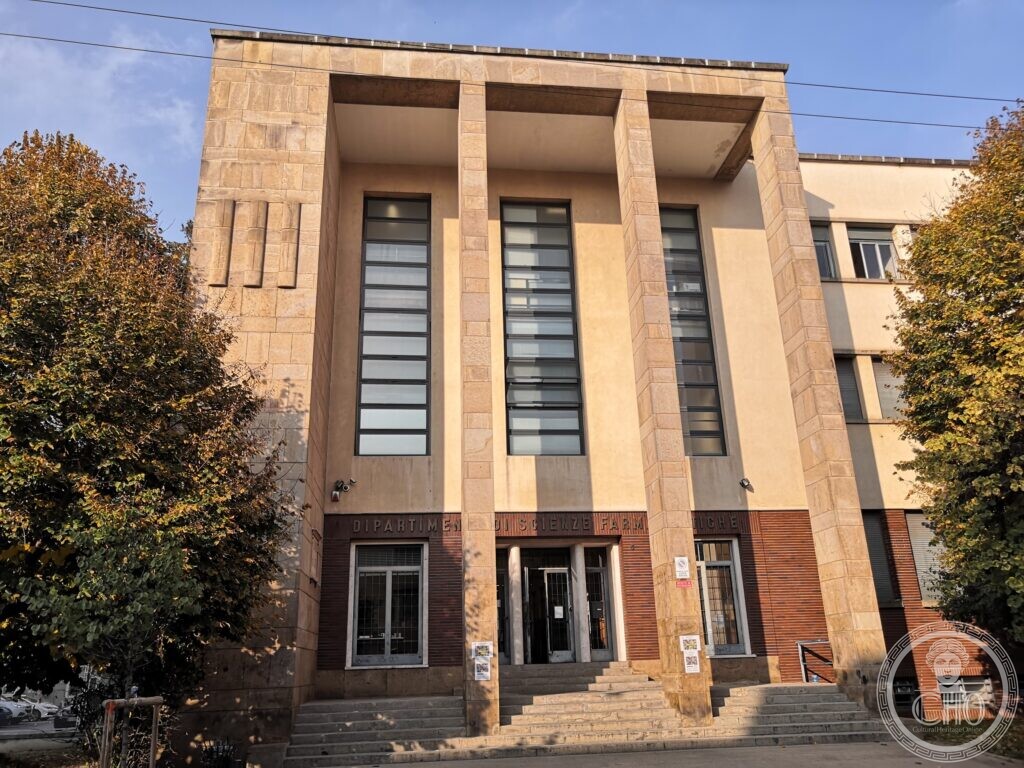
The monumental stone front of the former Institute of Pharmaceutical Chemistry, designed by the Milanese architect Giuseppe Merlo and built from 1935 under the rector Carlo Anti; on its left pier a Latin inscription composed by the Latinist Concetto Marchesi records the visit of 25 September 1938, with a name in red letters.
At a glance
The building stands at Via Marzolo 5, in the scientific quarter of the University of Padua, between the institutes of Physics and Physiology. The university decided it in 1933, within the fourth building consortium authorised under the rectorship of Carlo Anti; the Milanese architect Giuseppe Merlo designed it in 1935–36, construction began in April 1935 and was completed in a year, and another year went into furnishing and equipping the laboratories, which were ready in 1937. It was the Institute of Pharmaceutical Chemistry and Toxicology, seat of the Faculty of Pharmacy, and it is today the Department of Pharmaceutical Sciences. On the left pier of the front a Latin inscription records that Mussolini undertook and dedicated the building on 25 September 1938, in the sixteenth year of the regime, with the rector Carlo Anti; its author was Concetto Marchesi.
Key facts
- Decided: 1933; built: from April 1935, completed in a year, furnished in 1937
- Architect: Giuseppe Merlo, of Milan, design of 1935–36
- Patron: the University of Padua under rector Carlo Anti (1932–1943), fourth building consortium
- Original use: Institute of Pharmaceutical Chemistry and Toxicology, seat of the Faculty of Pharmacy; today: Dipartimento di Scienze del Farmaco
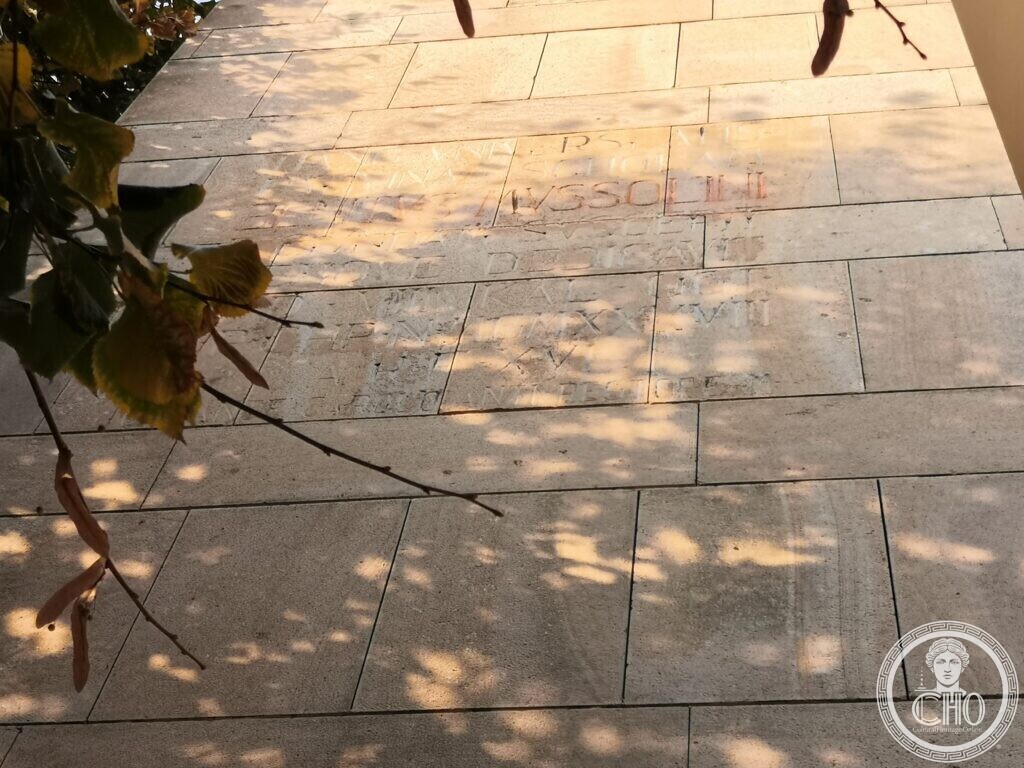
- Inscription: on the left pier, dated 25 September 1938, composed by Concetto Marchesi, with the name Benitus Mussolini in red
- GPS: 45.4096, 11.8862 · Open in Google Maps (OpenStreetMap)
History
The 1930s were the decade in which the University of Padua moved its sciences out of the old city into the open ground inside the Portello walls, along the new Via Marzolo. Carlo Anti, rector from 1932 to 1943, drove the programme through a series of building consortia with the state and the city; the fourth of them, in 1933, included a new institute for pharmaceutical chemistry. Giuseppe Merlo of Milan drew the plans in 1935–36, the site opened in April 1935, the shell was finished within the year and the laboratories equipped by 1937, when the director Efisio Mameli described the new institute in the city’s monthly review.
The inscription came last. In October 1937 Concetto Marchesi, the Latinist who would become rector himself after the war, sent Anti three drafts, which he called the classical, the barbarous and the fat epigraph; the classical one, with small changes, was carved on the left pier for Mussolini’s visit to the Via Marzolo quarter on 25 September 1938, when he paused at the institute for several minutes. The text dates itself both from the birth of Christ and from the sixteenth year of the regime, and uses a Greek rho in the abbreviation of Christ’s name in the manner of medieval christograms. It is still legible on the pier, the regime’s name in red, as the second photograph shows.
What you see
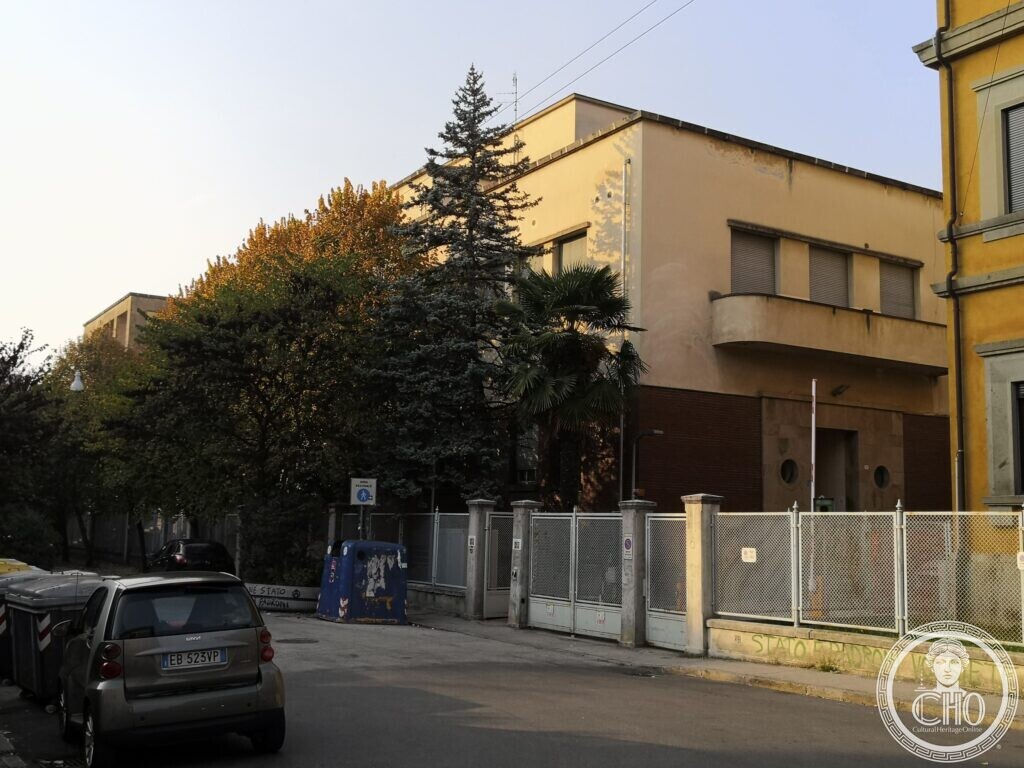
The front is a tall, narrow block faced in pale stone, in the monumental manner of Italian public architecture of the 1930s. Three giant piers rise the full height and frame two vertical strips of glazing, each divided by thin horizontal bands; a plain cornice closes the top, and on the left a group of vertical grooves cut into the stone is the only ornament. The base is of dark brick with two barred windows, the long inscription of the department’s name in metal letters, and the glazed entrance at the top of a wide flight of steps between the piers. To the right a lower wing in plaster, with rows of ordinary windows, holds the laboratories. The third photograph shows the side entrance on the garden, with its brick base and round windows, and the graffiti that the student quarter leaves on its fences.
Nearby
- The Physics Institute — the rationalist building opened in 1937, next door
- The Physiology Institute — the eclectic front of the 1900s at Via Marzolo 3
- Palazzo di Ingegneria — Donghi’s engineering school at the end of the street
Gallery
Sources
- Università di Padova, Palazzi novecenteschi — Edificio di Scienze Farmaceutiche: the decision of 1933 within the fourth building consortium under rector Anti, construction from April 1935 completed in a year with another year for furnishing, the Milanese architect Giuseppe Merlo, the seat of the Faculty of Pharmacy
- University of Oslo, Fascist Latin Texts, Padua, Dipartimento di Scienze del Farmaco (1938): the Latin text of the inscription and its location on the left pier of Via Marzolo 5, Concetto Marchesi’s three drafts of 31 October 1937, Giuseppe Merlo’s design of 1935–36, the furnishings of 1937, Mussolini’s visit of 25 September 1938, the dating formula and the Greek rho; citing the university yearbook 1938–39, E. Franceschini, Marchesi epigrafista (1978), and E. Mameli in Padova. Rassegna mensile del Comune, January 1938
- Stefano Vigolo, photographs of 21 October 2020: the inscription as it reads today, with the name in red
Find it on the map
See this place and what’s around it →📷 Become a Cultural Heritage Online photographer
Share your photos of places: they stay published under your name as the author. The more they're seen, the more you get noticed — and soon a contest will reward the most appreciated photos.
Log in or sign up free to add a photoIs this page about you?
This page is read by travellers and heritage enthusiasts who find it on Google. Tell us how you are connected to this place and we will take it from there.