
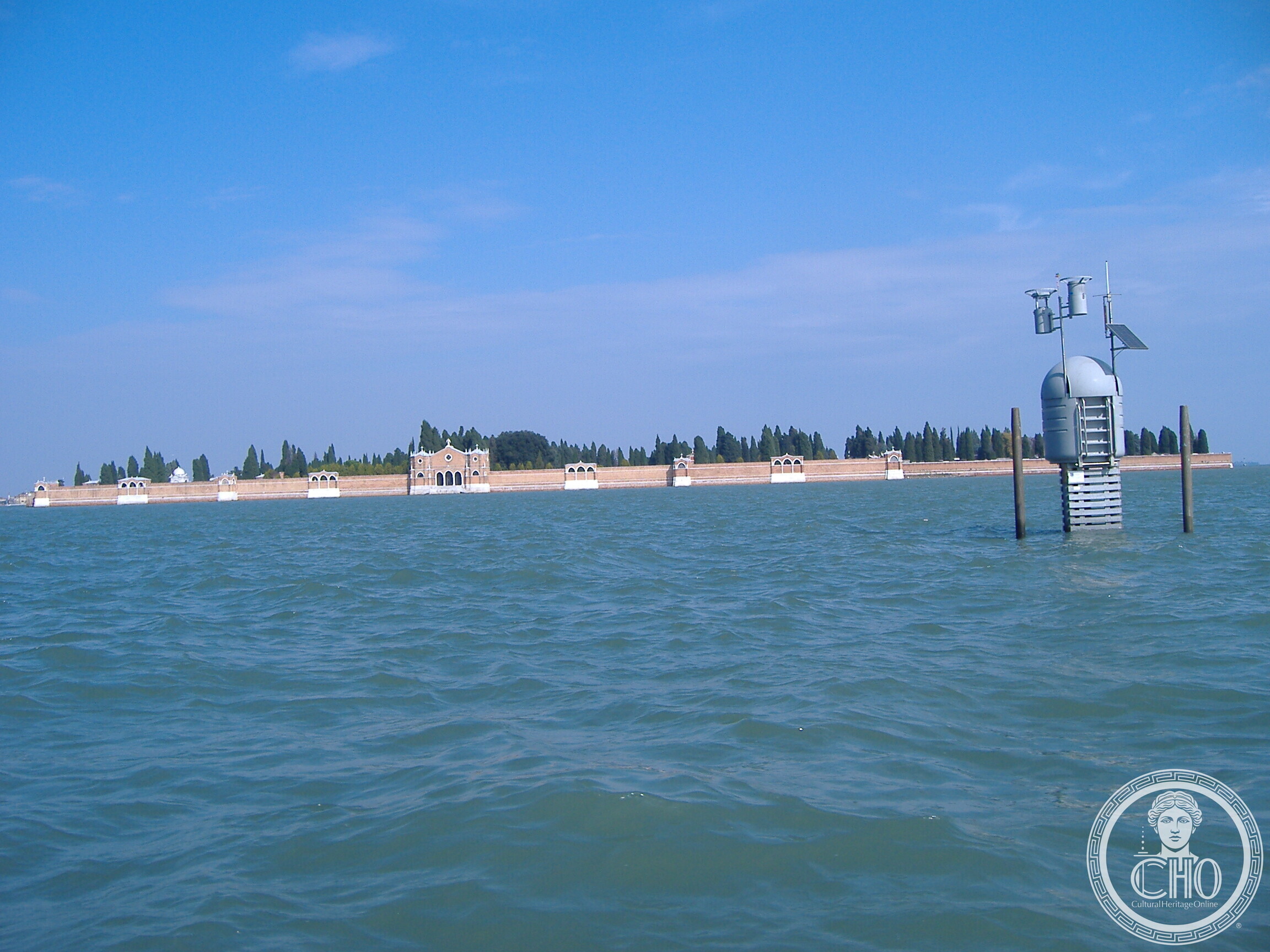
A walled island of cypresses between Venice and Murano, where the dead have arrived by boat since the Napoleonic decree that moved burials out of the city. Stravinsky, Diaghilev, Pound and Brodsky are among those who stayed.
At a glance
The cemetery of Venice occupies the island of San Michele, in the stretch of lagoon between the Fondamente Nove and Murano. It was created after Napoleon’s edict of Saint-Cloud of 1804, which forbade burials inside inhabited places: the architect Giannantonio Selva designed it on the neighbouring island of San Cristoforo della Pace, and the work was finished in the spring of 1813. Between 1835 and 1839 the canal between San Cristoforo and San Michele was filled in, and the two islands became one. Later in the century Annibale Forcellini gave the complex its present layout, with the hemicycle of chapels that joins the old Camaldolese convent of San Michele to the new burial grounds. The whole is enclosed by the red brick wall that one sees from the water.
Key facts
- Origin: Napoleonic edict of Saint-Cloud, 1804; Selva’s cemetery on San Cristoforo della Pace completed in 1813
- One island: the canal between San Cristoforo and San Michele filled in 1835–1839
- Layout: Annibale Forcellini, 19th century, with the hemicycle of chapels; extension by David Chipperfield after the competition of 1998
- Church: San Michele in Isola, by Mauro Codussi, begun 1469, the first Renaissance church front in Venice
- Sections: Catholic, Evangelical, Orthodox and Jewish
- Graves: Igor Stravinsky, Sergei Diaghilev, Ezra Pound, Joseph Brodsky, Luigi Nono, Christian Doppler, Franco Basaglia
- Member: of the Association of Significant Cemeteries in Europe (ASCE)
- Getting there: vaporetto stop Cimitero; the dead still arrive by boat
- GPS: 45.44857, 12.34633 · Open in Google Maps
History
Before 1804 the Venetians were buried in their parishes and in the campi; the French decree made a single cemetery outside the city compulsory, and the lagoon offered the island. Selva, the architect of the Fenice, planned the first enclosure; the filling of the canal and Forcellini’s plan of chapels, a Greek cross inscribed in a square with a semi-elliptical head, turned it into the monumental cemetery of the nineteenth century, with the Chapel of San Cristoforo on the main axis and the water gate on the south side.
At the end of the twentieth century the city held a competition for the enlargement, won in 1998 by David Chipperfield, whose new courts of stone have been built on the east side in stages since 2007. On the day of the dead a floating bridge of more than four hundred metres is laid from the Fondamente Nove, and the Venetians walk to the island.
What you see
From the water, a long red brick wall with white Istrian stone trim and small gothic-arched niches, and above it a dark line of cypresses; the white front of Codussi’s church is at the western end. The photograph was taken from a boat in the channel towards Murano, with a lagoon marker in the foreground.
Nearby
Sources
- Artribune — I cimiteri monumentali di Venezia: San Michele in Isola e i Lazzaretti: the edict of 1804, Selva’s project completed in 1813, the filling of the canal in 1835–1839, Forcellini’s hemicycle of chapels, the brick wall and the cypresses, the arrival of the dead by boat, the floating bridge, the sections and the graves of Doppler, Stravinsky, Pound and Basaglia
- Veritas / Comune di Venezia — Cimitero di San Michele, brochure 2025: the Benedictine and then Camaldolese convent, Forcellini’s monumental layout as a Greek cross inscribed in a square with a semi-elliptical head, the chapel of San Cristoforo on the axis, the water gate on the south, the extension by David Chipperfield, the ASCE circuit
Find it on the map
See this place and what’s around it →📷 Become a Cultural Heritage Online photographer
Share your photos of places: they stay published under your name as the author. The more they're seen, the more you get noticed — and soon a contest will reward the most appreciated photos.
Log in or sign up free to add a photo