
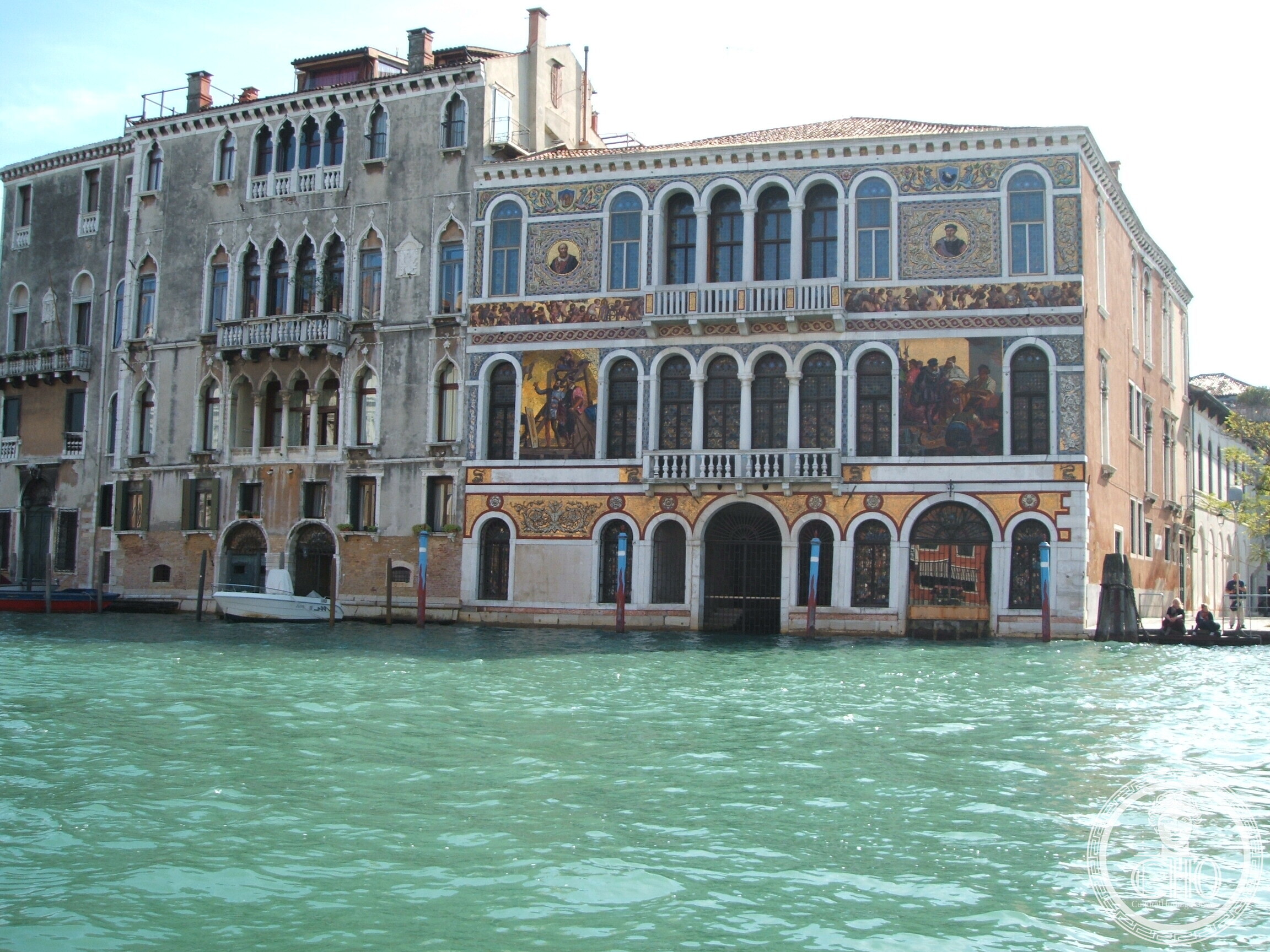
A Renaissance palace that a glass company turned into its shop window in 1886, covering the Grand Canal front with Murano mosaics on cartoons by Giulio Carlini. The neighbours called it vulgar; today it is one of the facades everyone photographs from the vaporetto.
At a glance
Palazzo Barbarigo stands on the Grand Canal in Dorsoduro, between Palazzo Da Mula Morosini and Campo San Vio. It was built in the sixteenth century for the Barbarigo family in the plain, well-proportioned manner of the Venetian Renaissance. Towards the end of the nineteenth century it became the seat of the Compagnia Venezia Murano, a producer of glass and mosaics, which in 1886 had the whole canal front covered with glass mosaics designed by the painter Giulio Carlini and executed by the Testolini brothers. The two large panels show Charles V visiting Titian in his studio and Henri III of France arriving in Venice in 1574; the frieze between the upper floors has thirty-five putti practising the arts, and the portraits of Titian and Tintoretto look down from above.
Key facts
- Built: 16th century, for the Barbarigo family
- Mosaics: 1886, Murano glass, designed by Giulio Carlini, executed by the Fratelli Testolini for the Compagnia Venezia Murano
- Subjects: Charles V in Titian’s studio; Henri III received in Venice in 1574; thirty-five putti of the arts; Titian and Tintoretto; the lion of St Mark and the cockerel of Murano
- Reception: the aristocratic neighbours judged it the taste of the newly rich
- Today: still a glass showroom on the lower floors; a hotel in the building, according to the French guide cited below
- GPS: 45.43097, 12.33055 · Open in Google Maps
History
The Compagnia Venezia Murano was one of the firms that revived Murano glass and mosaic in the late nineteenth century, and the palace it bought on the Grand Canal was both headquarters and advertisement. The mosaics on the front, inspired by those of St Mark’s, were meant to be seen from the water by every visitor to Venice: they show the company’s trade, the glory of Venetian painting, and the symbols of the city and of Murano.
Venetian society did not approve. A palace on the Grand Canal dressed in coloured glass, between the sober fronts of its neighbours, was read as the work of parvenus. The judgement has softened with time: the facade is now one of the sights of the canal, and the showroom on the ground floor still sells the glass it was built to promote.
What you see
A three-storey front on the water with a ground-floor arcade and rows of round-arched windows; the plaster between the windows and the whole upper band are covered with gold-ground mosaic, with two large figurative scenes under the top-floor windows and a frieze of small figures above. To the left the gothic front of Palazzo Da Mula Morosini makes the contrast that the nineteenth century complained about.
Nearby
- Palazzo Da Mula Morosini — the gothic palace next door
- Dorsoduro — the sestiere
Sources
- Bonjour Venise — Palazzo Barbarigo: the 16th century, the Compagnia Venezia Murano, the mosaics of 1886 by Carlini and the Testolini brothers, the thirty-five putti, Charles V and Titian, Henri III in 1574, the portraits of Titian and Tintoretto, the lion and the cockerel
- Le Routard — Palazzo Barbarigo: the Renaissance structure, the transformation of 1886 on Carlini’s cartoons, the scenes depicted, the disapproval of Venetian society, the hotel in the building today
Find it on the map
See this place and what’s around it →📷 Become a Cultural Heritage Online photographer
Share your photos of places: they stay published under your name as the author. The more they're seen, the more you get noticed — and soon a contest will reward the most appreciated photos.
Log in or sign up free to add a photoIs this page about you?
This page is read by travellers and heritage enthusiasts who find it on Google. Tell us how you are connected to this place and we will take it from there.