
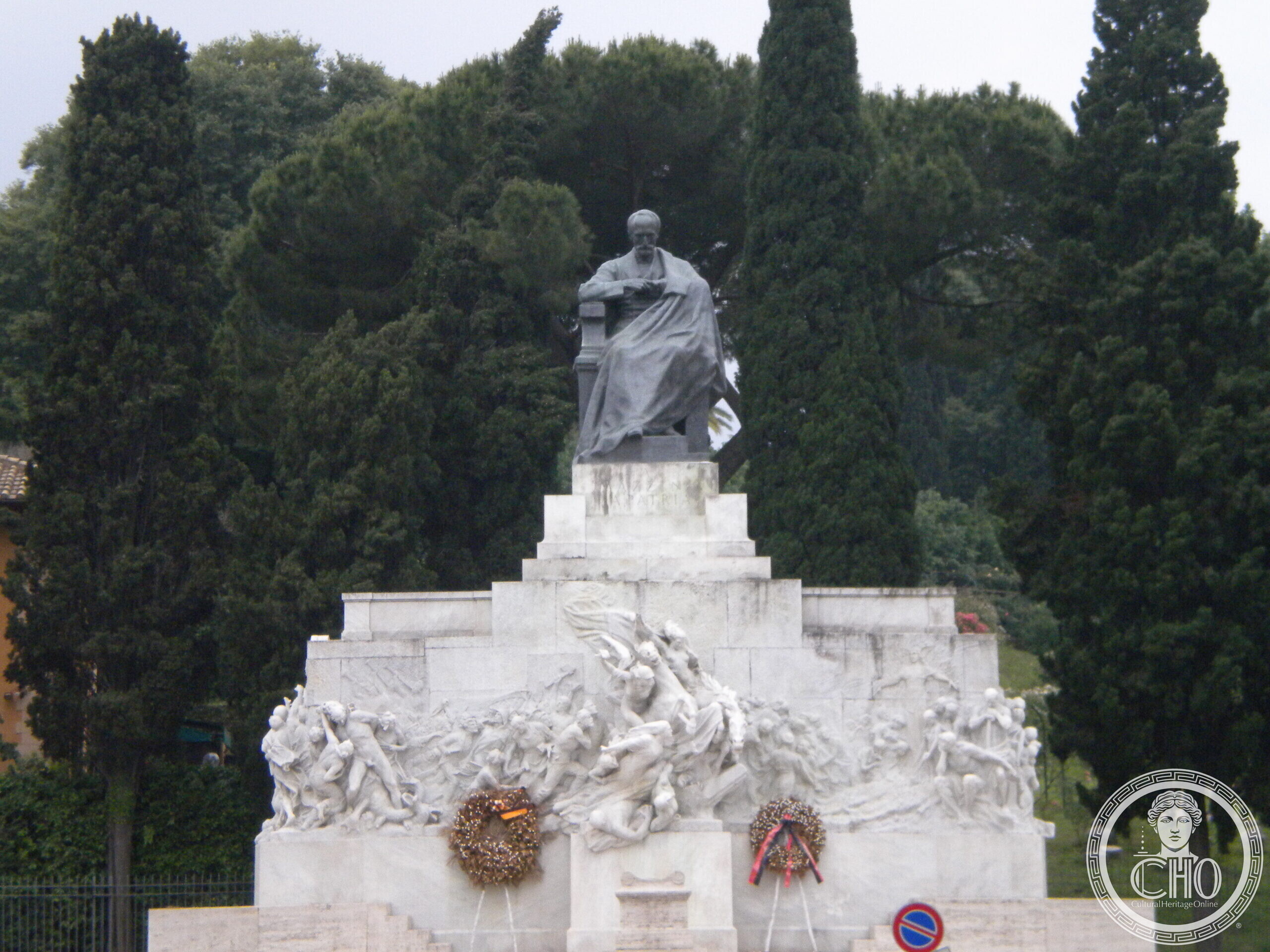
A monument that waited half a century: commissioned in 1902, finished by the sculptor’s death in 1929, and only erected in 1949, when the Republic that Mazzini had preached could celebrate him without offending the Vatican.
At a glance
The monument to Giuseppe Mazzini stands on the northern slope of the Aventine, in Piazzale Ugo La Malfa, facing the Circus Maximus and the Palatine, beside the entrance of the municipal rose garden. It is the work of Ettore Ferrari (1845–1929), the sculptor of the Giordano Bruno in Campo de’ Fiori. The commission came in 1902 and the model was ready in 1905; the first stone was laid in 1922, and when Ferrari died in 1929 the sculpture was essentially complete. It was finally set up with the help of his son Gian Giacomo Ferrari and the sculptor Ettore Guastalla and unveiled in 1949, the centenary of the Roman Republic of 1849.
Key facts
- Sculptor: Ettore Ferrari (1845–1929); completion by Gian Giacomo Ferrari and Ettore Guastalla
- Commissioned: 1902 · model: 1905 · first stone: 1922 · bronze cast: 1929
- Inaugurated: 1949, for the centenary of the Roman Republic
- Composition: Mazzini seated, pensive, on a high base with reliefs of the Mazzinian ideals; among them, on the back, Jessie White Mario
- Materials: bronze figure, marble reliefs, travertine base and seat
- Site: Piazzale Ugo La Malfa, above the Circus Maximus, at the rose garden
- GPS: 41.88520, 12.48433 · Open in Google Maps
History
The idea of a Roman monument to Mazzini goes back to the end of the nineteenth century and involved Francesco Crispi, Domenico Farini and the philosopher Antonio Labriola, whose ideas shaped the political symbolism of the base. Under the monarchy and in the years of the Concordat a large monument to the republican enemy of the Papal State was politically awkward, and the finished work stayed in storage.
After 1946 Mazzini became a father of the new Republic, and the monument was erected on the Aventine and unveiled in 1949. Some of the reliefs were toned down before the inauguration so as not to displease the Holy See. The seated figure looks over the Circus Maximus towards the Palatine, the view that the photograph on this page shows from below.
What you see
A high stepped base of white marble carved with crowded figures in relief, and on top the dark bronze of Mazzini seated in his cloak, among the cypresses and pines of the Aventine. Two wreaths with tricolour ribbons lie on the base. The monument is seen here from the road below, with the roses of the garden out of frame to the right.
Nearby
- Circus Maximus — the valley the monument looks over
Sources
- Sovrintendenza Capitolina — Monumento a Giuseppe Mazzini: Ettore Ferrari, the commission of 1902 and the model of 1905, the first stone of 1922, the completion after 1929 by Gian Giacomo Ferrari and Ettore Guastalla, the inauguration of 1949, the seated figure and the reliefs, the materials and the site
- Rome Art Lover — the Rose Garden and the monument: the bronze cast in 1929, the unveiling in 1949 at the centenary of the Roman Republic, the political reasons for the delay, the view over the Circus Maximus, the relief of Jessie White Mario
- Memoria e Ricerca / Mimesis Journal (University of Bologna) — Il monumento romano a Giuseppe Mazzini: the long genesis from the end of the 19th century to 1949, the roles of Crispi, Labriola and Farini, the censoring of the symbolism after the war
Find it on the map
See this place and what’s around it →📷 Become a Cultural Heritage Online photographer
Share your photos of places: they stay published under your name as the author. The more they're seen, the more you get noticed — and soon a contest will reward the most appreciated photos.
Log in or sign up free to add a photoIs this page about you?
This page is read by travellers and heritage enthusiasts who find it on Google. Tell us how you are connected to this place and we will take it from there.