
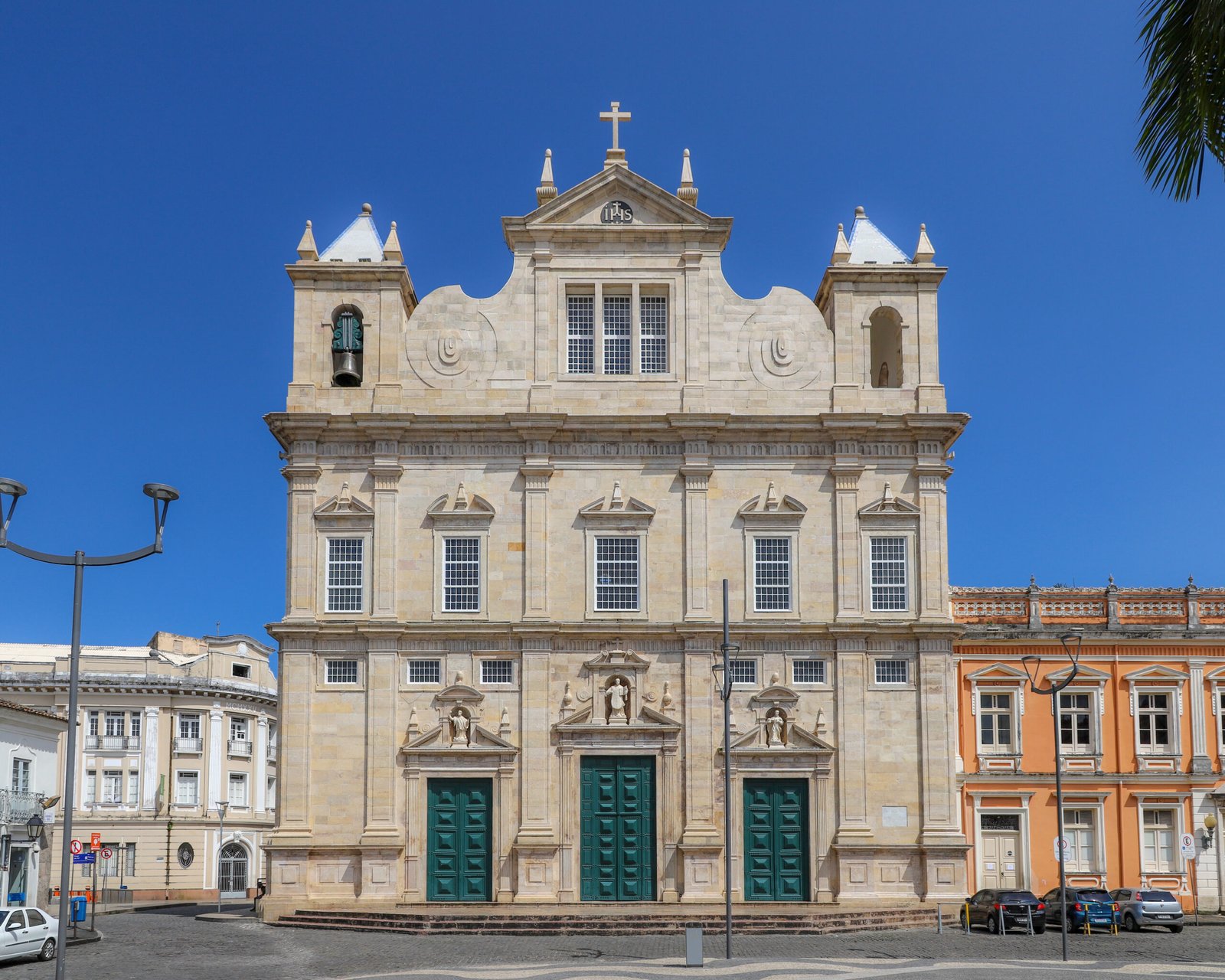
The Primatial Cathedral Basilica of São Salvador, on the Terreiro de Jesus in the heart of the Pelourinho, did not begin as a cathedral but as the church of the Jesuit college, the Jesuits being the first to arrive with the governor Tomé de Sousa in 1549. It is the fourth church raised on the same site; the building seen today was begun in 1657 — the foundation stone laid in July — and consecrated on 27 June 1672 (some English-language sources write 1654, but that is an error: that is the date of the final expulsion of the Dutch from Pernambuco, which unblocked the work). It became a cathedral in two stages: after the expulsion of the Jesuits in 1759, the church was transferred to the archbishopric by royal decree of 1765 and served as the seat from then on; then, on 7 August 1933, the old Sé Primatial — the ancient cathedral, seat of the first diocese of Brazil, erected in 1551 — was demolished to widen a tramway line, and the former Jesuit church became the definitive cathedral. The see is primatial: the archbishop of São Salvador is Primate of Brazil. It was raised to a minor basilica in 1922. The style is Mannerist, and the facade — like the whole fabric — is of lioz stone imported from Portugal; the sources report that the main stone arrived already worked from the Kingdom, as ships’ ballast. Inside, beneath the high altar, rests Mem de Sá, third governor general of Brazil, who died in 1573; thirteen altars, a gilded barrel vault centred on a great medallion with the Jesuit monogram IHS, and a sacristy faced to half height with Portuguese azulejos. It is the last surviving building of the Colégio dos Jesuítas, cradle of Jesuit education in Brazil; after the expulsion it housed various uses and, in 1833, the first medical school in Brazil. The cathedral is not inscribed by UNESCO in its own right: the official description names it among the major monuments of the Historic Centre of Salvador de Bahia, first capital of Brazil and a crossroads of European, African and Amerindian cultures, inscribed in 1985 under criteria (iv) and (vi).
About the Cathedral
The Cathedral Basilica of Salvador, on the Terreiro de Jesus in the Pelourinho, was built as the church of the Jesuit College — the fourth church on the site — between 1657 and 1672, of lioz limestone shipped from Portugal. It became the archiepiscopal cathedral after the Jesuits were expelled (ceded to the see in 1765), and the definitive one in 1933, when the old Sé Primacial was demolished for a tramway. Seat of the Primate of Brazil and a minor basilica since 1922, it holds the tomb of governor-general Mem de Sá. It stands within the Historic Centre of Salvador de Bahia, a UNESCO World Heritage Site since 1985.
Key facts
- 1549–1550: the Jesuits arrive in Salvador and found the college whose church this became; the fourth church rose on the site
- 1657–1672: the present building constructed, in lioz limestone from Portugal; consecrated 27 June 1672
- 1765: after the Jesuits’ expulsion (1759), the church is ceded to the archbishopric and serves as cathedral
- 1922: raised to the rank of minor basilica
- 7 August 1933: the old Sé Primacial demolished for a tram line, making this the definitive cathedral
- Under the high altar: the tomb of Mem de Sá, third governor-general of Brazil (d. 1573)
- 1985: Historic Centre of Salvador de Bahia inscribed by UNESCO, criteria (iv)(vi)
History
Salvador was Brazil’s first capital, and its cathedral carries that primacy twice over. The see was the first diocese of Brazil, erected in 1551, and its archbishop is Primate of Brazil; but the building that holds the title today was not the original cathedral. It was the church of the Jesuit College, begun in 1657 and consecrated in 1672, the fourth church raised on the Terreiro de Jesus since the Jesuits landed with the first governor-general in 1549. Its stone came from Portugal — lioz limestone, carved in the Kingdom and shipped as ballast — and its facade still carries the Jesuit IHS monogram.
The Jesuits were expelled from Portugal’s empire in 1759, and their church was handed to the archbishopric in 1765, serving from then as the cathedral. The old Sé Primacial, the ancient seat of the first diocese, survived until 7 August 1933, when it was pulled down to widen a tram route — and the former Jesuit church became the sole and definitive cathedral. Along the way the college buildings held, among other things, Brazil’s first medical school, opened here in 1833.
What you see
A Mannerist facade of pale Portuguese lioz limestone, twin bell towers flush with the wall, a scrolled pediment and the IHS monogram in the tympanum — the mark of the Jesuit builders. Inside is a single wide nave under a barrel-vaulted, gilded wooden ceiling whose centre is a great radiant medallion bearing the same IHS. Thirteen altars line the church; the sacristy is sheathed to mid-height in painted Portuguese azulejos, beneath jacarandá cabinetry and polychrome-marble altars. Beneath the high altar lies Mem de Sá, the governor-general who pushed the earlier building forward before his death in 1573.
Practical information
- Opening hours: open to visitors most days outside services; check current times before visiting
- Admission: a small entry fee is charged (subject to change)
- Location: Largo Terreiro de Jesus, Pelourinho, Centro Histórico, Salvador, Bahia, Brazil
- Status: active cathedral, seat of the Archdiocese of São Salvador da Bahia, Primate of Brazil
Getting there
The cathedral fronts the Terreiro de Jesus in the upper town (Cidade Alta), at the heart of the Pelourinho; the Elevador Lacerda and the Mercado Modelo lie downhill on the bayfront. GPS: 12.9726°S, 38.5105°W.
Nearby
- Historic Centre of Salvador de Bahia — the UNESCO-listed Pelourinho, first capital of Brazil and a meeting point of European, African and Amerindian cultures
- Church and Convent of São Francisco — the gold-drenched Baroque church a short walk across the historic core
- Terreiro de Jesus and Largo do Pelourinho — the monumental squares around the cathedral
Sources
- IPHAN — Instituto do Patrimônio Histórico e Artístico Nacional (heritage listing)
- UNESCO World Heritage Centre — “Historic Centre of Salvador de Bahia” (ref. 309)
- Prefeitura de Salvador — official municipal record for the Catedral Basílica
- GCatholic and Catholic-Hierarchy — basilica title and the see’s foundation dates
- Wikipedia (English and Portuguese) — “Cathedral Basilica of Salvador” / “Old Cathedral of Salvador”, used as a map and cross-checked
Find it on the map
See this place and what’s around it →📷 Become a Cultural Heritage Online photographer
Share your photos of places: they stay published under your name as the author. The more they're seen, the more you get noticed — and soon a contest will reward the most appreciated photos.
Log in or sign up free to add a photo