
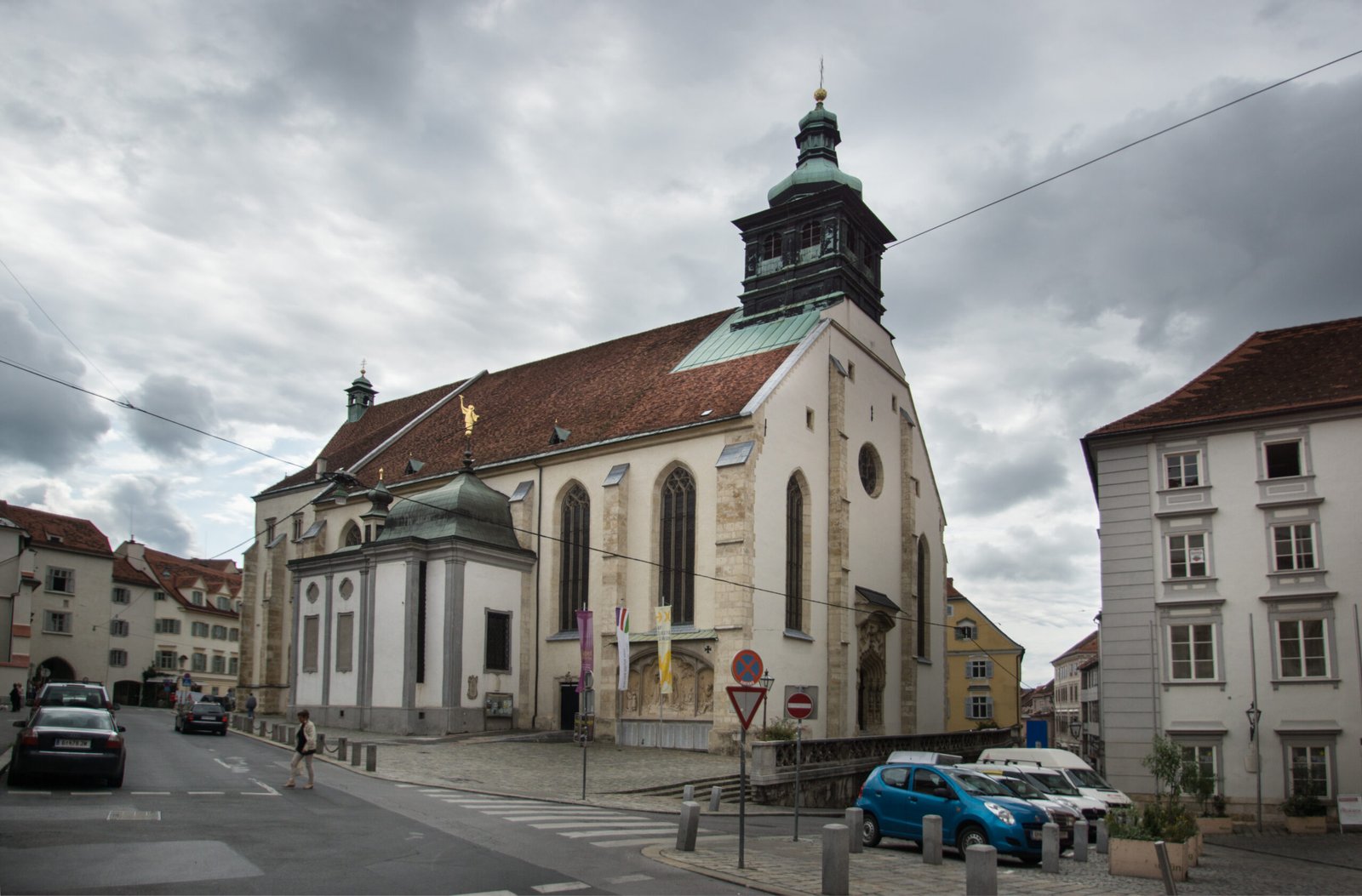
The Domkirche zum Heiligen Ägydius, the cathedral of Graz dedicated to Saint Giles, was built from 1438 as the court and parish church of the emperor Frederick III, in late Gothic forms; the sources give it as finished in 1462 or around 1464, and attribute the design «by supposition» to the Swabian Hans Niesenberger, without certainty. The emperor’s personal motto, the sequence of vowels AEIOU, recurs several times on the building; many later readings of it exist, but none is carved there as an explanation, so only its presence is recorded here. It became a cathedral in 1786 when — as part of Joseph II’s reforms — the episcopal see was moved from Seckau to Graz. Its most famous feature is outside, on the south wall, under a small canopy: the Landplagenbild, or Gottesplagenbild, a votive fresco showing the three plagues that fell on Styria in the year 1480 — the Turkish invasion, the plague of locusts and the pestilence. Note the date: 1480 is the year of the calamities, not of the fresco, which the sources place around 1485 and attribute, cautiously, to Thomas von Villach. At the entrance to the choir stand two wedding chests of Paola Gonzaga, daughter of Ludovico II of Mantua, inlaid with ivory and bone and later reused by the Jesuits as reliquaries; an attribution of the reliefs to Andrea Mantegna circulates in the guidebooks, but is not documented, and is not asserted here. The Baroque high altar is the work of Georg Kraxner (1730–33), with sculpture by Francesco Robba and Johann Jakob Schoy. Beside the cathedral stands the Mausoleum of the emperor Ferdinand II, with its domes. The cathedral is not inscribed by UNESCO in its own right: it lies within the boundary of the Historic Centre of Graz, inscribed in 1999 — extended in 2010 to include Eggenberg Castle — under criteria (ii) and (iv).
About the Cathedral
Graz Cathedral (Domkirche zum Heiligen Ägydius), dedicated to St. Giles, was built from 1438 as the late-Gothic court and parish church of Emperor Frederick III, whose AEIOU device still appears across the building. It became a cathedral only in 1786, when the bishop’s seat moved from Seckau to Graz. Its south exterior wall keeps the Landplagenbild, a votive fresco of the three plagues that struck Styria in 1480, and inside are the Gonzaga bridal chests and a Baroque high altar. The cathedral stands within the Historic Centre of Graz, a UNESCO World Heritage Site since 1999.
Key facts
- 1438: construction begins as the court church of Emperor Frederick III; completed 1462/64
- c. 1485: the Landplagenbild fresco painted on the south exterior wall, recording the three calamities of 1480 — the Turkish invasion, locusts and plague
- 17th century: Baroque chapels added; the Gonzaga bridal chests repurposed by the Jesuits as reliquaries
- 1730–33: the Baroque high altar by Georg Kraxner, with sculpture by Robba and Schoy
- 1786: becomes a cathedral when the episcopal seat is moved from Seckau to Graz under Joseph II’s reforms
- 1999: Historic Centre of Graz inscribed by UNESCO (extended 2010 with Schloss Eggenberg), criteria (ii)(iv)
History
Graz Cathedral began not as a cathedral but as an emperor’s church. Frederick III raised it from 1438, beside his castle, as the court and parish church of St. Giles, in the sober late-Gothic of the mid-15th century; sources put its completion at 1462 or around 1464, and only tentatively name the Swabian Hans Niesenberger as its master builder. Frederick left his mark literally, scattering his enigmatic AEIOU device across the fabric. For three centuries it remained a court and, under the Jesuits after 1577, a university church; it became the cathedral of the diocese of Graz-Seckau only in 1786, when Joseph II’s reforms moved the bishop’s seat down from Seckau.
The building’s most arresting survival is outside. On the south wall, under a small canopy, a weather-worn fresco — the Landplagenbild — records the three calamities that fell on Styria in the disastrous year 1480: the Turkish invasion, a plague of locusts, and the plague itself. It was painted afterwards, around 1485, as a votive thanksgiving, and is attributed to Thomas von Villach. Inside, the Baroque age added chapels and Georg Kraxner’s marble high altar, and set two ivory-inlaid bridal chests of Paola Gonzaga, brought from Mantua, to new use as reliquaries.
What you see
A tall white late-Gothic church under a single copper-domed tower, its Gothic tracery windows and pointed portal facing the Burggasse; the domed Mausoleum of Ferdinand II rises immediately alongside. The one exterior painting to seek out is the faded Landplagenbild by the south portal, sheltered under its ledge — a rare open-air medieval fresco of catastrophe. Within are the Baroque high altar by Kraxner, with sculpture by Robba and Schoy, and, at the entrance to the chancel, the two ornate ivory-and-bone chests of Paola Gonzaga, their reliefs illustrating Petrarch’s Triumphs.
Practical information
- Opening hours: open daily outside services; check current times before visiting
- Location: Burggasse 3, 8010 Graz, Austria — in the Innere Stadt, beside the Burg and the Mausoleum
- Status: active cathedral of the Diocese of Graz-Seckau
Getting there
The cathedral stands in the Innere Stadt at the foot of the Schlossberg, a few minutes’ walk from the Hauptplatz and the Uhrturm; Graz’s old town is compact and walkable. GPS: 47.0720°N, 15.4424°E.
Nearby
- Mausoleum of Ferdinand II — the Mannerist-Baroque imperial tomb with turquoise domes, directly beside the cathedral
- Historic Centre of Graz — the UNESCO-listed old town of Renaissance courtyards and the Schlossberg
- Schloss Eggenberg — the Baroque palace added to the UNESCO listing in 2010, on the city’s western edge
Sources
- Diocese of Graz-Seckau (graz-dom.graz-seckau.at) — official cathedral history, chapels, high altar and fresco
- Graz Tourismus — semi-official records on the Landplagenbild and the Gonzaga chests
- UNESCO World Heritage Centre — “City of Graz – Historic Centre and Schloss Eggenberg” (ref. 931)
- Wikipedia (English and German) — “Graz Cathedral”, used as a map and cross-checked
Find it on the map
See this place and what’s around it →📷 Become a Cultural Heritage Online photographer
Share your photos of places: they stay published under your name as the author. The more they're seen, the more you get noticed — and soon a contest will reward the most appreciated photos.
Log in or sign up free to add a photo