
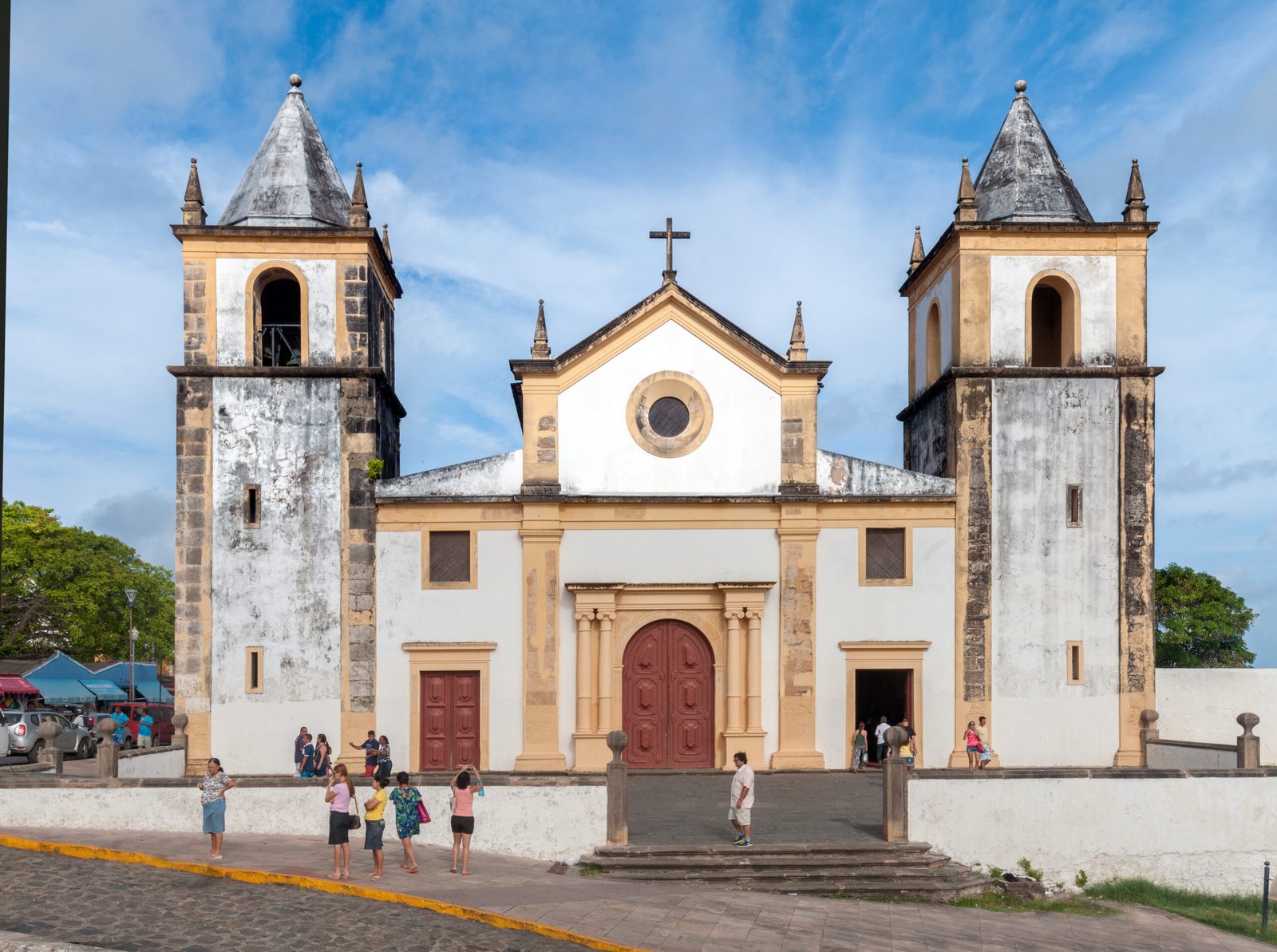
Olinda Cathedral, the Igreja da Sé, dedicated to the Saviour of the World, crowns the Alto da Sé, the highest point of the historic centre. It is the seat of the Archdiocese of Olinda and Recife — a cathedral, not a basilica: no authoritative source gives it that title.
The first chapel, built of taipa (rammed earth), went up between 1537 and 1540. In 1584 it was replaced by a masonry church.
During the Dutch occupation of Pernambuco the church was desecrated, and its ruin completed by the fire that consumed part of Olinda in 1631. It was then rebuilt after the Dutch were expelled.
It became a cathedral in 1676, with the creation of the Diocese of Olinda.
The cathedral’s current appearance is the result of a major restoration in 1974-83, carried out under the PCH programme by Fundarpe and overseen by IPHAN. That restoration removed the neo-Gothic and neo-Baroque reforms of the early twentieth century, returning the building toward its colonial style — the transitional style between Renaissance and Baroque known as Mannerism.
It is worth being precise here: the academic study documenting that restoration describes it as an interpretive reconstruction toward a “presumed” eighteenth-century appearance, based on nineteenth-century photographs and on comparisons with Portuguese churches, not as the recovery of a documented original.
Its position is its fortune: from the forecourt of the Alto da Sé the view runs over Olinda’s red rooftops, along the coast, and as far as the Recife skyline. In the words of the UNESCO description, it looks over the town “nestled in a mass of green, bathed in tropical light, with its sandy beach and the ocean below.”
The cathedral is named explicitly in the UNESCO citation (“a Catedral Alto da Sé”) as one of the notable buildings of the Historic Centre of the Town of Olinda, inscribed in 1982 under criteria (ii) and (iv).
About the Cathedral
Olinda Cathedral, the Igreja da Sé, dedicated to the Saviour of the World, stands at the Alto da Sé, the highest point of the colonial town. Seat of the Archdiocese of Olinda and Recife, it grew from a 1537–1540 mud-walled chapel through a 1584 masonry church that the Dutch desecrated and fire ruined in 1631; rebuilt, it became a cathedral in 1676. A 1974–83 restoration stripped later additions to return it toward its colonial Mannerist appearance. Its hilltop forecourt commands the classic panorama over Olinda toward Recife. The cathedral is named in the UNESCO listing of the Historic Centre of Olinda (1982).
Key facts
- 1537–1540: first chapel built in taipa (rammed earth), dedicated to the Saviour of the World.
- 1584: replaced by a larger masonry church under the 3rd Bishop of Brazil.
- 1631: desecrated and ruined by fire during the Dutch occupation of Pernambuco.
- 1676: elevated to cathedral with the creation of the Diocese of Olinda.
- 1974–1983: IPHAN-supervised restoration returns the church toward its colonial Mannerist appearance.
- 1982: Historic Centre of the Town of Olinda inscribed by UNESCO, criteria (ii)(iv), with the cathedral named in the citation.
History
Olinda’s cathedral is as old as Portuguese Pernambuco. A chapel of rammed earth went up on the hilltop between 1537 and 1540, dedicated to Christ as Saviour of the World; a masonry church replaced it in 1584. Then came the Dutch: during their occupation of Pernambuco the church was desecrated, and the fire that swept Olinda in 1631 completed its ruin. Rebuilt after the Dutch were expelled, it was raised to cathedral in 1676 when the Diocese of Olinda was created, its first bishop installed the following year.
The building the visitor sees is largely a 20th-century recovery. Eclectic neogothic and neobaroque reforms of the early 1900s were later judged valueless, and between 1974 and 1983 a restoration under the federal PCH programme — Fundarpe, overseen by IPHAN — stripped them away to expose the colonial fabric. Scholars are careful to note that this was an interpretive reconstruction toward a presumed 18th-century state, not the retrieval of a documented original; what stands is a considered return to the church’s colonial, Mannerist character.
What you see
A whitewashed colonial facade of austere lines: a triangular pediment topped by a cross, a large circular rose window at its centre, a Roman-arched portal, and two flanking bell towers under grey conical spires. Inside, three naves run beneath the plain colonial roof. But the cathedral’s greatest asset is outside the doors — the forecourt of the Alto da Sé, the town’s belvedere, from which the red-tiled roofs of Olinda fall away toward the coast and the skyline of Recife on the horizon.
Practical information
- Opening hours: open regularly outside services; Sunday Mass in the morning — check current times before visiting.
- Location: Alto da Sé, Carmo, Olinda, Pernambuco, Brazil.
- Status: active cathedral, seat of the Archdiocese of Olinda and Recife.
Getting there
The cathedral crowns the Alto da Sé at the top of Olinda’s historic centre, a steep walk up through the colonial streets; Olinda adjoins Recife, about 7 km from its centre. GPS: 8.0138°S, 34.8491°W.
Nearby
- Historic Centre of the Town of Olinda — the UNESCO-listed colonial town of churches, convents and painted houses.
- Alto da Sé belvedere — the panoramic terrace beside the cathedral, over the coast toward Recife.
- Monastery of São Bento — the Benedictine monastery with its celebrated gilded Baroque church, downhill in the old town.
Sources
- Arquidiocese de Olinda e Recife — official cathedral history and status.
- UNESCO World Heritage Centre — “Historic Centre of the Town of Olinda” (ref. 189).
- IPHAN — national heritage listing and the “Rota do Patrimônio” study of the Igreja da Sé.
- SciELO — academic study of the 1974–83 PCH restoration.
- Wikipedia (English and Portuguese) — “Holy Saviour of the World Cathedral, Olinda”, used as a map and cross-checked.
Find it on the map
See this place and what’s around it →📷 Become a Cultural Heritage Online photographer
Share your photos of places: they stay published under your name as the author. The more they're seen, the more you get noticed — and soon a contest will reward the most appreciated photos.
Log in or sign up free to add a photo