
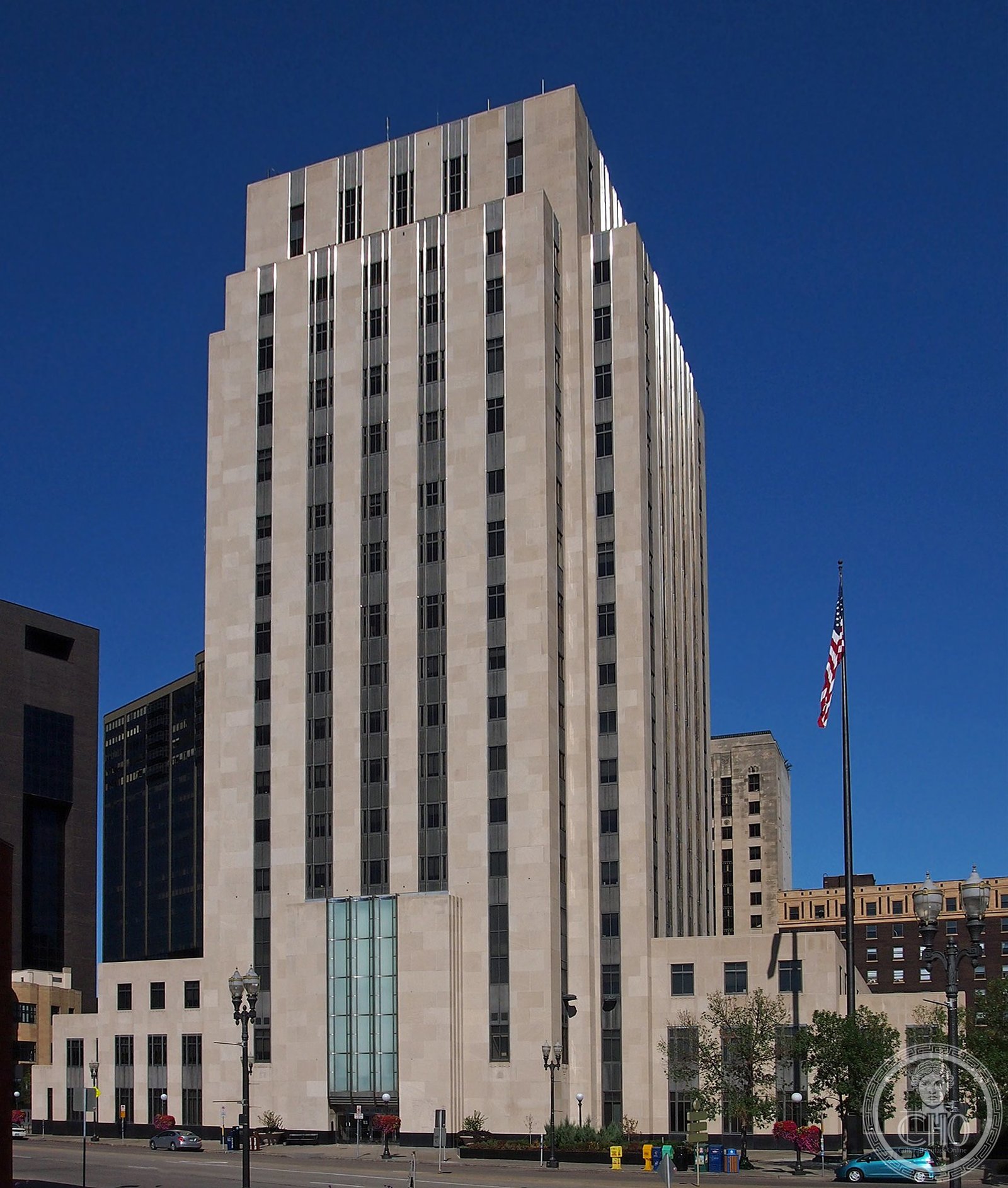
A $4 million Great Depression-era commission that came in under budget — and delivered one of the finest Art Deco civic buildings in the Midwest, crowned inside by a 60-ton white onyx sculpture.
At a glance
The Saint Paul City Hall and Ramsey County Courthouse, completed in 1932, is one of the most distinguished Art Deco civic buildings in the American Midwest. Built during the Great Depression when falling prices left its $4 million budget underspent, the result was a 20-story tower clad in Indiana limestone with higher-quality materials and craftsmanship than the original specifications required. The architects — Thomas Ellerbe & Company of Saint Paul working with Chicago’s Holabird & Root — drew on Finnish architect Eliel Saarinen’s verticalist approach to produce the “American Perpendicular” style. Inside, Memorial Hall is organized around Carl Milles’s 60-ton, 38-foot-tall white onyx “Vision of Peace” — a slowly rotating sculpture that has anchored the building’s civic identity since 1936. Listed on the National Register of Historic Places in 1983.
Key facts
- Completed: 1932
- Architects: Thomas Ellerbe & Company; Holabird & Root (Chicago)
- Style: Art Deco, “American Perpendicular” exterior; Zigzag Moderne interior
- Height: 20 stories
- Address: 15 Kellogg Boulevard West, Saint Paul, Minnesota
- Budget: $4 million (underspent — higher quality materials than specified due to Depression-era pricing)
- NRHP: February 11, 1983 (ref. 83000940)
History
Construction proceeded during the Great Depression, when falling prices kept the project under budget while actually raising its quality above specification. The architects drew from Eliel Saarinen’s influential 1922 submission for the Chicago Tribune Tower competition — a design that had shown American architects a way to organize tall building setbacks that was neither Gothic nor Classical but purely geometric and vertical. Thomas Ellerbe and Holabird & Root translated that influence into a Minnesotan civic structure: restrained, smooth, authoritative, and scaled to Saint Paul’s river-bluff downtown rather than to Chicago’s Loop.
The sculpture program was executed by several major figures. Lee Lawrie — who had worked on the Nebraska State Capitol and the entrance sculptures for 30 Rockefeller Plaza — carved the relief sculptures above the Fourth Street entrance and flanking the Kellogg Boulevard entrance. In 1936, the centerpiece of Memorial Hall arrived: the Swedish sculptor Carl Milles delivered a 60-ton, 38-foot-tall figure carved in white onyx, originally titled “Indian God of Peace” and later renamed “Vision of Peace.” The piece rotates slowly, presenting its geometry differently throughout the day. Additional notable features include woodwork from 23 different species of wood, five types of imported marble, murals by John W. Norton, and six bronze elevator doors by Albert Stewart.
What you see
The exterior is smooth Indiana limestone, its vertical window registers connected by flat black spandrels that eliminate all horizontal interruption between the ground and the crown. The composition produces an upward movement from base to setback to crown that is the defining gesture of the American Perpendicular mode — restrained where the Chicago Tribune Tower’s Gothic detailing had been elaborate, but equally committed to the idea that a tall building should read as one continuous vertical force rather than a stack of horizontal floors.
The interior Zigzag Moderne design draws on the 1925 Paris Exposition Internationale des Arts Décoratifs that named the movement. Memorial Hall’s white marble floor leads between three-story black marble piers to a gold-leaf ceiling — a total interior environment rather than a decorated room. The hall is designed around the “Vision of Peace,” whose 38-foot mass reads at different scales as visitors move through the space. Woodwork across the building uses 23 species of wood; five types of imported marble are deployed in the public corridors.
Practical information
- Open to the public during civic and court business hours; no admission charge
- Memorial Hall with the Vision of Peace is on the ground level, directly accessible from the main entrance
- Allow 30–45 minutes for the building’s public spaces
- The building is an active government facility; building security is standard courthouse level
- Photography permitted in public areas
Getting there
15 Kellogg Boulevard West is in downtown Saint Paul at the corner of Fourth Street and Kellogg Boulevard, adjacent to the Wabasha Street Bridge approach. Metro Transit buses serve the Kellogg/Wabasha stop. By light rail, the Green Line connects downtown Minneapolis to downtown Saint Paul; Central Station is four blocks north. Minneapolis-Saint Paul International Airport is 12 miles southwest. GPS: 44.9440°N, 93.0936°W.
Nearby
- Landmark Center (1902) — one block north, the former federal courthouse now operating as a cultural center and one of Saint Paul’s best Romanesque Revival landmarks
- Cathedral of Saint Paul — ten minutes on foot uphill, a Baroque Revival cathedral completed in 1915
- Mississippi River & Wabasha Street Caves — two blocks south, accessible via the Wabasha Street Bridge and caves trail
Sources
- Wikipedia: Saint Paul City Hall and Ramsey County Courthouse
- Minnesota Historical Society: St. Paul City Hall-Ramsey County Courthouse
- Historic American Buildings Survey, Library of Congress (September 9, 1981)
- MNopedia: St. Paul City Hall and Ramsey County Courthouse (Minnesota Encyclopedia)
- National Register of Historic Places: ref. 83000940 (February 11, 1983)
Find it on the map
See this place and what’s around it →Record researched and written by Luigi De Marchi for Cultural Heritage Online, 2026.
📷 Become a Cultural Heritage Online photographer
Share your photos of places: they stay published under your name as the author. The more they're seen, the more you get noticed — and soon a contest will reward the most appreciated photos.
Log in or sign up free to add a photoIs this page about you?
This page is read by travellers and heritage enthusiasts who find it on Google. Tell us how you are connected to this place and we will take it from there.