

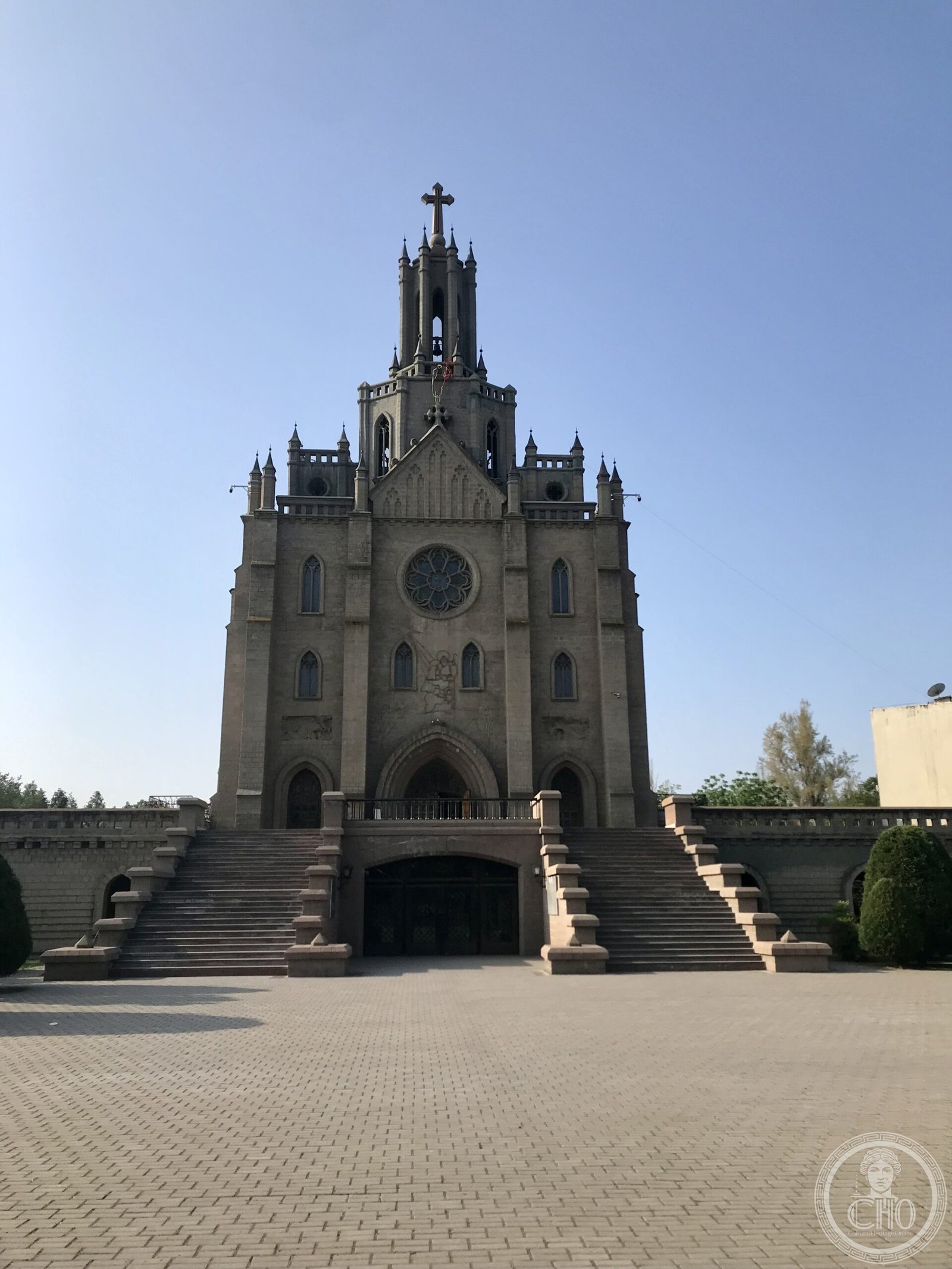
In Tashkent, in Uzbekistan, the Cathedral of the Most Sacred Heart of Jesus, locally known as the “Polish church,” was begun in 1912 under the Tsarist Russian empire, in the Turkestan Governorate-General, on the initiative of the priest Justyn Bonaventura Pranaitis, serving a Catholic community made up of Poles, Lithuanians, Germans, French and other Europeans linked to the Tsarist military presence, as well as exiles, prisoners and fugitives who had arrived in Turkestan. The idea, often repeated, that these were specifically Polish political exiles deported after a particular uprising finds no direct confirmation in any source consulted, and should therefore be treated as plausible but undocumented. The work was carried out first by Catholic soldiers stationed in Tashkent, then by prisoners of war, among them qualified engineers, sculptors and stonemasons; the architect was the Pole Ludwik Panczakiewicz (whose spelling varies among sources). On the death of Pranaitis, in 1917, the work continued briefly under the priest Boleslav Ruthenis, before stopping for lack of funds with the Bolshevik revolution. In neo-Gothic style, in red brick, with pointed arches, stained-glass windows and a central spire, the building includes, according to tourist sources, a crypt-chapel, a hall dedicated to Saint Anthony of Padua and a library named after Pope John Paul II; no precise capacity, however, is documented. On the closure in Soviet times sources diverge, placing it in 1917 or in 1925, with the building used, depending on the source, as a warehouse, a dormitory or even a hospital. In 1976 the Soviet authorities carried out a structural restoration, transferring it to the Ministry of Culture of the Uzbek SSR, and in 1981 it was declared a historical-architectural monument of the country. Informal religious use resumed, according to one source, in 1991, with the official transfer to the Catholic community in 1992. A complete restoration, carried out between 1993 and 2000 by the architect Sergey Adamov and the engineer Alexander Ponomarev, brought new stained glass, marble and granite cladding and a 26-stop organ, a gift from a parish in Bonn, Germany. The cathedral was finally consecrated on 22 October 2000 by Archbishop Marian Oleś, apostolic nuncio for Kazakhstan and central Asia — eighty-eight years after the laying of the first stone. Uzbekistan has no diocese in the proper sense: the country’s Catholic jurisdiction is the Apostolic Administration of Uzbekistan, established as a mission sui iuris on 29 September 1997, separated from the then Apostolic Administration of Kazakhstan, and promoted to a full apostolic administration on 1 April 2005, with this cathedral as its seat; the current apostolic administrator is Monsignor Jerzy Maculewicz, a Conventual Franciscan, in office since 2005. The Uzbek Catholic community numbers, according to 2022 data, about 4,058 faithful out of a national population of more than 35 million, spread across five parishes and two missions, an extremely small minority in a majority-Muslim country.
About Sacred Heart Cathedral
In Tashkent, Uzbekistan, the Cathedral of the Most Sacred Heart of Jesus, locally known as the “Polish church,” began construction in 1912 under Tsarist Russian rule in the Turkestan Governorate-General, initiated by priest Justyn Bonaventura Pranaitis for a Catholic community of Poles, Lithuanians, Germans, French and other Europeans tied to the tsarist military presence, along with exiles, prisoners, and refugees who had arrived in Turkestan. Work was carried out first by Catholic soldiers stationed in Tashkent, then by prisoners of war, including skilled engineers, sculptors and stonemasons; the architect was Polish-born Ludwik Panczakiewicz.
Key facts
- 1912: construction begins under Tsarist rule, halted by the Bolshevik Revolution.
- 1976: Soviet authorities structurally restore the building, transferring it to the Ministry of Culture.
- 1992: officially returned to the Catholic community.
- 1993-2000: full restoration, new stained glass and a German-donated organ installed.
- 22 October 2000: consecrated as a cathedral, 88 years after its first stone.
- 1 April 2005: becomes seat of the Apostolic Administration of Uzbekistan.
History
Begun by soldiers and finished by prisoners of war under the last years of Tsarist rule, this cathedral sat unfinished through revolution and closed through most of the Soviet era, repurposed as a warehouse or dormitory before a 1976 Soviet restoration ironically preserved it as a protected monument. Returned to the Catholic community in 1992 and fully restored by 2000, it was finally consecrated as a cathedral 88 years after construction began, becoming the seat of a Catholic community that today numbers barely 4,000 in a nation of 35 million.
What you see
A Gothic Revival cathedral of red brick rises with pointed arches, stained-glass windows, and a central spire, its interior lined in marble and granite from a 1990s restoration. Inside stand a crypt chapel, a hall dedicated to Saint Anthony of Padua, and a 26-stop organ donated by a parish in Bonn, Germany.
Practical information
- Opening hours: generally open daily outside services; check current hours before visiting.
- Address: Makhtumkuli St. 80/1, Tashkent 100047, Uzbekistan (sources vary; verify locally before visiting).
Getting there
The cathedral stands in central Tashkent. GPS: 41°18′20″N, 69°17′45″E.
Nearby
- Central Tashkent — the historic administrative core of the Uzbek capital surrounding the cathedral.
Sources
- Wikipedia — “Sacred Heart Cathedral, Tashkent” and “Apostolic Administration of Uzbekistan” (en.wikipedia.org).
- Catholics in Tashkent — official parish website (catholics-in-tashkent.org).
- GCatholic.org — Cathedral of the Sacred Heart of Jesus and Apostolic Administration of Uzbekistan listings.
Find it on the map
See this place and what’s around it →📷 Become a Cultural Heritage Online photographer
Share your photos of places: they stay published under your name as the author. The more they're seen, the more you get noticed — and soon a contest will reward the most appreciated photos.
Log in or sign up free to add a photo