

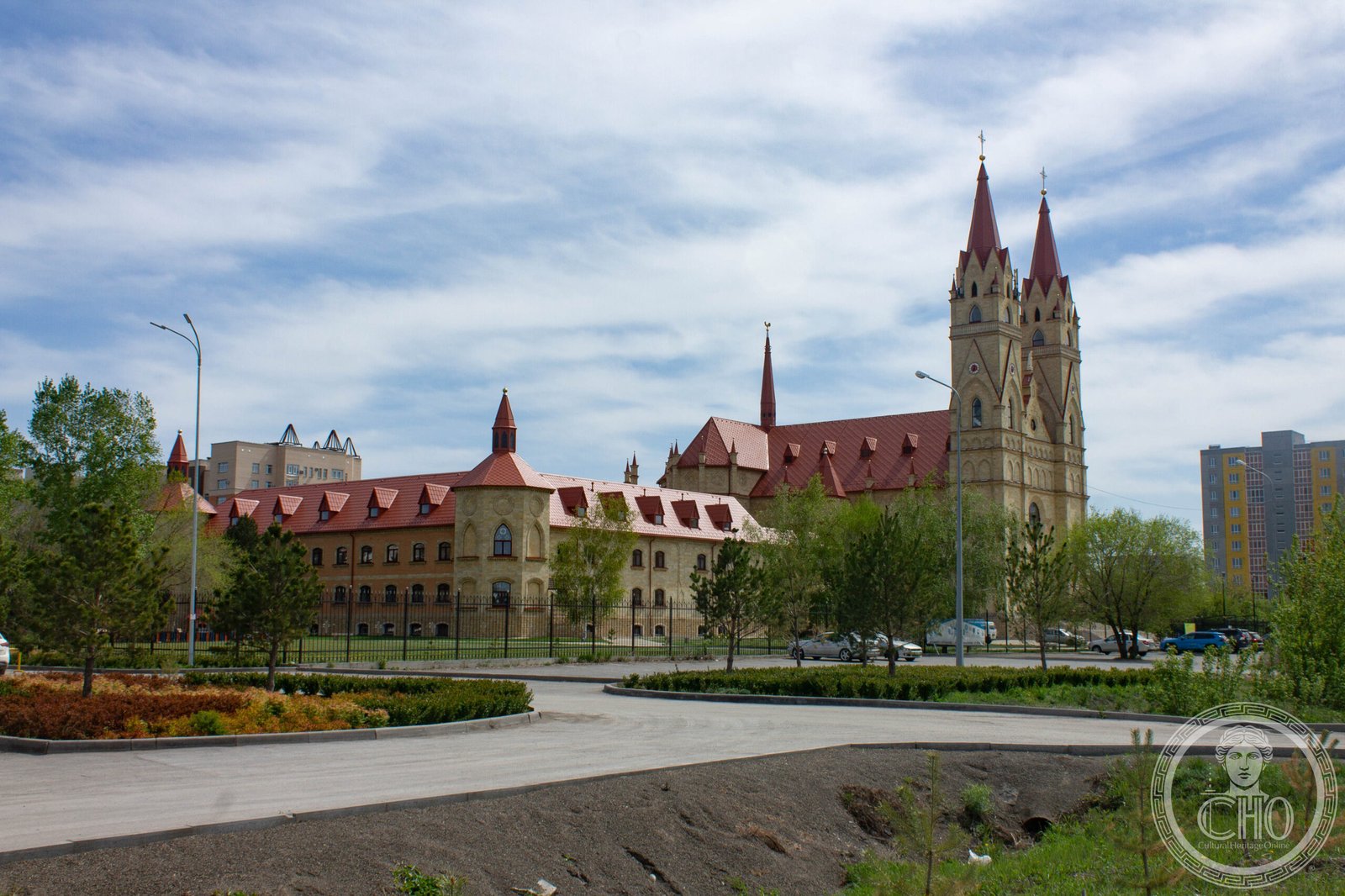
In Karaganda, in Kazakhstan, the Catholic presence has its roots in Stalin’s deportation of the Volga Germans. It was ordered on 28 August 1941, after the German invasion of the USSR, and carried out between 3 and 20 September of that year, moving about 950,000 people to Siberia and Kazakhstan. Its other root is the forced labour system of Karlag (the Karaganda corrective labour camp), active from 1931 to 1959, which by various estimates held between 800,000 and over a million people of more than a hundred different ethnic groups, thousands of them Polish, German, Ukrainian, Lithuanian and Belarusian Catholics. The descendants of the deportees and the survivors of the camps, who stayed on in the region after their release, formed the core of the local Catholic community on which the diocese was later founded. The minor basilica of Saint Joseph, the diocese’s original seat, had become too small. So Bishop Jan Pawel Lenga obtained from the city authorities, on 13 May 2003 — a date deliberately chosen to fall on the anniversary of the apparitions of Fatima — the land on which the present cathedral stands. The auxiliary bishop Athanasius Schneider, then at Karaganda until his move to Astana in 2011, is named by the sources as the figure most directly responsible for the building and for raising the money, which came from international donations with no single large documented donor. It was he, too, who commissioned for the crypt a cycle of fourteen eucharistic paintings from the Italian artist Rodolfo Papa. On the architect’s name the sources disagree: the German Wikipedia gives Karl-Maria Ruf, who drew on Cologne Cathedral and the proportions of Chartres, and the English Wikipedia gives Vladimir Sergeyev, with no more authoritative source to settle it. Built between 2003/2004 and 2012, the cathedral was consecrated on 9 September 2012 by Cardinal Angelo Sodano. It is neo-Gothic, with brick walls faced in travertine, two twin bell towers and a white marble statue of Our Lady of Fatima between the spires. It is often described as the largest Catholic cathedral in Central Asia, a claim widely repeated but not confirmed by independent sources of the first rank. It also holds what the sources describe as the largest organ in Kazakhstan, built by the Austrian firm Pflüger Orgelbau. The apostolic administration of Kazakhstan was set up on 13 April 1991, separated from the diocese of Vladivostok, and promoted to the diocese of Karaganda on 7 July 1999, later ceding territory to the apostolic administrations of Astana, Almaty and Atyrau. Lenga, bishop from 1999 to 2011, was followed by Janusz Wieslaw Kaleta (2011-2014) and, since 2015, by the present bishop Adelio Dell’Oro. On 11 September 2016 the cathedral hosted the first beatification ever celebrated in Kazakhstan, that of Blessed Wladyslaw Bukowinski, a Polish priest who survived more than thirteen years in the Soviet camps and then stayed in Kazakhstan for the rest of his life; the mass was led by Cardinal Angelo Amato on behalf of Pope Francis. Blessed Oleksiy Zarytsky, a Ukrainian Greek Catholic priest who died in the camp of Dolinka, near Karaganda, in 1963, was instead beatified at Lviv in 2001, as a member of a rite other than the Latin one of this cathedral. In September 2025 the diocesan phase of the beatification cause of the laywoman Gertrude Detzel closed, under Bishop Dell’Oro. On his apostolic journey to Kazakhstan in September 2022, Pope Francis did not go to Karaganda: his meeting with the bishops was held in the Cathedral of Our Lady of Perpetual Help in Astana, a different building — though in his address to the bishops he named Bukowinski, Zarytsky and Gertrude Detzel, honouring from a distance the history of persecution bound up with this community.
About the Cathedral of Our Lady of Fatima
In Karaganda, Kazakhstan, the Catholic presence traces back to the Stalin-era deportation of Volga Germans, ordered on 28 August 1941 and carried out between 3 and 20 September of that year, moving roughly 950,000 people to Siberia and Kazakhstan, and to the Karlag forced-labor camp system, active from 1931 to 1959, which by various estimates held between 800,000 and over a million people of more than a hundred ethnicities, including thousands of Polish, German, Ukrainian, Lithuanian, and Belarusian Catholics. Descendants of deportees and camp survivors who remained in the region formed the basis of the local Catholic community that later founded the diocese.
Key facts
- 13 May 2003: land granted for the cathedral, chosen to mark the Fatima apparitions’ anniversary.
- 9 September 2012: consecrated by Cardinal Angelo Sodano.
- Widely described, though not independently verified, as the largest Catholic cathedral in Central Asia.
- 11 September 2016: hosts Kazakhstan’s first-ever beatification, of Blessed Władysław Bukowiński.
- Houses Kazakhstan’s largest organ, built by the Austrian firm Pflüger Orgelbau.
- September 2022: Pope Francis visits Kazakhstan but not this cathedral, while naming its associated martyrs in a speech to bishops.
History
Built by the descendants of people deported to Soviet Kazakhstan and imprisoned in the Karlag gulag, this cathedral stands as a monument raised by survivors’ grandchildren rather than by any colonial or state power. Its land was granted on the anniversary of the Fatima apparitions, and in 2016 it hosted Kazakhstan’s first-ever beatification — that of a Polish priest who survived over a decade in Soviet camps and chose to stay in the country for the rest of his life.
What you see
A neo-Gothic cathedral of brick clad in travertine rises with twin bell towers framing a white marble statue of Our Lady of Fatima, its crypt housing a 14-painting Eucharistic cycle by Italian artist Rodolfo Papa. Inside stands Kazakhstan’s largest organ, built by the Austrian firm Pflüger Orgelbau.
Practical information
- Opening hours: generally open daily outside services; check current hours before visiting.
- Address: Shakhtyorov Avenue 32, Yugo-Vostok district, Karaganda 100026, Kazakhstan.
Getting there
The cathedral stands on Shakhtyorov Avenue in Karaganda’s Yugo-Vostok district. GPS: 49°46′53″N, 73°08′05″E.
Nearby
- Minor Basilica of St. Joseph, Karaganda — the diocese’s original, smaller cathedral seat.
Sources
- Wikipedia — “Diocese of Karaganda” and “Cathedral of Our Lady of Fatima, Karaganda” (en.wikipedia.org).
- Agenzia Fides — “Mary in the Land of the Gulag” (fides.org).
- Catholic News Agency / EWTN — coverage of the 2012 consecration and 2016 beatification of Władysław Bukowiński.
- Vatican.va — Pope Francis, address to bishops, clergy and pastoral workers, Nur-Sultan, 15 September 2022.
Find it on the map
See this place and what’s around it →📷 Become a Cultural Heritage Online photographer
Share your photos of places: they stay published under your name as the author. The more they're seen, the more you get noticed — and soon a contest will reward the most appreciated photos.
Log in or sign up free to add a photo