
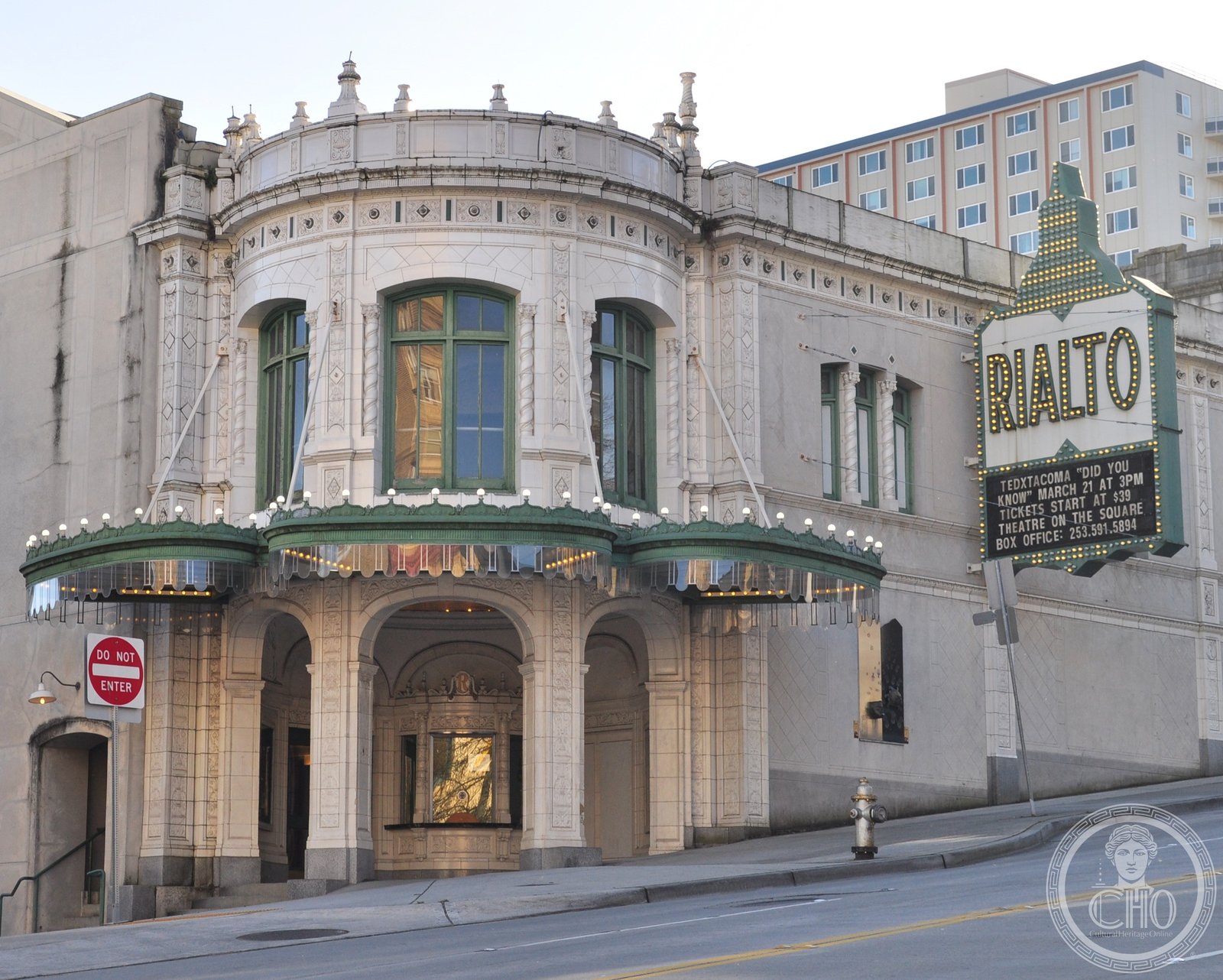
A compact Art Deco movie house in the lower Broadway district of downtown Tacoma, the Rialto Theatre represents the mid-twentieth-century commercial entertainment infrastructure of a port city that was building toward the economic expansion that World War II’s shipyard contracts would soon accelerate.
At a glance
Tacoma occupies a distinctive position on Puget Sound: it is the second largest city in Washington State and one of the oldest, its deep-water harbor having been selected as the western terminus of the Northern Pacific Railroad in the 1870s over the competing claims of Seattle — a choice that briefly made Tacoma appear to be the dominant city in the region before Seattle’s position on more favorable transcontinental routes reversed the advantage. By the 1930s, when the Rialto was built, Tacoma’s economy was defined by its port, its lumber and paper industries, and the industrial shipyards that would become central to the Pacific war effort after 1941. The Broadway Theater District that had grown up in the first decades of the twentieth century gave Tacoma a concentration of cinema and vaudeville houses in its downtown core; the Rialto was a smaller commercial cinema in this urban entertainment landscape, a neighborhood movie house in a district that had grander venues nearby.
Key facts
- Built: c.1930s
- Style: Art Deco / Streamline Moderne
- Location: Lower Broadway district, downtown Tacoma
- Context: Tacoma Broadway Theater Historic District
- GPS: 47.2533° N, −122.4435° W
History
Tacoma’s Broadway Theater District took shape in the first decades of the twentieth century, when B. Marcus Priteca — the Seattle-based architect who designed theaters for Alexander Pantages’s vaudeville circuit and for other Northwest entertainment operators — contributed several of its anchor buildings. The Pantages Theatre at 901 Broadway (1918) is the district’s most prominent surviving example, a grand Beaux Arts auditorium that has operated in recent decades as a performing arts venue under city stewardship. The Rialto is a smaller-scale complement to this formal entertainment infrastructure: an Art Deco storefront cinema of the sound-film era, designed for the commercial audience rather than the special-occasion audience that the Pantages served.
The geography of the district matters for understanding the Rialto’s original role. Broadway runs through the commercial core of downtown Tacoma toward the waterfront and the comaw Station to the northwest; the streets surrounding it in the 1930s contained the hotels, restaurants, and services that supported Tacoma’s working waterfront and the workers of the industrial economy. A cinema in this district served a daily audience of working people for whom the movies were the primary entertainment medium of the decade.
Tacoma’s twentieth-century urban history was shaped by the same forces that affected mid-sized industrial port cities across the country: the wartime shipyard boom of 1941-1945, the postwar suburban expansion, the decline of the downtown commercial core, and the later preservation and revitalization efforts that identified the Broadway Theater District as a historic resource worth protecting. The Rialto’s survival in the district connects its fabric to this broader arc.
What you see
The Rialto’s facade in the lower Broadway district is an Art Deco composition at the commercial vernacular scale: the building occupies a standard urban lot, its entrance distinguished by the marquee structure and the vertical name display that the movie house formula prescribed. The Streamline Moderne elements — the horizontal banding, the smooth surfaces, the aerodynamic ornamental vocabulary — place it in the decade between the early Deco of the late 1920s and the stripped modernism that wartime austerity imposed on American commercial architecture after 1941.
The building’s position in the Broadway Historic District places it in a context of architecturally varied commercial blocks, with the Pantages Theatre’s Beaux Arts bulk visible nearby. The scale difference between the two buildings illustrates the range of the entertainment economy: the grand auditorium for the occasional major performance and the neighborhood cinema for the nightly screening.
Practical information
- District walk: the Broadway Theater Historic District repays a walking tour; combine the Rialto with the Pantages Theatre (901 Broadway), the Tacoma Art Museum, and the Museum of Glass on the waterfront
- Time needed: allow 2-3 hours for the full Broadway District and waterfront walk
Getting there
Seattle-Tacoma International Airport (SEA) is approximately 20 miles north via Interstate 5; the Sounder commuter rail connects Tacoma’s Union Station (near the waterfront, roughly 0.5 miles from the Broadway District) to King Street Station in Seattle in approximately 60 minutes. Interstate 5 passes through central Tacoma; Exit 133 (City Center/Union Avenue) gives direct access to the downtown core. The SR-16 bridge over the Tacoma Narrows connects Tacoma to the Kitsap Peninsula and the Olympic Peninsula beyond.
Nearby
- Pantages Theatre — the 1918 B. Marcus Priteca Beaux Arts theater at 901 Broadway, the Broadway Theater District’s anchor building; now operating as a performing arts venue under Tacoma Arts Live stewardship; 0.3 miles northeast
- Tacoma Art Museum — regional art collection with significant holdings in Pacific Northwest, Californian, and international art; Glasswork collection; 1 mile northwest at 1701 Pacific Avenue
- Museum of Glass — Dale Chihuly’s glass art and the region’s studio glass tradition; outdoor bridge with suspended glass installations connecting to the Tacoma Art Museum; adjacent to the waterfront
- Commencement Bay — the deep-water port and Puget Sound waterfront; views across the Sound to the Olympic Mountains and southward to Mount Rainier on clear days; the Port of Tacoma (one of the largest container ports on the US West Coast) is visible from the waterfront promenade
Sources
- Broadway Theater District, Tacoma — historic district documentation
- Tacoma Landmarks Preservation Commission — downtown historic survey
- Washington State Department of Archaeology and Historic Preservation — statewide theater inventory
- HistoryLink.org — Tacoma economic and architectural history
- Wikimedia Commons — building image
Find it on the map
See this place and what’s around it →📷 Become a Cultural Heritage Online photographer
Share your photos of places: they stay published under your name as the author. The more they're seen, the more you get noticed — and soon a contest will reward the most appreciated photos.
Log in or sign up free to add a photoDo you manage this place?
This page is read by travellers and heritage enthusiasts who find it on Google. Keep it accurate — and make it work for you. Free for non-profit heritage institutions.