
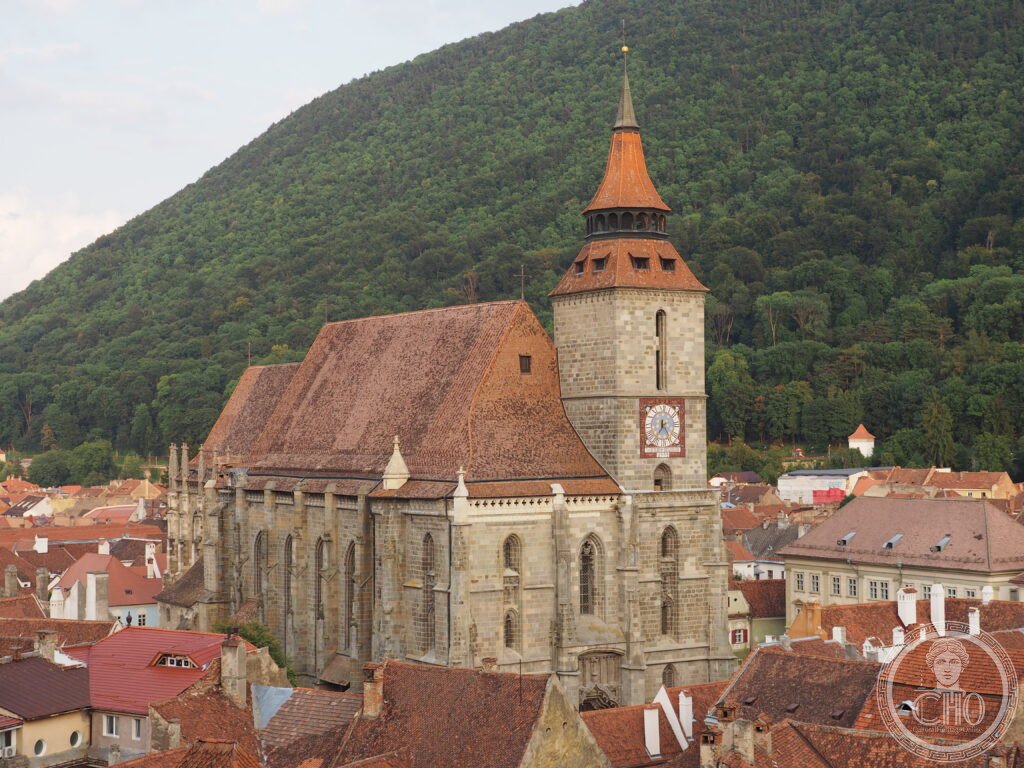
The Biserica Neagră of Brașov is the largest Gothic church in south-eastern Europe, the spiritual heart of the Saxon community of Transylvania. The name comes from the fire of 1689 that blackened its walls. It holds one of the most imposing nineteenth-century organs in the region and a rare collection of Anatolian carpets.
At a glance
The Black Church (Biserica Neagră) dominates the old town of Brașov, the principal city of the Transylvanian Saxons. Built between 1383 and 1477, it is the largest Gothic church in south-eastern Europe — often described as the largest between Vienna and Istanbul — and the spiritual centre of Transylvania’s Saxon Lutheran community. Its popular name comes from a great fire in 1689 that blackened its walls. Inside, it holds a celebrated 19th-century organ and an extraordinary collection of Anatolian (Ottoman) carpets, donated over centuries by Saxon merchants. It remains an active Lutheran church and a concert venue.
Key facts
- Built: 1383–1477, in the Gothic style, on the site of an earlier church
- Size: about 89 m long; the largest Gothic church in south-eastern Europe
- Name: from the great fire of 1689, which scorched the exterior walls
- Organ: a large Buchholz organ of 1839, with around 4,000 pipes; used for regular concerts
- Carpets: one of the finest collections of Anatolian carpets outside Turkey
- Denomination: Lutheran (Evangelical Church A.C.), serving the Saxon community since the Reformation
History
Brașov (German: Kronstadt) was the wealthiest of the seven Saxon towns of Transylvania, grown rich on trade between Central Europe and the Ottoman lands. Construction of its great parish church began around 1383 and continued, through interruptions including Ottoman raids, until about 1477. After the Reformation reached the Saxons in the 16th century, it became a Lutheran church. The catastrophic fire of 1689, which devastated much of Brașov, blackened the church’s walls and gave it the name by which it is now universally known.
Restored over the following centuries, the church accumulated its remarkable collection of Anatolian carpets — gifts and trophies of Saxon merchants — and its monumental organ. It survived the emigration of most Transylvanian Saxons in the 20th century and continues as both an active place of worship and a major cultural monument.
What you see
The church is a towering Gothic hall with a single massive tower, buttresses and a steep roof, rising above the surrounding Saxon houses of Brașov’s old town. The exterior still shows the darkened stone that gave it its name, set with statues and pinnacles. Inside, the lofty nave is hung with dozens of richly coloured Anatolian carpets along the galleries and pillars — an unforgettable sight. The great Buchholz organ stands at the west end, and concerts are held regularly. Medieval and Renaissance furnishings, the font and the pulpit complete the interior.
Practical information
- Getting there: in the centre of Brașov old town, a short walk from the main square (Piața Sfatului)
- Organ concerts: held regularly, especially in summer; check the schedule
- Tickets: entry fee for visitors; the carpet collection is a highlight
- Time needed: 45 minutes to an hour
Getting there
The Black Church stands in the heart of Brașov, a major city in central Romania about 2.5–3 hours by train or road from Bucharest. It is a short walk from Piața Sfatului, the old town’s main square. GPS: 45.6410° N, 25.5876° E.
Nearby
- Piața Sfatului — Brașov’s medieval main square and council house, steps away
- Bran Castle — the “Dracula” castle, about 30 km south-west
- Râșnov Citadel — Saxon peasant fortress, about 15 km away
Sources
- Biserica Neagră — official parish and heritage documentation
- Evangelical Church of Augsburg Confession in Romania — historical materials
- Studies of Gothic architecture and the Transylvanian Saxons
- Institutul Național al Patrimoniului — Romanian heritage register
Find it on the map
See this place and what’s around it →📷 Become a Cultural Heritage Online photographer
Share your photos of places: they stay published under your name as the author. The more they're seen, the more you get noticed — and soon a contest will reward the most appreciated photos.
Log in or sign up free to add a photoIs this page about you?
This page is read by travellers and heritage enthusiasts who find it on Google. Tell us how you are connected to this place and we will take it from there.