
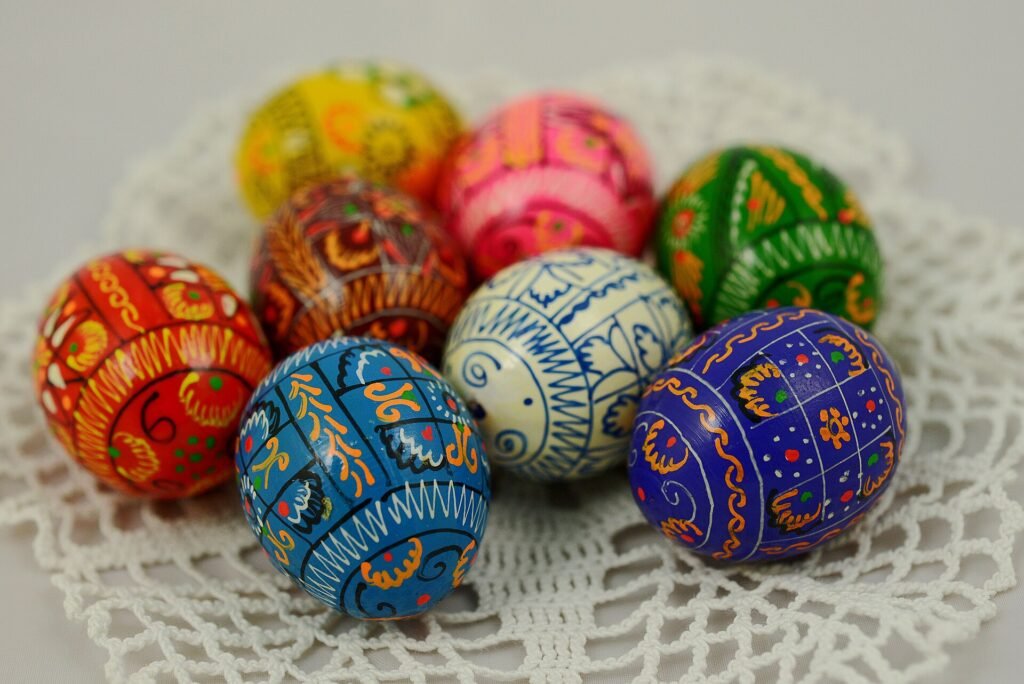
An ancient Slavic craft born in pagan times, pysanka transforms plain eggs into intricate miniature canvases through wax-resist dyeing, blending pre-Christian symbolism with Christian meaning.
At a glance
Pysanka is the Ukrainian tradition of decorating eggs using traditional wax-resist (batik) techniques. What began as a pagan practice was absorbed into Christian Easter observance, yet many decorated eggs retain their original symbolic meanings alongside newer religious motifs. The craft demands patience, precision, and deep knowledge of symbolic language expressed through color, pattern, and imagery.
Origins & history
The tradition of egg decoration in Slavic cultures originated in pagan times and was transformed through religious syncretism into the Christian Easter egg. The oldest decorated eggs known were found in Ukraine. Over centuries, new techniques were added to the practice, expanding its vocabulary while preserving core methods and meanings that stretch back millennia.
The practice
Decorators work with a stylus called a kistka, dipping it in melted beeswax to draw fine lines and patterns onto raw eggs. The decorated egg is then immersed in successive dye baths, from light to dark colors. Where wax protects the shell, the underlying color remains; where the stylus has not touched, dye penetrates. After all dyeing is complete, heat melts away the wax, revealing the finished design—a layered composition of precise geometric patterns, symbolic motifs, and vibrant color combinations. Each pattern carries meaning: stars suggest success, flowers represent love, geometric shapes invoke protection and eternity.
Cultural significance
Pysanka represents continuity between ancient pagan beliefs and Christian practice, a living bridge across spiritual traditions. In Central Europe the craft developed into a small-scale art form of remarkable sophistication. National traditions, color preferences, and motifs vary across the wider Slavic world—the practice is no longer strictly Slavic, known across Europe and also practiced in non-Slavic countries including Britain, Spain, Hungary, Lithuania, Romania, and Sweden. Yet Ukraine remains the heartland where the deepest knowledge and most intricate techniques are preserved and passed from generation to generation.
Key facts
- UNESCO Intangible Cultural Heritage (reference 02134)
- Anchor community: Kolomyia, Ukraine (48.52808°N, 25.03724°E)
- Also practiced in: Estonia and across Europe
- Primary tool: kistka (wax-resist stylus)
- Primary material: beeswax, natural dyes, eggs
Where to experience it
Kolomyia, in western Ukraine, is the heartland of pysanka tradition and home to master decorators who teach and practice the craft. The city hosts the world’s only Pysanka Museum, dedicated entirely to the art form. Visitors can observe demonstrations, purchase decorated eggs from local artisans, and learn techniques from practitioners who have inherited knowledge through family and apprenticeship.
Sources & resources
- Egg decorating in Slavic culture — Wikipedia
- Pysanka: Ukrainian tradition and art of decorating eggs — UNESCO Intangible Cultural Heritage
- Cultural Heritage Online
Find it on the map
See this place and what’s around it →📷 Become a Cultural Heritage Online photographer
Share your photos of places: they stay published under your name as the author. The more they're seen, the more you get noticed — and soon a contest will reward the most appreciated photos.
Log in or sign up free to add a photo