
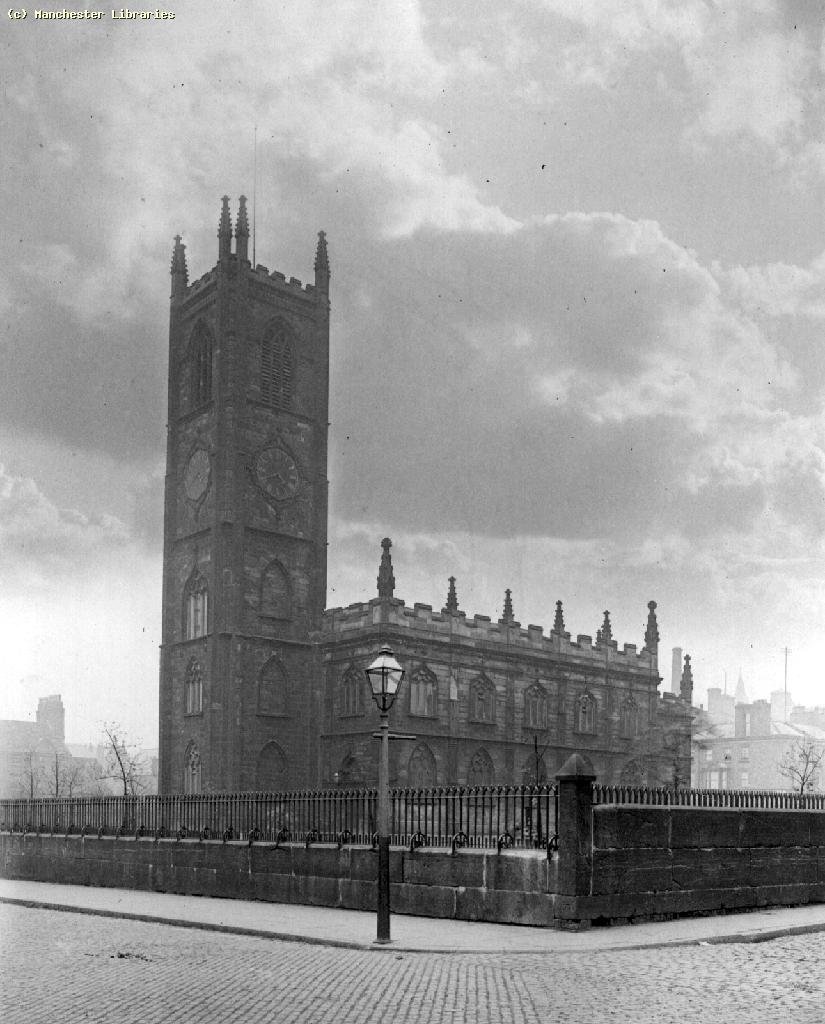
A pioneering Gothic Revival parish church that served Manchester for 162 years before demolition, leaving behind a graveyard holding over 22,000 burials and a legacy of religious innovation.
At a glance
St John’s Church stood on Deansgate as Manchester’s first significant Gothic Revival structure. Founded by banker Edward Byrom in 1769, it anchored parish life through two centuries of urban growth until merger with a neighboring congregation led to its 1931 demolition. Its graveyard survives as St John’s Gardens.
History
Edward Byrom, co-founder of Manchester’s first bank, built St John’s in 1769. John Clowes, its first rector, served an extraordinary 62 years until 1831, establishing the church as a center of social reform. Clowes preached the first Sunday school sermon in the Manchester area and introduced Swedenborgianism to the region.
William Huntington succeeded Clowes and served until 1874. In 1827, he laid the foundation stone for the Sunday school, which by 1906 attracted around 250 children and supported affiliated organizations including a Penny Bank and Choral Society. By the 1920s, declining attendance and the nearby St Matthew’s Church prompted diocesan merger in 1927, culminating in demolition four years later.
What you see
The church pioneered Gothic Revival architecture in Manchester. Its tower, completed May 1770, originally housed a peal of eight bells cast by Lester and Pack, rehung in 1832 and again around 1883 and described as “among the best peal of bells in Manchester.”
Major restorations marked its lifespan: 1821 work included reroofing funded by Byrom’s daughter; 1874–1878 improvements cost £1,600; 1898 saw conversion from gas to electric lighting. A roof collapse in 1924 was rebuilt by 1926.
Cultural significance
St John’s advanced Manchester’s religious and educational landscape. Rector Clowes championed Whit Walks, while Huntington’s Sunday school model influenced educational provision across the city. The church windows commemorated John Owens, founder of Owens College, and Sir Thomas Bazley, reflecting its prominence among Manchester’s merchant and intellectual classes.
Key facts
- Country: United Kingdom
- City: Manchester
- Founded: 1769
- Demolished: 1931
- Coordinates: 53.47777778, -2.25277778
- Notable burials: John Owens (Owens College founder), William Marsden (advocate of Saturday half-day)
Practical information & getting there
The church no longer stands. Its site, bounded by Lower Byrom Street, Byrom Street and Quay Street, is now St John’s Gardens. A stone cross and commemorative plaque mark the graveyard where over 22,000 bodies are buried.
Sources & resources
Find it on the map
See this place and what’s around it →📷 Become a Cultural Heritage Online photographer
Share your photos of places: they stay published under your name as the author. The more they're seen, the more you get noticed — and soon a contest will reward the most appreciated photos.
Log in or sign up free to add a photoIs this page about you?
This page is read by travellers and heritage enthusiasts who find it on Google. Tell us how you are connected to this place and we will take it from there.