

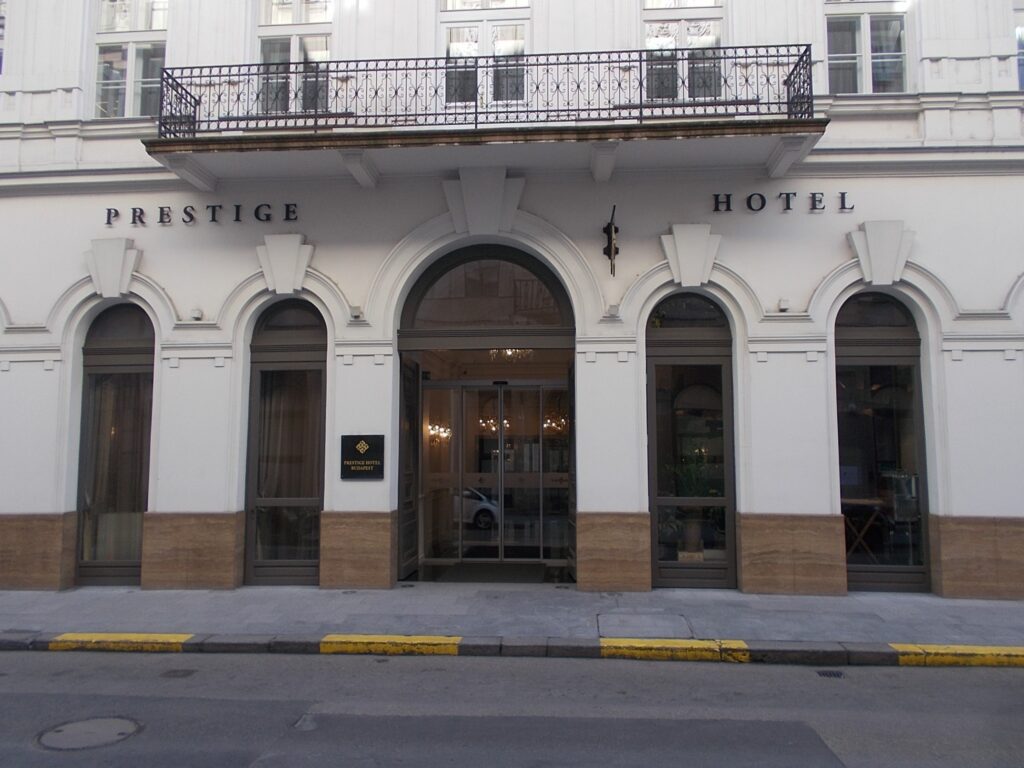

A town house in the short street that runs from the Academy of Sciences towards Nádor utca, among neighbours designed by József Hild and his contemporaries. It is not on Hungary’s national register of monuments, but District V protects it individually in its own townscape decree. Its construction history rests mostly on the hotel’s account, and part of that account does not add up; both are set out below.
At a glance
Vigyázó Ferenc utca is a short street of Lipótváros, the quarter of Pest that grew up north of the old town from the late eighteenth century. Three of its houses, numbers 2, 3 and 4, and the bank building at number 8 are national listed monuments, most of them classicist houses of the 1830s and early 1840s. Number 5 is not among them. It is, however, on the list of buildings protected individually by the local government of District V, Belváros-Lipótváros (entry VH513 of its 2020 townscape decree). According to the hotel, the house was built in the 1860s to plans by József Hild and completed after his death by Lőrinc Zofahl; its courtyard wings were demolished in 2004 and the street wing kept, and the hotel opened in April 2015. We have not found the design or the date confirmed in a source independent of the hotel.
Key facts
- Where: Vigyázó Ferenc utca 5, 1051 Budapest, District V (Lipótváros); land-registry parcel 24563
- Street names: Bélagasse (1829), Béla utca (1874), gróf Vigyázó Ferenc utca (1929), Vigyázó Ferenc utca (1946)
- Protection: district-level individual protection, Belváros-Lipótváros decree 5/2020 (I.30.) on townscape protection, Annex 2, entry VH513; earlier listed under district streetscape protection (decree 14/2008, entry VHU 282). Not a national listed monument
- Design and date: 1860s, József Hild, completed by Lőrinc Zofahl, according to the hotel; not confirmed independently, and the sequence conflicts with Zofahl’s recorded date of death (see History)
- First owner: probably the merchant Albert Spitzer, according to the hotel
- Later changes: offices after the residential use ended; courtyard wings demolished in 2004 and a new reinforced-concrete structure built behind the street wing (plans by Zoltán Porcsalmi); hotel conversion from 2014 (plans by Péter Hegedűs and Ágnes Bolyó), all according to the hotel
- Current use: Prestige Hotel Budapest, opened in April 2015
- Coordinates: 47.500896, 19.048476 · open in Google Maps
History
The street was first called Bélagasse, recorded in 1829, and Béla utca from 1874. In 1929 it took the name of Count Ferenc Vigyázó, who had died in July 1928 and whose will left his entire fortune to the Hungarian Academy of Sciences, the institution whose palace stands close to the head of the street. The houses that went up here in the 1830s and 1840s are the work of the builders who shaped reform-era Pest. The national register describes number 4 as a three-storey classicist house by József Hild of 1837, and number 3 as a classicist house by Ferenc Kasselik of 1837 with work by Hild in 1841. Hild, born in Pest in 1789 and died there on 6 March 1867, was the most prolific architect of the city in his time; in his lifetime the old Kirakodó tér on the river, today’s Széchenyi István tér, was built up entirely to his designs.
For number 5 the only detailed account we have found is the hotel’s own. It states that the house was built in the 1860s to Hild’s plans, as one of his late works, and that after his death it was finished by the architect Lőrinc Zofahl in an early eclectic style, probably for the merchant Albert Spitzer. That sequence runs into a problem of dates. The Magyar Életrajzi Lexikon places Zofahl’s activity in Pest mainly between 1831 and 1843, and Hungarian Wikipedia, citing his funeral notice, gives his death as 5 September 1863, three and a half years before Hild’s. Either the building was completed by someone else, or it was begun earlier than the hotel says, or the attribution is mistaken. We have not seen the building permits, which would settle it; the published list of Hild’s buildings that we consulted does not include number 5.
The later history also comes from the hotel. Once the residential use ended the house served as offices. In 2004 the courtyard parts were demolished, the street wing was kept, and a new reinforced-concrete structure was built behind it to plans by Zoltán Porcsalmi for flats that were never completed; only the shell was finished. Hotel conversion began in 2014 to plans by Péter Hegedűs and Ágnes Bolyó, and the hotel opened in April 2015. By 2012 at the latest the house was already on the district’s list of buildings protected for their part in the streetscape, and it is on the current list of individually protected buildings, as set in 2021. Under that decree a protected building may not be demolished entirely, and alterations need a documented assessment of its values.
What you see
The photograph shows the lower part of a pale, painted street front. The ground floor is an arcade of round-arched openings resting on a low base of brown stone slabs; each arch has a moulded surround and a plain, fan-shaped keystone block. The central arch, wider than the others, holds the glazed entrance, and the lettering “Prestige” and “Hotel” is fixed to the wall on either side of it. Above the entrance a long balcony on plain brackets carries a wrought-iron railing of scrolls and rings.
A second photograph by the same author shows the whole front, and a third the first floor. The first-floor windows are framed by flat pilaster strips and topped by a frieze of female masks between leafy scrolls; the window behind the balcony has a small triangular pediment carried by pilasters with leaf capitals. At the left end a slightly projecting bay rises over a wide arched carriage entrance, with a first-floor window flanked by columns and crowned by a pediment, and a carved panel on brackets beneath it. The upper floors are plainer, with straight window heads, and the front ends in a deep cornice. The simplified profile of the ground-floor keystones differs from the carved work above; we have not found whether they are original or date from the works of 2004–2015. The hotel describes the inside as rooms opening off galleries round a six-storey inner space, which on the hotel’s own account belongs to the structure built after 2004.


Practical information
- The building is a hotel, the Prestige Hotel Budapest; the interiors are for guests.
- The street front can be seen from the pavement of Vigyázó Ferenc utca, a narrow street; the upper floors are best seen from the opposite side.
- What District V protects is the historic building on the street; the inner structure behind it dates from after 2004, according to the hotel.
Getting there
Vigyázó Ferenc utca runs between Akadémia utca, beside the Academy of Sciences, and Nádor utca. The tram 2 stop at Széchenyi István tér is about 200 metres away. Deák Ferenc tér (metro lines 1, 2 and 3), Vörösmarty tér (line 1) and Arany János utca (line 3) are each about 500 to 600 metres on foot.
Nearby
- Vigyázó Ferenc utca 3 and 4, next door and across the street: listed classicist houses of 1837, number 4 by József Hild, number 3 by Ferenc Kasselik with later work by Hild (national register nos. 15495 and 15496).
- Akadémia utca 1, at the corner of the street: a four-storey classicist corner house by Mátyás Zitterbarth, 1835 (no. 15304); and at the other end, Nádor utca 16, a listed bank building of the 1910s (no. 15947).
- Gresham Palace, the Art Nouveau landmark on Széchenyi István tér, about 150 metres away, next to the palace of the Hungarian Academy of Sciences.
- Sas utca 12, another listed classicist house of Lipótváros, near St Stephen’s Basilica, about 250 metres to the east.
Do you know more?
On this page we have published what can be seen and what we were able to verify. We could not confirm who designed this house or when it was built: the attribution to József Hild, its completion by Lőrinc Zofahl and the date in the 1860s rest on the hotel’s account alone, and the dates do not fit together. If you know something — the building permit, a name, a date, the Spitzer family or later owners, an old photograph, a document, a book that mentions it — write to Sofia, who looks after these pages.
Write to Sofia or send a message on WhatsApp
Please start your message with the title of this page, so it reaches the right file. Every contribution is checked against independent sources before it goes on the page, and we always say where a piece of information came from.
Sources
- Belváros-Lipótváros, decree 5/2020 (I.30.) on townscape protection, consolidated text: Annex 2, “Kerületi egyedi védett értékek”, entry VH513, parcel 24563, Vigyázó Ferenc utca 5, block 94 (annex as set by decree 19/2021, in force from 1 October 2021); § on district individual protection (no total demolition; alterations only on the basis of a value assessment).
- Belváros-Lipótváros, decree 14/2008 (IV.3.) on the local protection of the architectural heritage, consolidated text to 2012: “Kerületi utcaképi védelem alatt álló épületek (VHU)”, no. 282, parcel 24563, Vigyázó Ferenc utca 5.
- Műemlékem.hu, national monuments in the street: Vigyázó Ferenc utca 3 (no. 15495), no. 4 (15496), Akadémia utca 1 / Vigyázó Ferenc utca 2 (15304), Vigyázó Ferenc utca 8 / Nádor utca 16 (15947). A search of the street returns no record for number 5.
- Prestige Hotel Budapest, “Introduction – Hotel History” and the Hungarian version: the owner’s account of Hild, Zofahl, Albert Spitzer, the 2004 demolition, the 2014 conversion and the April 2015 opening.
- PestBuda, “Egy lenyűgözően gazdag építészi életmű – 155 éve hunyt el Hild József” (7 March 2022): Hild’s death on 6 March 1867, his buildings on the former Kirakodó tér.
- Magyar Életrajzi Lexikon, “Zofahl Lőrinc” (Hungarian Electronic Library): his houses in Pest between 1831 and 1843; and Wikipedia (hu), Zofahl Lőrinc, which gives his death on 5 September 1863 from his funeral notice.
- Magyar Hang, “Aki mindenét a magyar tudománynak adta”: Count Ferenc Vigyázó’s death in July 1928 and his bequest to the Academy.
- Wikipedia (hu), Lipótváros (street names and their dates) and Hild József által tervezett épületek listája (no entry for Vigyázó Ferenc utca 5).
- OpenStreetMap / Nominatim: position, returned as Prestige Hotel, 5, Vigyázó Ferenc utca, Lipótváros, V. kerület, Budapest.
Find it on the map
See this place and what’s around it →📷 Become a Cultural Heritage Online photographer
Share your photos of places: they stay published under your name as the author. The more they're seen, the more you get noticed — and soon a contest will reward the most appreciated photos.
Log in or sign up free to add a photoIs this page about you?
This page is read by travellers and heritage enthusiasts who find it on Google. Tell us how you are connected to this place and we will take it from there.