

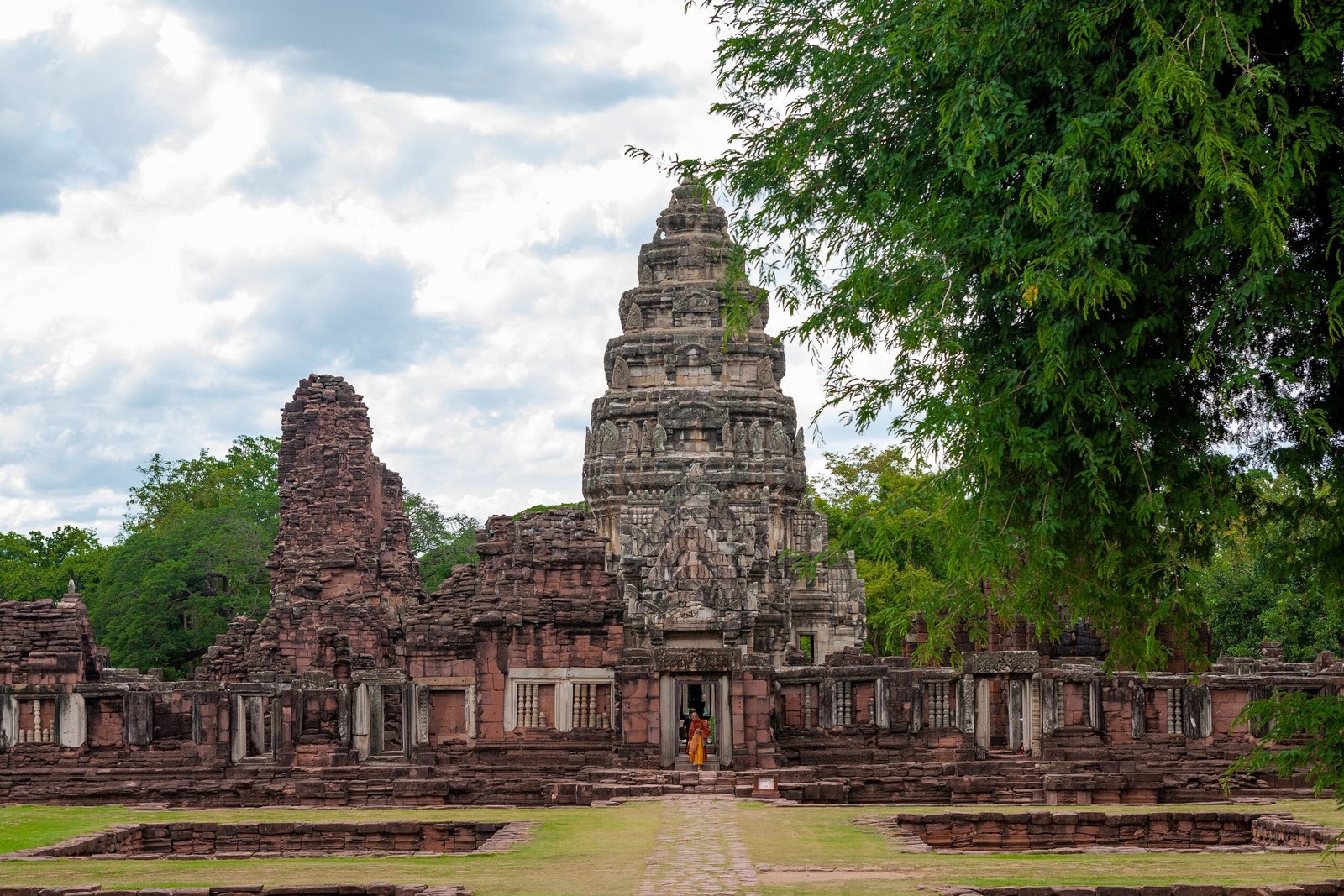
The largest Khmer temple complex in Thailand — connected to Angkor by a 220 km royal road, its white sandstone prang rising above galleries of some of the finest surviving Khmer decorative stonework outside Cambodia.
At a glance
In the Nakhon Ratchasima province of northeastern Thailand (Isan), approximately 60 km northeast of the provincial capital, the Khmer temple complex of Phimai — ancient name Vimayapura — is the largest Khmer temple in Thailand and one of the most important outside Cambodia. A compact but elaborately carved sandstone complex, its white sandstone prang (central tower) rises approximately 28 metres above galleries, gopuram gateway towers, and naga bridges that rank among the finest surviving examples of Khmer decorative stonework outside Angkor. Built in the late 11th to early 12th century AD and linked directly to Angkor by one of the Khmer Empire’s great royal roads, Phimai represents the northernmost extension of Khmer imperial ambition and a site whose iconographic relationship with the Bayon at Angkor Thom has produced enduring scholarly debate about the origins of Jayavarman VII, the greatest of the Khmer builder-kings.
Key facts
- Location: Phimai district, Nakhon Ratchasima (Korat) province, northeastern Thailand (Isan region).
- Period: Late 11th – early 12th century AD; Khmer Empire, with modifications into the Jayavarman VII era (r. 1181–1218 AD).
- Central tower: White sandstone prang approximately 28 metres high; unusually, white sandstone rather than the pink/grey sandstone used at most Khmer sites.
- Royal road: Connected to Angkor (approximately 220 km to the southeast) by a paved Khmer processional road approximately 8 metres wide, marked by rest houses at intervals of 15–20 km.
- Iconography: Superimposed Hindu (Vishnuist) and Mahayana Buddhist programmes, visible in surviving lintels, pediments, and gallery reliefs — reflecting successive modifications to the complex.
- Designation: Thai national historical park, administered by the Fine Arts Department; in the vicinity of Phimai National Museum (one of Thailand’s most important regional archaeology museums).
- Scholarly significance: Some researchers propose Jayavarman VII was born or raised at Phimai, based on architectural parallels with the Bayon.
History
Phimai stands at a site that was already significant before Khmer construction began: archaeological evidence indicates earlier occupation, and the town sits on a slight natural elevation surrounded by the Mun river flood plain that gave it strategic and religious importance. The principal Khmer construction phase began in the late 11th century under Khmer imperial patronage, when the complex was dedicated to the Hindu gods — particularly Vishnu — in alignment with the religious policy of the Khmer court at Angkor. The builders used white sandstone, a material choice that distinguishes Phimai from the pink and grey sandstone of most Khmer monuments, and created a complex whose axial orientation faces south (toward Angkor) rather than the conventional east, emphasising the royal road connection.
The major modification of the complex occurred in the late 12th to early 13th century, when the Khmer king Jayavarman VII — who is identified as having strong personal connections to Phimai by some scholars — introduced Mahayana Buddhist iconography into what had been a Hindu complex. The face-tower motifs associated with Jayavarman VII’s building programme at Angkor Thom appear at Phimai, and the layered superimposition of Buddhist over Hindu sculptural programmes is visible throughout the galleries and pediments. The site went out of active religious use after the decline of the Khmer Empire’s influence over northeastern Thailand in the 13th–14th centuries, and much of the complex fell into ruin before systematic archaeological study and partial reconstruction were undertaken by the Thai Fine Arts Department from the 1950s onward.
Today, Phimai Historical Park is the centrepiece of a town that retains its ancient grid street plan — itself inherited from the Khmer urban layout — and is flanked by a large open-air museum of architectural fragments and sculpture. The annual Phimai Festival, held in November, combines traditional boat racing on the Mun river with cultural performances and illuminations of the temple complex.
What you see
The complex is entered through a large gopuram (gateway tower) on the south side — the direction of Angkor — and proceeds through a series of enclosure walls, galleries, and smaller towers to the central prang. The outer gallery walls and connecting corridors carry carved lintels and pediments in remarkably good condition: scenes from the Hindu epics (Ramayana, Mahabharata), cosmological compositions with deity figures, and — in the later Buddhist phase — bodhisattva and Buddha images. The naga balustrades of the entrance bridges, with the multi-headed serpent bodies rising from the ground on either side of the path, are characteristic Khmer devices that symbolise the crossing from the human world to the sacred space of the temple mountain. The central prang itself, in white sandstone, is the dominant vertical element: its surface is carved with kala (monster face) and makara (sea creature) motifs at the base of the tower and with diminishing tiers of carved decoration up to the summit.
Adjacent to the main complex, the Phimai National Museum displays a comprehensive collection of sculpture and architectural fragments from the site and from Khmer-period sites throughout the Korat plateau — including the famous sandstone portrait statue of Jayavarman VII in the cross-legged meditation pose that is one of the finest surviving Khmer royal portraits. The museum provides the interpretive context that the temple itself, stripped of most of its portable sculpture, cannot convey alone.
Practical information
- Open: Daily 06:00–18:00.
- Admission: 100 THB for foreign visitors (includes both the Historical Park and the National Museum with separate entry).
- Best time: November (Phimai Festival, illuminations) or cool season October–February; avoid April–May heat.
- Time needed: 2–3 hours for the temple complex; half a day if including the National Museum.
- On-site facilities: Parking, basic refreshment stalls around the entrance; small souvenir shops in the adjacent town.
Getting there
Phimai is approximately 60 km northeast of Nakhon Ratchasima (Korat) city, which is served by regular buses and trains from Bangkok (approximately 3–4 hours). From Nakhon Ratchasima bus terminal 2, direct minibuses to Phimai run every 30–60 minutes (approximately 1.5 hours). The town of Phimai itself is compact and walkable; the historical park is at the northern edge of the town centre. No direct public transport from Bangkok to Phimai; the Korat connection is necessary.
Nearby
- Phanom Wan Historical Park (approx. 25 km southwest of Phimai) — another Khmer sanctuary of the 10th–12th century, smaller but with well-preserved lintels and an active Buddhist monastery occupying part of the ancient complex.
- Phimai National Museum (adjacent to the historical park) — essential complement, housing the Jayavarman VII portrait and the finest collection of Khmer sculpture from the Korat plateau.
- Sai Ngam Banyan Grove (approximately 2 km from the park) — one of the largest banyan tree groves in Thailand, a pleasant addition to a half-day visit.
- Nakhon Ratchasima (Korat) city (approx. 60 km) — regional hub with the Maha Wirawong National Museum and Thao Suranari Memorial.
Sources
- Fine Arts Department of Thailand, Phimai Historical Park, official guide publication.
- Higham, Charles. The Civilization of Angkor. University of California Press, 2001.
- Woodward, Hiram. The Art and Architecture of Thailand. Brill, 2003.
- Wikipedia: Phimai Historical Park.
- Phimai National Museum, exhibition documentation (Fine Arts Department, 2010).
Find it on the map
See this place and what’s around it →📷 Become a Cultural Heritage Online photographer
Share your photos of places: they stay published under your name as the author. The more they're seen, the more you get noticed — and soon a contest will reward the most appreciated photos.
Log in or sign up free to add a photo