

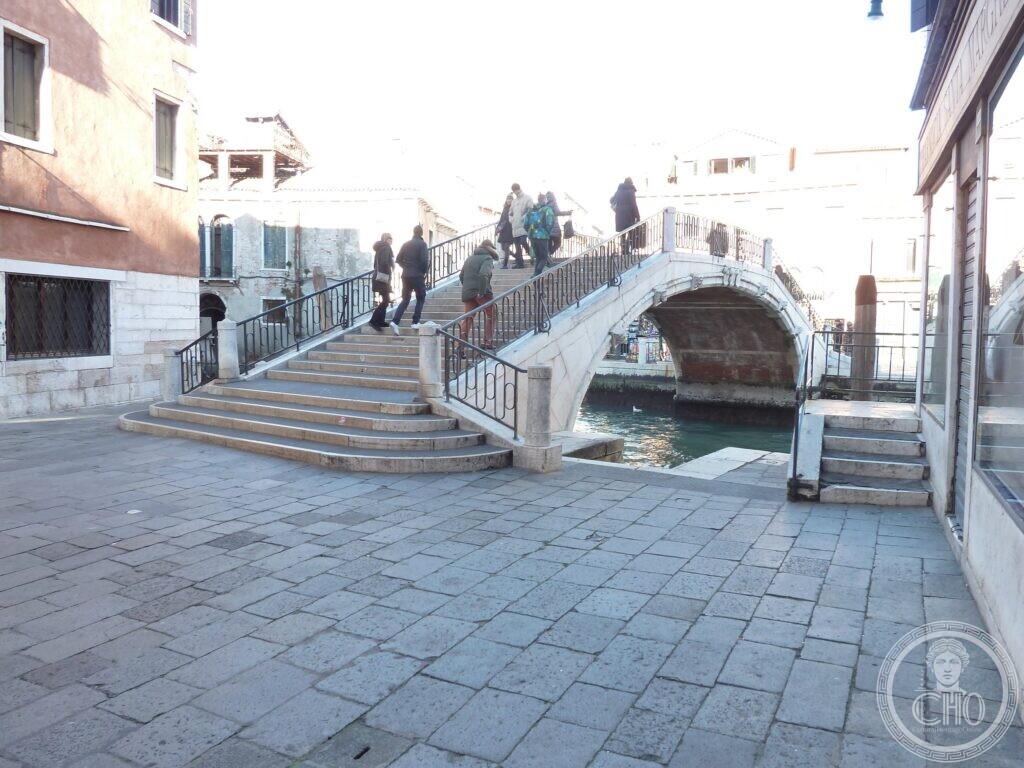
A brick bridge at the western edge of Venice, where the fondamenta meets the wall of the Santa Maria Maggiore prison and the bell tower of the church that gave both their name. The church’s story is well documented; the bridge’s is not, and this page says so.
At a glance
The bridge stands in the sestiere of Santa Croce, on the Fondamenta de Santa Maria Maggiore, in the quiet western quarter between Piazzale Roma and the former tobacco factory. The street sign on the house at its foot gives both names, bridge and fondamenta; OpenStreetMap records it as the bridge of the Campo Santa Maria Maggiore. Beyond it rises the brick perimeter wall of the prison, with the bell tower of the former church of Santa Maria Maggiore on the left and the prison blocks of the 1920s behind.
What this page does not say. No source we could find describes the bridge itself, its date or its rebuilding. The Ministry of Culture’s record and the tourism pages of Venice concern the church and the prison; the bridge appears only on the map and on its street sign. What is described below is what the photograph shows.
Key facts
- Where: Santa Croce, Fondamenta de Santa Maria Maggiore, below the prison wall
- Structure: a single brick arch with stone edging, stone steps on both sides and iron railings between stone posts (as seen in the photograph)
- Behind it: the former church of Santa Maria Maggiore (1523–1531) and the prison that took its name
- Date and builder of the bridge: not documented in any published source found so far
- GPS: 45.4351, 12.3162 · Open in Google Maps (OpenStreetMap)
What is known, and what is believed
The name belongs to the church. In 1497 a community of Franciscan women was granted land on the island of Santa Maria Maggiore, at the western margin of the city, and a wooden church and convent went up in the following years; the present church was built between 1523 and 1531, and the Ministry of Culture’s record associates the sculptor and architect Tullio Lombardo with its construction. The convent was suppressed under Napoleon and demolished in 1900; the church, deconsecrated, served as a stable and then as a warehouse for the tobacco factory next door, and in the 1920s the state prison of Santa Maria Maggiore was built around it. A restoration by the Superintendency at the end of the 1960s removed the nineteenth-century superstructures from the church, which still stands inside the prison walls.
The bridge is the way across the canal to the fondamenta under that wall. Stefano Vigolo photographed it in January 2011; it is believed, from its form, to be one of the ordinary brick-and-stone bridges rebuilt or repaired many times over the centuries, but no date is documented and none is given here.
What you see
A single arch in brick, edged in white stone, rising from brick abutments at the water; stone steps climb it on both sides between simple iron railings on small stone posts, and the fondamenta continues along the canal in brick and stone, with mooring rings and boats below. Across the water the high brick wall of the prison runs the length of the view, topped with barbed wire; above it, on the left, the brick bell tower of the former church with its belfry openings, and behind, the long pale blocks of the prison with their rows of windows and a central tower. The sign on the corner house reads «Ponte de Santa Maria Maggiore» and, below it, «Fondamenta de Santa Maria Maggiore».
Do you know more about this bridge?
If you know when the Ponte de Santa Maria Maggiore was built or last rebuilt, or a document, a map or a photograph that tells its story, write to Sofia at sofia@culturalheritageonline.com or through the contact page. What arrives with a source goes into this page, with your name as the contributor.
Nearby
- Santa Maria Maggiore Prison — the complex behind the wall, built in the 1920s around the old church
- The Former Manifattura Tabacchi — the tobacco factory that used the church as a warehouse
Sources
- Ministero della Cultura, Chiesa di Santa Maria Maggiore di Venezia: the church and its history, Tullio Lombardo’s involvement
- Italia.it (Ministero del Turismo), Former church of Santa Maria Maggiore: the Franciscan foundation of 1497, the church of 1523–1531, the demolition of the monastery in 1900, the use as a tobacco warehouse, the restoration of the late 1960s
- Cultural Heritage Online, Santa Maria Maggiore Prison — Venice (1926): the prison complex of the 1920s
- Stefano Vigolo, photograph of January 2011 and notes to the editorial staff (2026): the identification of the bridge. Not a published source
- OpenStreetMap, Ponte del Campo Santa Maria Maggiore: the name and the coordinates
Find it on the map
See this place and what’s around it →📷 Become a Cultural Heritage Online photographer
Share your photos of places: they stay published under your name as the author. The more they're seen, the more you get noticed — and soon a contest will reward the most appreciated photos.
Log in or sign up free to add a photoIs this page about you?
This page is read by travellers and heritage enthusiasts who find it on Google. Tell us how you are connected to this place and we will take it from there.