

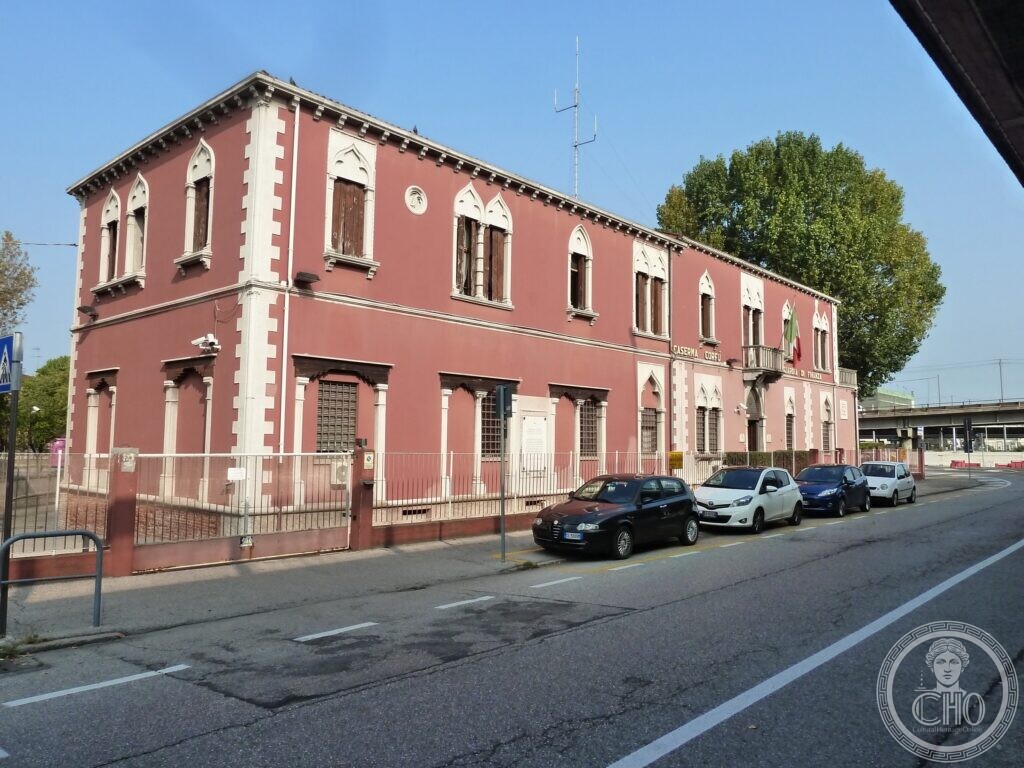
On the road that leads from Mestre to the port, a pink two-storey building with pointed Venetian windows carries the name of a Greek island and the sign of the Guardia di Finanza. No published source we could find tells when it was built or why it is called Corfù: this page says what is seen and what is missing.
At a glance
The Caserma Corfù stands on Via Fratelli Bandiera in Marghera, the mainland district of Venice built in the twentieth century beside the industrial port, next to the railway flyover. OpenStreetMap records it as the seat of a Guardia di Finanza unit, the Nucleo Operativo Pronto Impiego of the Venice group; the inscriptions on the front read «Caserma Corfù» and «Guardia di Finanza». Stefano Vigolo, who photographed it in September 2014, notes it as the seat of the Comando II Gruppo and of the Compagnia Pronto Impiego.
What this page does not say. We searched the Ministry of Infrastructure’s records of Guardia di Finanza barracks, the regional heritage catalogues and the local histories of Mestre and Marghera: none describes this building, its date, its architect or the origin of its name. Italian barracks are usually named after a fallen serviceman or a place of arms; which Corfù this is, we cannot say.
Key facts
- Where: Via Fratelli Bandiera, Marghera, by the railway flyover
- Use: barracks of the Guardia di Finanza (Nucleo Operativo Pronto Impiego, Venice group, per OpenStreetMap)
- Style: Venetian Gothic revival — pointed and trefoiled windows, white stone trim on pink plaster (as seen in the photograph)
- Date and architect: not documented in any published source found so far
- GPS: 45.4801, 12.2338 · Open in Google Maps (OpenStreetMap)
What is known, and what is believed
Marghera is a creation of the twentieth century: the industrial port on the lagoon’s edge and the quarter beside it were laid out on land that in the Middle Ages held the cattle market of Malghera, by the site of the later fort of the same name. The Guardia di Finanza, Italy’s financial police, has its reasons to be here, at the gate of the port. Beyond that, what we have on the barracks is the building itself: its Venetian Gothic dress, the fashion of the first decades of the century for public buildings on the mainland that wished to look Venetian, suggests the years between the wars — a belief from the photograph, not a documented date.
What you see
A long two-storey block in pink plaster with white stone quoins, string courses and a dentilled cornice. The ground floor has tall windows under ogee arches with stone hood-moulds, barred; the upper floor repeats the pointed, cusped windows in pairs and singles, with a round medallion between them. Towards the right end the front steps forward slightly, with a stone balcony on brackets under the inscription and the Italian flag above the entrance; a marble plaque is set beside the door at the left end. A radio mast rises from the roof, and the railway flyover and the port’s cranes stand behind.
Do you know more about this building?
If you know when the Caserma Corfù was built, who designed it, what it was before the Guardia di Finanza, or the origin of its name, write to Sofia at sofia@culturalheritageonline.com or through the contact page. What arrives with a source goes into this page, with your name as the contributor.
Nearby
- Historical Military Museum of Forte Marghera — the nineteenth-century fort on the site of the old cattle market
- VEGA – Venice Science and Technology Park — in the old industrial zone of Porto Marghera
Sources
- Centro Studi Storici di Mestre, Le stagioni di Mestre, 1 (PDF): the medieval cattle market of Malghera on the site of the later Forte Marghera
- FAI – Fondo per l’Ambiente Italiano, Forte Marghera: the nineteenth-century fort and former army barracks beside the district
- Stefano Vigolo, photograph of 28 September 2014 and notes to the editorial staff (2026): the identification of the barracks and of its unit. Not a published source
- OpenStreetMap, Guardia di Finanza, Via Fratelli Bandiera, Marghera: the position and the unit’s name
Find it on the map
See this place and what’s around it →📷 Become a Cultural Heritage Online photographer
Share your photos of places: they stay published under your name as the author. The more they're seen, the more you get noticed — and soon a contest will reward the most appreciated photos.
Log in or sign up free to add a photoIs this page about you?
This page is read by travellers and heritage enthusiasts who find it on Google. Tell us how you are connected to this place and we will take it from there.