

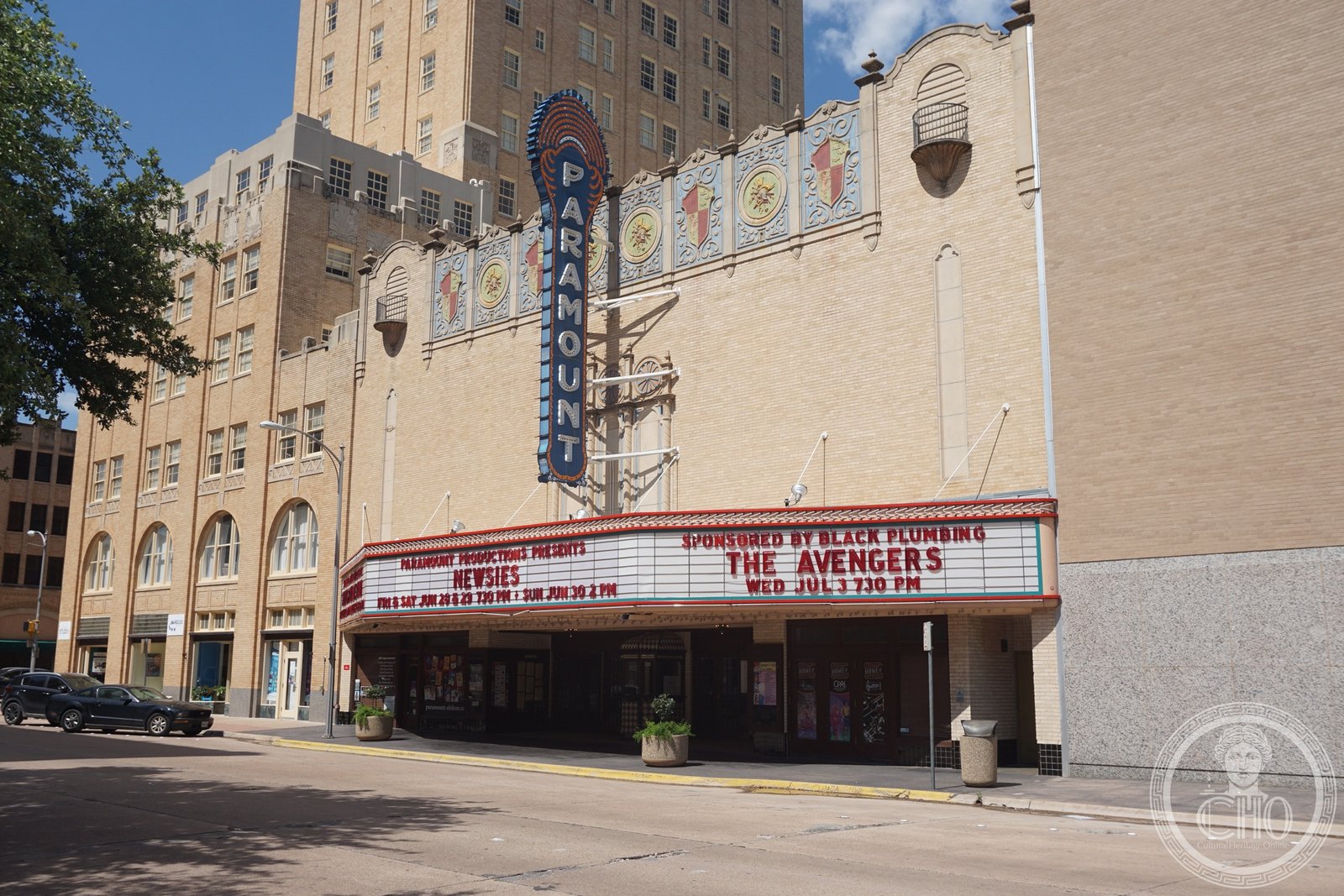
Rising above the ranch-country horizon of downtown Abilene since 1930, the Paramount Theatre is a meticulously preserved Art Deco landmark that continues to host live performances in its original auditorium.
At a glance
The Paramount Theatre stands on Cypress Street in the heart of downtown Abilene, a city whose fortunes in the early twentieth century were built on cattle, cotton, and the transcontinental railroad. When the theatre opened in 1930, Abilene was a prosperous West Texas commercial hub of roughly 23,000 residents, ambitious enough to build and sustain a major cinema palace in the spirit of the era’s great urban entertainment houses. The building’s Art Deco exterior of terra-cotta and brick, its original marquee, and its carefully maintained auditorium have survived decades of changing entertainment habits to emerge as one of the most intact surviving examples of 1930 movie palace architecture in Texas. The Paramount today serves as a performing arts venue drawing audiences from across the West Texas region.
Key facts
- Opened: 1930
- Address: 352 Cypress Street, Abilene, Texas 79601
- Style: Art Deco with Moorish ornamental accents, terra-cotta cladding
- Capacity: Approximately 1,186 seats
- Current use: Performing arts center, live concerts, film screenings, community events
- NRHP: Listed on the National Register of Historic Places
- Operator: Paramount Foundation of Abilene, non-profit performing arts organization
History
Abilene’s commercial growth in the 1920s — driven by oil discoveries in the Permian Basin to the south, expanded cattle ranching, and the presence of Hardin-Simmons University — made it a natural market for a grand cinema palace. The Paramount opened in 1930 at the height of talking-picture fever, offering West Texas audiences first-run Hollywood films in a setting of metropolitan elegance. The building was constructed as part of the national Paramount theatre circuit, one of the major chains that competed for dominance of American moviegoing in the late silent and early sound eras.
Through the midcentury the Paramount operated continuously as a first-run cinema, then as a second-run and revival house as suburban multiplexes drew audiences from downtown Abilene. By the late 1970s its future was uncertain. The Paramount Foundation, established by civic advocates, took over management and undertook a comprehensive restoration program that returned the auditorium’s plasterwork, original seating, and decorative elements to their 1930 condition. The restored Paramount reopened to national recognition and has since built a programming calendar that mixes touring Broadway productions, classic film series, and local performing arts organizations.
Its NRHP listing acknowledges the theatre as both an architectural document of Texas’s 1920s-1930s commercial prosperity and a community asset whose survival required organized civic effort. The building’s longevity owes much to Abilene’s relative insulation from the urban renewal campaigns that demolished comparable theatres in larger Texas cities during the 1960s and 1970s.
What you see
The Cypress Street facade presents a compact but forceful expression of 1930 Art Deco taste: a vertical tower of terra-cotta panels rises above the marquee, ornamented with geometric stepped motifs, stylized cartouches, and low-relief panels in the Zigzag Moderne idiom. The original illuminated marquee, restored to period appearance, projects over the sidewalk and announces programming in changeable letters of the kind that once defined American commercial streetscapes. Moorish-inflected arched window surrounds on the upper floors add a note of exotic ornament characteristic of the Paramount circuit’s house style in the Southwest.
The auditorium interior preserves its original plaster ceiling with coffers and applied ornament, carved box fronts, and the proscenium arch whose decorative program echoes the terra-cotta exterior. The sightlines are generous — a feature of the era’s design philosophy, which placed premium emphasis on clear sight angles for the full audience. The lobby retains its terrazzo floor and period light fixtures, offering visitors a compressed but authentic experience of the 1930s movie palace sequence from street to seat.
Practical information
- Hours: Open on performance evenings; box office typically open 1 hour before curtain — check the Paramount Foundation website for the current schedule
- Tickets: Available online, by phone, or at the box office; advance purchase recommended for popular touring productions
- Access: Accessible entrance and seating available; contact the box office to arrange specific accommodations
- Time needed: 1.5 to 2.5 hours per performance; the lobby and facade are worth 10-15 minutes of independent inspection
- Parking: Street parking and surface lots available in the surrounding downtown blocks
Getting there
Abilene sits at the intersection of Interstate 20 and US Highway 83/84, approximately 150 miles west of Fort Worth and 290 miles west of Dallas. By air, Abilene Regional Airport (ABI) serves the city with connections to Dallas/Fort Worth via American Eagle; the airport is approximately 4 miles east-southeast of downtown. Cypress Street, home to the Paramount, runs through the core of the downtown district and is reached most directly by taking the Pine Street exit from I-20 and heading north two blocks. Amtrak does not serve Abilene directly; the nearest Amtrak stations are in Fort Worth and San Antonio, each several hours away by car.
Nearby
- Grace Museum, Abilene — A multi-venue complex of art, children’s, and history museums occupying the former Hotel Grace (1909) on Cypress Street, two blocks from the Paramount
- Frontier Texas! — An interpretive museum with life-size holographic figures tracing the Comanche, buffalo hunters, and frontier settlers of West Texas, one block from the Paramount
- Buffalo Gap Historic Village — Restored 19th-century frontier settlement approximately 14 miles south of Abilene, near the original Taylor County seat
- Plaza Theatre (1930), El Paso TX — Contemporary Art Deco movie palace in western Texas built the same year, sharing the Paramount’s era and ambition
Sources
- Paramount Foundation of Abilene, official history and restoration documentation
- National Register of Historic Places nomination, Texas Historical Commission
- Texas Historical Commission, Recorded Texas Historic Landmark records
- Abilene Reporter-News archive, theatre opening and restoration coverage
- Ben M. Hall, The Best Remaining Seats: The Golden Age of the Movie Palace (1961)
Find it on the map
See this place and what’s around it →Record researched and written by Luigi De Marchi for Cultural Heritage Online, 2026.
📷 Become a Cultural Heritage Online photographer
Share your photos of places: they stay published under your name as the author. The more they're seen, the more you get noticed — and soon a contest will reward the most appreciated photos.
Log in or sign up free to add a photoIs this page about you?
This page is read by travellers and heritage enthusiasts who find it on Google. Tell us how you are connected to this place and we will take it from there.