

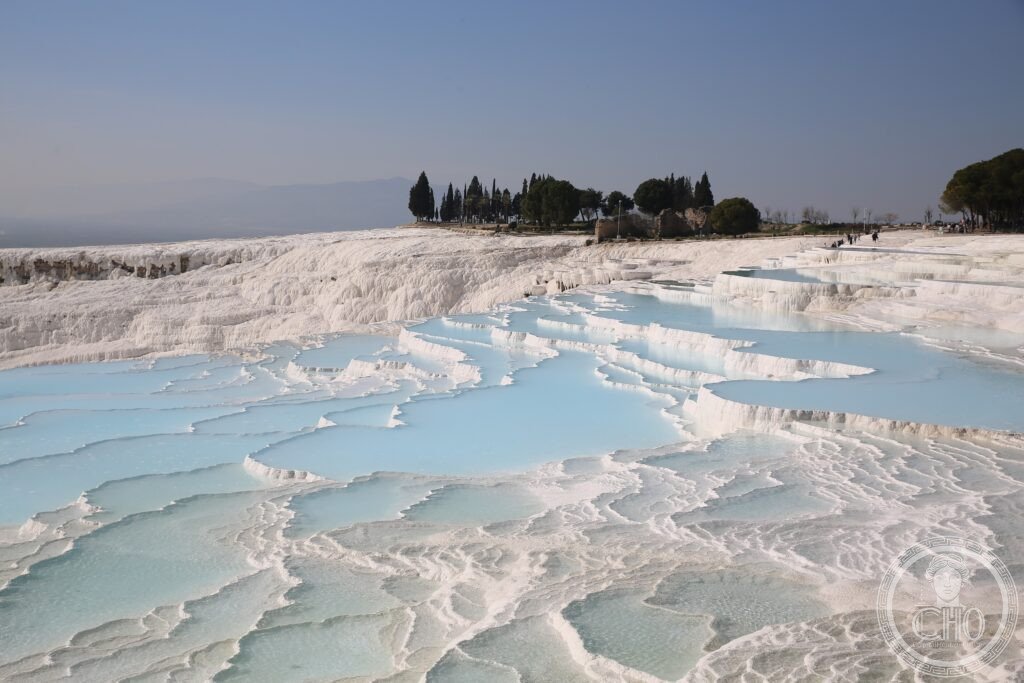
Pamukkale’s white travertine terraces, built up by warm mineral springs over hundreds of thousands of years, sit below the ruined Roman spa city of Hierapolis. Visitors walk barefoot across the cascading pools before reaching a colonnaded street, a theatre and a vast Greco-Roman necropolis on the plateau above.
At a glance
Pamukkale, whose name means Cotton Castle in Turkish, is a cliff of white calcium carbonate terraces filled with shallow thermal pools. Visitors are required to remove their shoes and cross the travertine barefoot, both to protect the surface and because the rock can be slippery. Above the terraces stand the ruins of Hierapolis, a Roman spa city built to make use of the same hot springs.
The site was in poor condition before its 1988 UNESCO inscription, when hotels stood directly on the travertine and pollution had turned the once-white surface grey. After inscription the hotels were demolished and the natural water flow restored. Artificial channels now direct the thermal water around different parts of the terrace in rotation, so that the white colour, which only appears where water is actively flowing, can be maintained across the whole formation over time; not every section is white at once.
Key facts
- Formation: calcium bicarbonate-rich thermal water emerges at around 35°C and deposits calcium carbonate as travertine when it cools and loses carbon dioxide, a process that has built up the terraces over roughly 400,000 years.
- Scale: the travertine cliff face extends over 2,700 metres and rises about 160 metres above the valley floor.
- Hierapolis: a Roman spa city founded around 190 BC by Eumenes II of Pergamon, built directly above the springs to exploit their reputed healing properties.
- Necropolis: the largest Greco-Roman necropolis in Anatolia, with roughly 1,200 tombs ranging from simple rock-cut graves to elaborate temple-fronted sarcophagi; bodies were brought here from across the ancient world for burial near the springs.
- Martyrium of Saint Philip: an octagonal structure on the hill above Hierapolis, built where the apostle Philip is said to have been martyred in 80 CE, and still a pilgrimage destination for Eastern Orthodox Christians.
History
Before Hierapolis existed, the site was a Phrygian cult centre dedicated to Cybele, the Mother Goddess, focused on a cave from which lethal carbon dioxide gas seeps and which was believed to be a gate to the underworld. Pergamon founded Hierapolis around 190 BC and bequeathed it to Rome in 133 BC. Under Roman rule the city grew into a major spa and pilgrimage centre, said to have had a population of 100,000. An earthquake in 60 CE devastated Hierapolis, and the emperor Nero had it rebuilt. Philip the Apostle is said to have been martyred here in 80 CE. Hierapolis and the Pamukkale travertine were jointly inscribed as a UNESCO World Heritage Site in 1988, recognising both the Roman ruins and the natural phenomenon together.
What you see
The main route up begins at the South Gate and climbs the terraces barefoot through a series of pools, some ankle-deep and cool, others waist-deep and warm enough to bathe in. On reaching the plateau, visitors find the remains of Hierapolis, including a colonnaded Roman street around a kilometre long and a theatre that could seat some 12,000 people, its stage building decorated with three tiers of relief carvings showing the birth of Apollo. It is considered one of the best-preserved Roman theatres in Turkey.
Nearby is the Sacred Pool, also known as Cleopatra’s Pool, a thermal pool at around 36°C containing submerged ancient Roman columns, pediments and other architectural fragments that fell into the water during a 7th-century earthquake. The pool occupies the site of the sacred precinct of Apollo, and visitors can swim among the ruins; entry is ticketed separately from the main site. A short distance away is the Plutonium, a cave from which carbon dioxide gas continuously seeps and which the Phrygians and Romans regarded as a gate to the underworld; priests of Cybele are said to have demonstrated their powers by holding animals over the opening until they died. The cave was sealed in antiquity and later reopened for visitors, though it remains fenced off, as birds that fly too close to the opening are killed by the gas.
Practical information
- Footwear: shoes must be removed to walk on the travertine terraces.
- Best times: the site is at its most atmospheric at sunrise or sunset, when the white travertine takes on a golden colour and the pools steam in cooler air; the terraces are busiest around the middle of the day in July and August, so early morning visits or travel in the shoulder seasons are worth considering.
- Cleopatra’s Pool: entry is a separate ticket from the main site; visitors wishing to swim should bring a costume.
- Coordinates: 37.9197° N, 29.1203° E.
Getting there
Denizli Çardak Airport has a direct connection from Istanbul, with a shuttle or taxi onward to Pamukkale village. There are also bus services from İzmir and from Antalya. Current timetables and fares are best checked with the relevant carriers before travelling.
Nearby
- Ephesus — around 180 km west, a UNESCO World Heritage Site inscribed in 2015; home to the Library of Celsus, the Temple of Artemis site, the House of the Virgin Mary and the Terrace Houses.
- Aphrodisias — around 100 km northeast, a UNESCO World Heritage Site inscribed in 2017; noted for its ancient stadium, its marble city dedicated to Aphrodite, the Sebasteion relief panels and its renowned sculptural school, with an on-site museum.
- Cappadocia — around 350 km east, a UNESCO World Heritage Site inscribed in 1985; known for its fairy chimneys, cave churches, underground cities and hot air balloon flights.
Sources
- Wikipedia
- UNESCO
Find it on the map
See this place and what’s around it →📷 Become a Cultural Heritage Online photographer
Share your photos of places: they stay published under your name as the author. The more they're seen, the more you get noticed — and soon a contest will reward the most appreciated photos.
Log in or sign up free to add a photo