
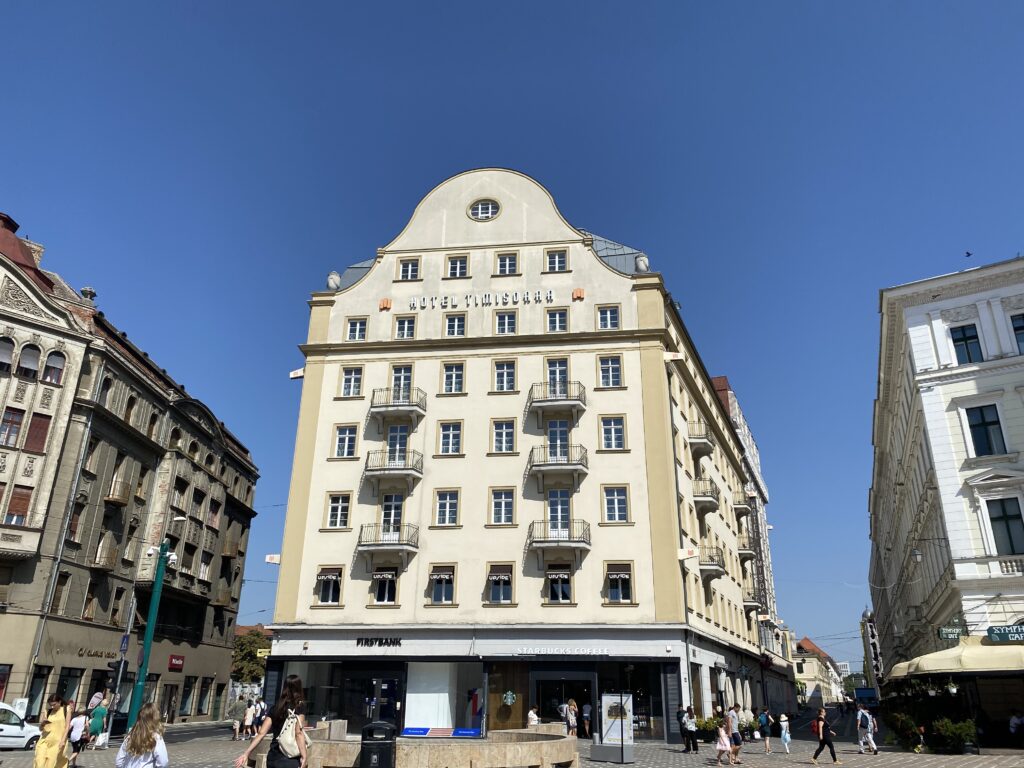

A bank headquarters that was also a hotel from the day it opened. Built in 1931–1933 for a consortium of Swabian banks, it closes the north end of the city’s great square with a gable borrowed from the villages of the Banat.
At a glance
At the northern end of Piața Victoriei, beside the National Theatre and Opera, stands the one building on the square that refuses ornament. The Palace of the United Banat Banks (Palatul Băncilor Bănățene Unite) was commissioned by a consortium of local Swabian banks and finished in 1933, twenty years after the Secession palaces of the Corso. It was planned from the start to hold the banks’ offices, shops on the street and a hotel, the Pension Central. The hotel is still there, now as Hotel Timișoara. The building lies inside the protected urban site of the Cetate quarter, listed as a historic monument of national value.
Key facts
- Where: Strada Mărășești 1, Cetate, Timișoara, Timiș County, Romania
- Built for: the United Banat Banks (Băncile Bănățene Unite), a consortium of local Swabian banks
- Building permit: 27 May 1931; completed 1933
- Architect: Mathias Hubert (born 1892), according to the Heritage of Timișoara survey; the Romanian and English Wikipedia articles also name László Székely
- Extension: a new wing of 1975–1978 by Gheorghe Gîrleanu, on the site of the demolished police headquarters
- Protection: within the Situl urban Cartierul «Cetatea Timișoara», Lista Monumentelor Istorice code TM-II-s-A-06095
- Coordinates: 45.754235, 21.225381 · open in Google Maps
History
The square in front of the building was born from demolition. After the decision of 1892 to dismantle the fortress of Timișoara, the ground by the Petrovaradin Gate was cleared and a broad boulevard was laid out from the theatre southwards. Between 1910 and 1913 its western side filled with Secession palaces, most of them by the city architect László Székely. The northern end, facing the theatre, was completed later and in a different language.
On 27 May 1931 the joint-stock company of the United Banat Banks obtained a permit for a new building. The design went to Mathias Hubert, an architect and teacher born in 1892 in Jamu Mare, trained in Budapest and qualified in 1919, whose other works in the city include the Banatia school. Construction was entrusted to the Martin firm. The Pension Central, one of the most modern hotels in Timișoara at the time, was already operating in the building in 1931 and was taken over in 1937 by Martin Eichart. On the ground floor the Jachan bookshop traded between the wars; in the communist years the same space held the Mercur department store.
Hubert himself was arrested for political reasons in 1945 because of his ethnicity, and in the last part of his life taught at the technical school of construction in the city. The hotel grew in 1975–1978, when a new block by Gheorghe Gîrleanu replaced the old police headquarters next door. It was fully renovated in 2007–2008 and the façade was restored in 2009. Today the building belongs to Bega Turism and operates as Hotel Timișoara.
What you see
The front towards the square is a tall, pale block of cream render framed by slightly darker corner strips. Above a commercial ground floor rise five storeys of plain rectangular windows, and over them a curved, bell-shaped gable with a round window at its top. The Heritage of Timișoara survey reads this gable as a quotation from the houses of the Swabian villages of the Banat: a discreet way for the banks to say whose building it was. Two stone vases stand on the shoulders of the gable, and the words Hotel Timișoara run across its base.
The balconies are the only other ornament. They are stacked in two vertical rows, each with a plain wrought-iron railing on a projecting slab carried by small consoles. Against the richly moulded Secession fronts nearby, the effect is deliberately calm. At street level the shop windows are taken today by a bank and a café, and a stone fountain basin sits on the paving in front.
Practical information
- The building is a working hotel (Hotel Timișoara); the façades can be seen from the square and from Strada Mărășești at any time.
- The shops on the ground floor are open to the public during business hours.
- The whole north end of Piața Victoriei is pedestrian; the Opera is next door.
- Allow fifteen minutes for the building, longer if you walk the length of the Corso to the Metropolitan Cathedral.
Getting there
The building is in the Cetate quarter, the historic centre of Timișoara, at the north end of Piața Victoriei. Timișoara Nord railway station lies west of the centre, within walking distance of the old town. Timișoara Traian Vuia International Airport is north-east of the city.
Nearby
- Romanian National Opera, Timișoara, in the theatre building beside the palace.
- Lloyd Palace, the first of the Secession palaces on the Corso (1910–1912).
- Dauerbach Palace, on the same side of the square.
- Timișoara — Secession Facades of the Banat, a walk through the quarter.
Sources
- Heritage of Timișoara (Asociația PRIN BANAT), Palatul Băncilor Bănățene Unite, text by Mihai-Claudiu Moldovan, 27 September 2023: permit date, architect, builder, the Swabian gable, the Pension Central, protection status.
- Lista Monumentelor Istorice 2015 (Ministry of Culture, Monitorul Oficial no. 113 bis, 15 February 2016), as transcribed on ro.wikipedia, Lista monumentelor istorice din județul Timiș: code TM-II-s-A-06095 for the Cetate urban site.
- ro.wikipedia, Ansamblul urban interbelic «Corso» din Timișoara: the demolition of the fortress and the building of the square; the Banat Banks palace named among the buildings closing its north end.
- en.wikipedia, Palace of the United Banat Banks, and ro.wikipedia, Hotel Timișoara: the 1975–1978 extension, the 2007–2009 renovation, the attribution to László Székely.
- Hotel Timișoara, official site, for the address; OpenStreetMap / Nominatim for the position («Hotel Timișoara, 3, Strada Mărășești»).
Find it on the map
See this place and what’s around it →📷 Become a Cultural Heritage Online photographer
Share your photos of places: they stay published under your name as the author. The more they're seen, the more you get noticed — and soon a contest will reward the most appreciated photos.
Log in or sign up free to add a photoIs this page about you?
This page is read by travellers and heritage enthusiasts who find it on Google. Tell us how you are connected to this place and we will take it from there.