
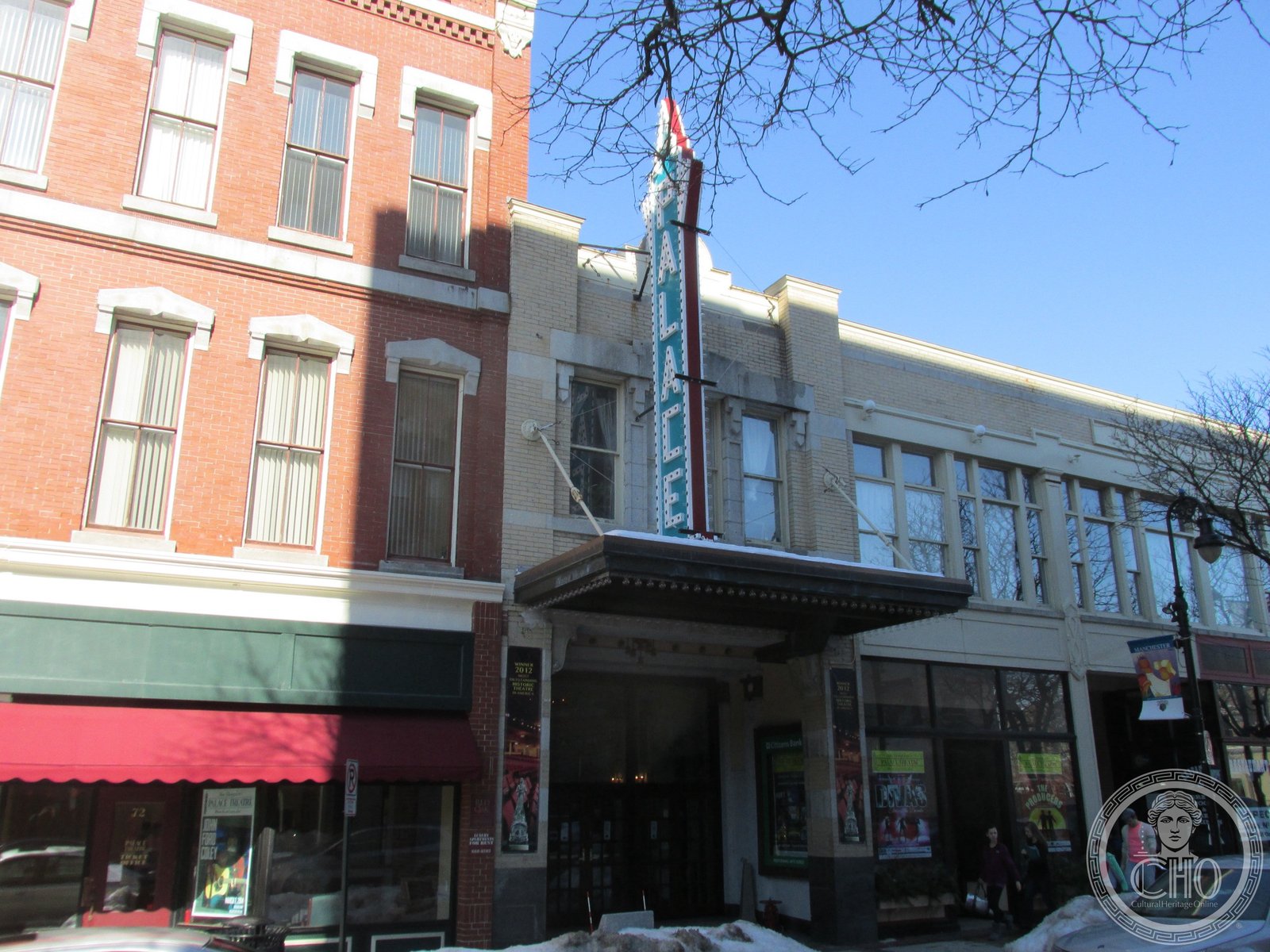
On Hanover Street in the center of Manchester, the Palace Theatre has served as New Hampshire’s premier cultural institution for over a century — a 1915 classical theater whose decorative interior and distinguished program have made it the anchor of the arts life of the state’s largest city, and whose preservation and ongoing activity make it one of the most complete surviving examples of early twentieth-century theatrical design in New England.
At a glance
The Palace Theatre at 80 Hanover Street is Manchester’s most important historic cultural building and the performing arts center that has defined the cultural life of New Hampshire’s largest city since 1915. Designed in the classical theatrical tradition of the early twentieth century, with an elaborately appointed interior appropriate to a building that aspired to bring the full range of theatrical entertainment to the mill city of the Merrimack Valley, it operated as a vaudeville palace and movie theater through the first half of the twentieth century before being rescued from demolition by community preservation efforts and rededicated as a performing arts center. Listed on the National Register of Historic Places, it now hosts Broadway productions, concerts, comedy, and the programming of the Palace Theatre organization, which has made it the most active performing arts venue in New Hampshire.
Key facts
- Address: 80 Hanover Street, Manchester, NH 03101
- Opened: 1915
- Style: Classical / early twentieth-century theatrical design
- Current use: Active performing arts venue; Broadway tours, concerts, comedy
- Designation: National Register of Historic Places
- GPS: 42.9949° N, 71.4601° W
History
Manchester in 1915 was the largest city in New Hampshire and the industrial hub of the Merrimack Valley: a city built on the Amoskeag Mills complex, which at its peak in the early twentieth century was the largest textile manufacturing operation in the world, employing tens of thousands of workers and shaping the physical and social fabric of the city in ways that were visible in every neighborhood. The city’s dense working-class population — drawn from French Canada, Greece, Ireland, Poland, and a dozen other countries — supported a rich entertainment culture in the blocks surrounding the mill district.
The Palace Theatre was built to serve this population with the full range of theatrical entertainment available in the vaudeville era: touring acts, musical comedy, drama, and eventually the new medium of motion pictures. Its classical interior — ornate plasterwork, painted ceilings, richly appointed boxes and balcony — gave the city’s mill workers an evening environment of genuine splendor, the theatrical experience of escaping the working day into a space of beauty and entertainment. This social function of the theatrical palace — giving working people access to a physically magnificent experience that transcended the ordinary environment of their lives — was precisely what the best theaters of the early twentieth century were designed to provide.
The Palace Theatre survived the decline of vaudeville, the golden age of Hollywood cinema, and the subsequent contraction of downtown entertainment that accompanied suburban development, eventually facing demolition before community advocates recognized its importance to Manchester’s cultural identity. Restored and rededicated, it has operated continuously as a performing arts center for decades, its programming spanning the full range from Broadway tours to local productions and making it the most significant live performance venue in the state.
What you see
The Hanover Street facade presents the Palace Theatre’s classical character: a formal theatrical entrance with the ornamental detailing characteristic of the early twentieth-century theater tradition, announcing the building’s purpose and importance on Manchester’s commercial street. The marquee continues to identify the theater’s programming in the tradition that has marked this facade since 1915.
The auditorium is the building’s essential interior: a classically appointed room of genuine richness, with plasterwork, decorative painting, and the spatial configuration of boxes, balcony, and orchestra level that gave the Palace Theatre its theatrical presence. The restoration has maintained the integrity of this interior, making it one of the most complete surviving examples of early twentieth-century theatrical design in the northern New England region.
Practical information
- Programming: Broadway tours, concerts, comedy, children’s theater, local productions; check palacetheatre.org for schedule
- Downtown Manchester: The Palace is in the city’s commercial core; the Millyard Museum and Amoskeag Mills complex are nearby; the elm Street restaurant corridor has expanded significantly in recent years
- Parking: Municipal garages and surface lots in downtown Manchester; the theater is walkable from the parking facilities
Getting there
Manchester is New Hampshire’s largest city, at the center of the Merrimack Valley, approximately 55 miles north of Boston via Interstate 93. Manchester-Boston Regional Airport (MHT) is 5 miles south and serves as one of the region’s alternative airports to Boston Logan. Concord Coach Lines provides bus service between Manchester and Boston South Station. The Palace Theatre is on Hanover Street in downtown Manchester, within walking distance of the city’s hotels and the Millyard district.
Nearby
- Amoskeag Mills / Manchester Millyard Museum — the vast red-brick complex of the former Amoskeag Manufacturing Company that once constituted the world’s largest textile manufacturing operation, now converted to offices, restaurants, and the Millyard Museum; the museum documents the immigrant labor history of Manchester’s mill era and the transformation of this industrial complex into a mixed-use neighborhood
- Currier Museum of Art — one of New England’s finest art museums, a mile from the Palace Theatre, with important collections of American and European art including a Frank Lloyd Wright house (the Zimmerman House, 1950) that is part of the museum’s holdings and open for tours
- New Hampshire State House, Concord — the oldest state capitol in the United States in which the legislature still meets in its original chambers, 18 miles north in Concord; the 1819 granite building with its 1864 gold dome is a masterpiece of early American federal civic architecture
- Anheuser-Busch Brewery, Merrimack — the large-scale brewing facility 10 miles south, with tours and the Budweiser Clydesdales stabling that attracts visitors from across the region; a counterpoint to the Palace’s cultural programming in the full range of Merrimack Valley attractions
Sources
- National Register of Historic Places, Palace Theatre nomination
- New Hampshire Division of Historical Resources documentation
- Manchester Historic Association architectural records
- Union Leader archives — Palace Theatre history
- Palace Theatre institutional history
Find it on the map
See this place and what’s around it →Record researched and written by Luigi De Marchi for Cultural Heritage Online, 2026.
📷 Become a Cultural Heritage Online photographer
Share your photos of places: they stay published under your name as the author. The more they're seen, the more you get noticed — and soon a contest will reward the most appreciated photos.
Log in or sign up free to add a photoIs this page about you?
This page is read by travellers and heritage enthusiasts who find it on Google. Tell us how you are connected to this place and we will take it from there.