
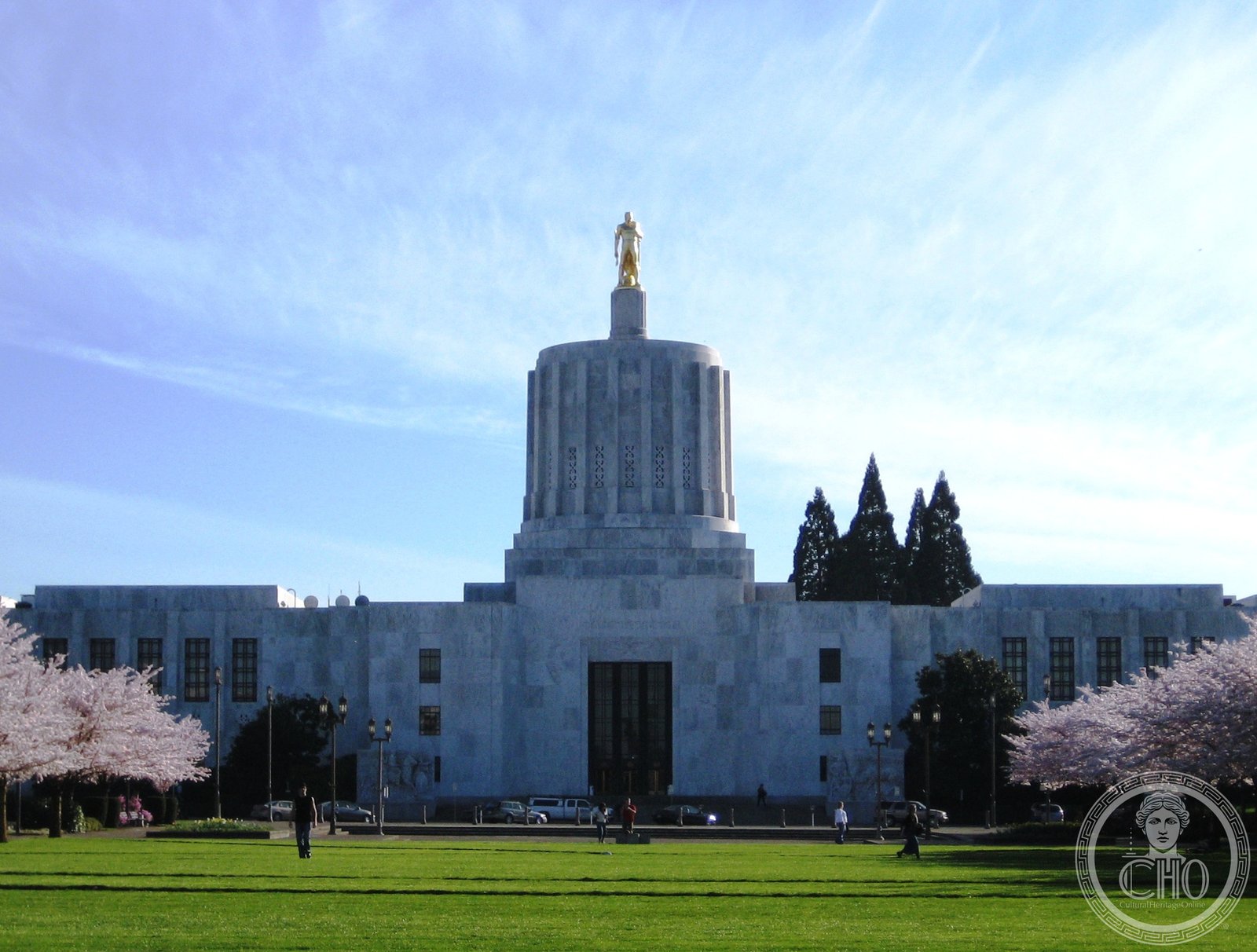
One of the most distinctive state capitals in America, this Art Deco marble tower carries a gold-plated bronze pioneer on its drum where other states raise a dome — a deliberate break with the classical tradition that defined a new identity for the Pacific Northwest.
At a glance
The Oregon State Capitol in Salem was completed in 1938, replacing the previous capitol that had burned to the ground in April 1935. Rather than rebuilding in the Neoclassical tradition that had dominated American capitols since the Revolution, Oregon commissioned a Streamline Moderne design in Vermont Danby marble that set the building apart from every other statehouse in the country. The building’s most distinctive element is its central drum — a broad cylindrical tower topped with a 23-foot bronze figure known as the Oregon Pioneer, gilded in gold leaf, facing west. The Capitol is a National Historic Landmark and the working home of Oregon’s legislature and governor.
Key facts
- Completed: 1938
- Architects: Trowbridge & Livingston (New York) with Francis Keally
- Address: 900 Court Street NE, Salem, Oregon 97301
- Style: Art Deco / Streamline Moderne
- Cladding: Vermont Danby marble
- Historic designation: National Historic Landmark
- Oregon Pioneer statue: 23 feet tall; gilded in 23.75-karat gold leaf
History
Oregon’s capitol history spans three buildings. The territorial capitol of 1854 served until statehood in 1859, when a permanent building was erected. That 1876 capitol — a more elaborate replacement for the original — burned in a dramatic fire on April 25, 1935, an event that coincided with the deepest years of the Depression. The fire and the era together pushed Oregon toward a capitol that would be decisively modern rather than another copy of the classical models that had followed the U.S. Capitol from state to state since the eighteenth century.
The state hired the New York firm of Trowbridge & Livingston, with Francis Keally as the principal architect, to design a building that would express Oregon’s character as a western, coastal, progressive state. Keally’s solution was a broad marble drum — more like a civic monument than a capitol — rising from low horizontal wings and topped with a bronze pioneer rather than a dome. The choice was deliberate: a covered wagon figure, gilded in gold leaf, facing west above the Willamette Valley, read as a statement about Oregon’s frontier identity rather than its European institutional inheritance.
The building opened in 1938, on time and within budget at a cost of approximately $2.5 million. The Oregon Pioneer statue was added the same year, cast in bronze by sculptor Ulric Ellerhusen and gilded with 23.75-karat leaf. The Capitol has since been expanded with underground additions and a connecting annex, but the original 1938 drum and wings remain the face that Oregonians present to the world.
What you see
Approaching from Court Street NE, the Capitol presents a horizontal composition in white marble interrupted by the central drum rising at mid-point to carry the Pioneer above the roofline. The wings are low and spare, their facades articulated by shallow pilasters and narrow vertical windows in a vocabulary that shares the Streamline Moderne’s preference for smooth planes and geometric abstraction over historical ornament. There are no columns, no pediments, no capitals — the Capitol reads as a clearly modern building despite its white marble, public function, and axial composition.
The drum itself, which supports the Pioneer, is visible from most of downtown Salem and from the hills to the east. At 166 feet the Capitol is not a tall building by commercial standards, but its isolation on the Capitol Mall — a landscaped axis running north from Court Street toward the Willamette River — gives it a commanding presence. The interior is finished in varied marbles and includes two large murals depicting Oregon’s settlement and Lewis and Clark’s arrival at the Pacific.
Practical information
- Access: Free public tours; open Monday–Friday during legislative sessions; observation level in the drum accessible by guided tour
- Best time to visit: Morning, when the Pioneer catches the eastern sun and the Capitol facade is in full light; legislative sessions (January–June in odd years) for maximum activity
- Parking: Metered street parking on Court Street NE; Capitol parking garage west of the building
- Time needed: 1–1.5 hours including interior tour; 30 minutes for exterior only
Getting there
Salem is located 47 miles south of Portland on I-5. The Capitol stands at 900 Court Street NE, a 10-minute walk from Salem’s downtown and 15 minutes from Salem’s Amtrak station (Cascades and Coast Starlight routes). Portland International Airport (PDX) is approximately 60 minutes north by car or one hour by Amtrak Cascades. From I-5, take Exit 253 (Commercial Street SE) and follow Capitol signs north for five minutes.
Nearby
- Willamette Heritage Center — mission-era buildings and Oregon Trail history, two blocks from the Capitol
- Bush’s Pasture Park — 90-acre urban park with the 1878 Bush House and Art Museum; 10-minute walk south
- Mission Mill Museum — 1889 woolen mill complex documenting Oregon’s industrial history; five-minute walk east
- Silver Falls State Park — Oregon’s largest state park with ten waterfalls; 26 miles east of Salem on OR-214
Sources
- Oregon State Capitol Foundation, official building history documentation
- National Historic Landmark nomination file: Oregon State Capitol (1988 designation)
- Oregon Blue Book, Oregon Secretary of State, capitol building specifications
- Steven Holl and William J. Hawkins III, Oregon Architecture (broader state architectural context)
Find it on the map
See this place and what’s around it →📷 Become a Cultural Heritage Online photographer
Share your photos of places: they stay published under your name as the author. The more they're seen, the more you get noticed — and soon a contest will reward the most appreciated photos.
Log in or sign up free to add a photoIs this page about you?
This page is read by travellers and heritage enthusiasts who find it on Google. Tell us how you are connected to this place and we will take it from there.