
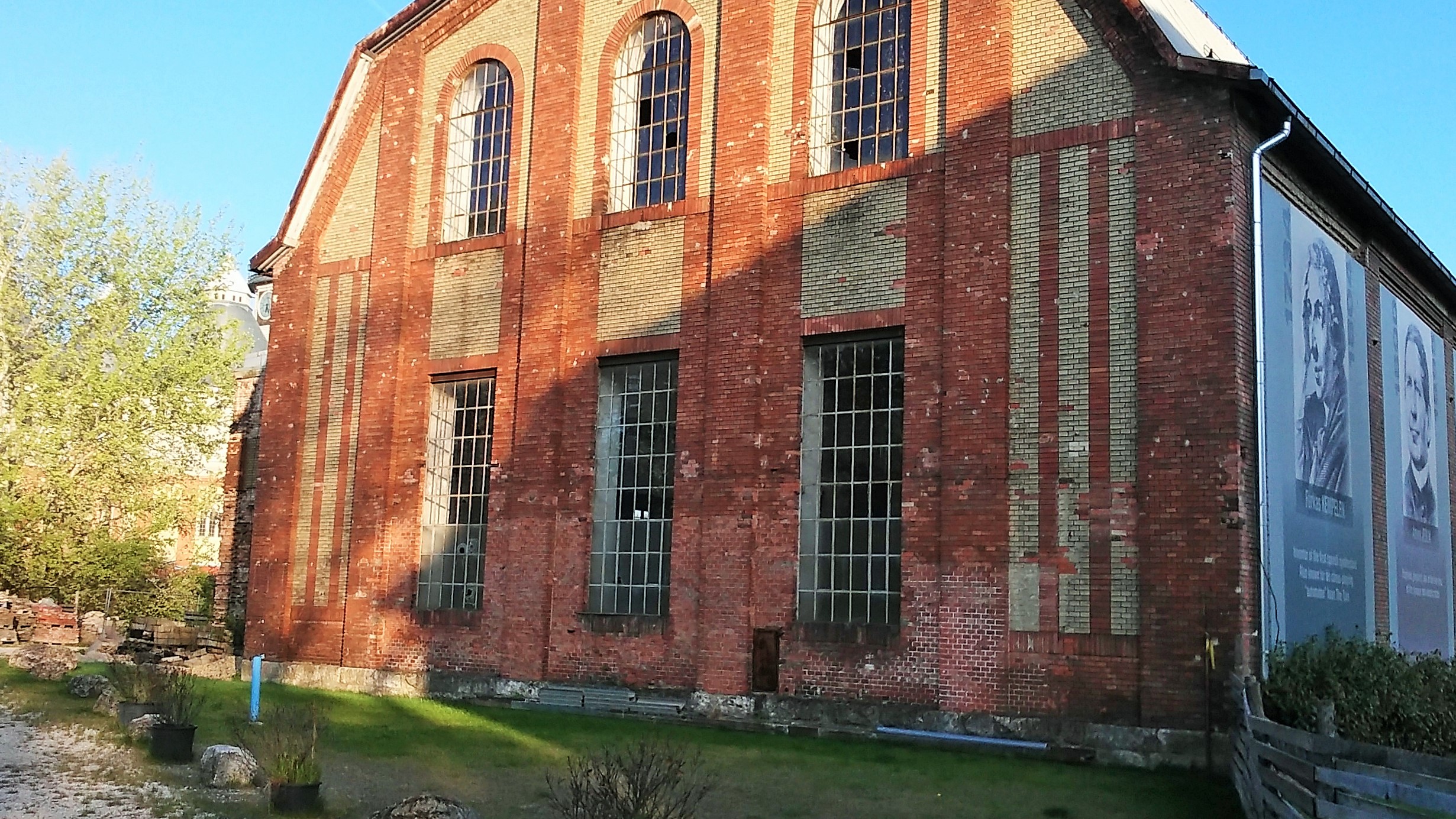

Twenty-seven hectares of brick on the right bank of the Danube, built to turn coal into the gas that lit a capital. When it opened it was called the most modern plant on the continent.
At a glance
The Óbuda gasworks made town gas from coal for Budapest between 1913 and 1984. It occupies a roughly triangular site of twenty-seven hectares in the Aquincum quarter of the third district, on the right bank of the Danube south of the Újpest railway bridge, running as far as the entrance to Óbuda Island. A number of its buildings are listed industrial monuments.
Key facts
- What it is: a former coal gasworks, now a heritage site with listed industrial buildings
- Decided: 1908, when the city resolved to build a new gasworks at Óbuda on the Homokos-dűlő
- Designer: Albert Weiss, a gasworks builder from Zurich, with Izidor Bernauer, director of lighting, and the engineer Győző Schön
- Built: from 1910; a kilometre of embankment along the Danube in 1912–1913, then industrial sidings and roads; most buildings and machinery ready by 1913
- Opened: officially on 13 June 1914; production had been started up gradually from October 1913
- Capacity: up to 250,000 cubic metres of gas a day, with eleven kilometres of railway track on site
- Closed: 1984
History
Gas consumption in Budapest rose through the early twentieth century as the city spread, and in 1908 the capital decided to build a new gasworks at Óbuda. The ground chosen was still on the edge of the city and had what such a plant needs: a railway, and a river to bring coal up by barge.
The design went to Albert Weiss, a recognised gasworks builder from Zurich, assisted by the lighting director Izidor Bernauer and the engineer Győző Schön; it was finished within two years. Construction began in 1910. A kilometre of quay wall went up along the Danube in 1912–1913, then the industrial sidings and the roads. By 1913 most of the buildings and machines were ready, and from October the plant was brought into operation stage by stage. The official opening was on 13 June 1914.
The works used the most advanced technology of its day and could produce a quarter of a million cubic metres of gas in twenty-four hours; eleven kilometres of track ran through the site, connected directly to the Buda circular railway on the right bank and to the Budapest–Esztergom line. It kept working until 1984.
What you see
Red and pale brick, in the manner of industrial building before the First World War: tall arched windows in two registers, pilaster strips picked out in lighter brick, iron glazing bars. Several of the buildings stand empty, with the frames still in the openings and grass grown up to the walls.
Practical information
- The site is a former industrial area under redevelopment; parts of it are not freely accessible.
- Guided walks are the usual way in; check the organiser’s dates and meeting points.
Getting there
The site lies in the third district, between the Újpest railway bridge and the entrance to Óbuda Island, on the Buda side of the Danube; suburban rail and buses serve Aquincum.
Nearby
- Aquincum, the Roman town and its museum, immediately north.
- Óbuda Island, at the southern end of the site.
- The Danube embankment between Óbuda and Újpest.
Sources
- Hungarian Wikipedia, Óbudai gázgyár — the operating years 1913–1984, the site and its twenty-seven hectares, the decision of 1908, the design by Albert Weiss with Izidor Bernauer and Győző Schön, the construction from 1910 and the quay wall of 1912–1913, the start-up from October 1913 and the opening on 13 June 1914, the daily capacity and the eleven kilometres of track.
- Wikidata (Q1471586) — coordinates.
Find it on the map
See this place and what’s around it →Events here — now on & upcoming
- Budapest’s signal tower: the gasworks utopia at Óbuda28 Aug 2026 — 18 Oct 2026See the event →
📷 Become a Cultural Heritage Online photographer
Share your photos of places: they stay published under your name as the author. The more they're seen, the more you get noticed — and soon a contest will reward the most appreciated photos.
Log in or sign up free to add a photo