
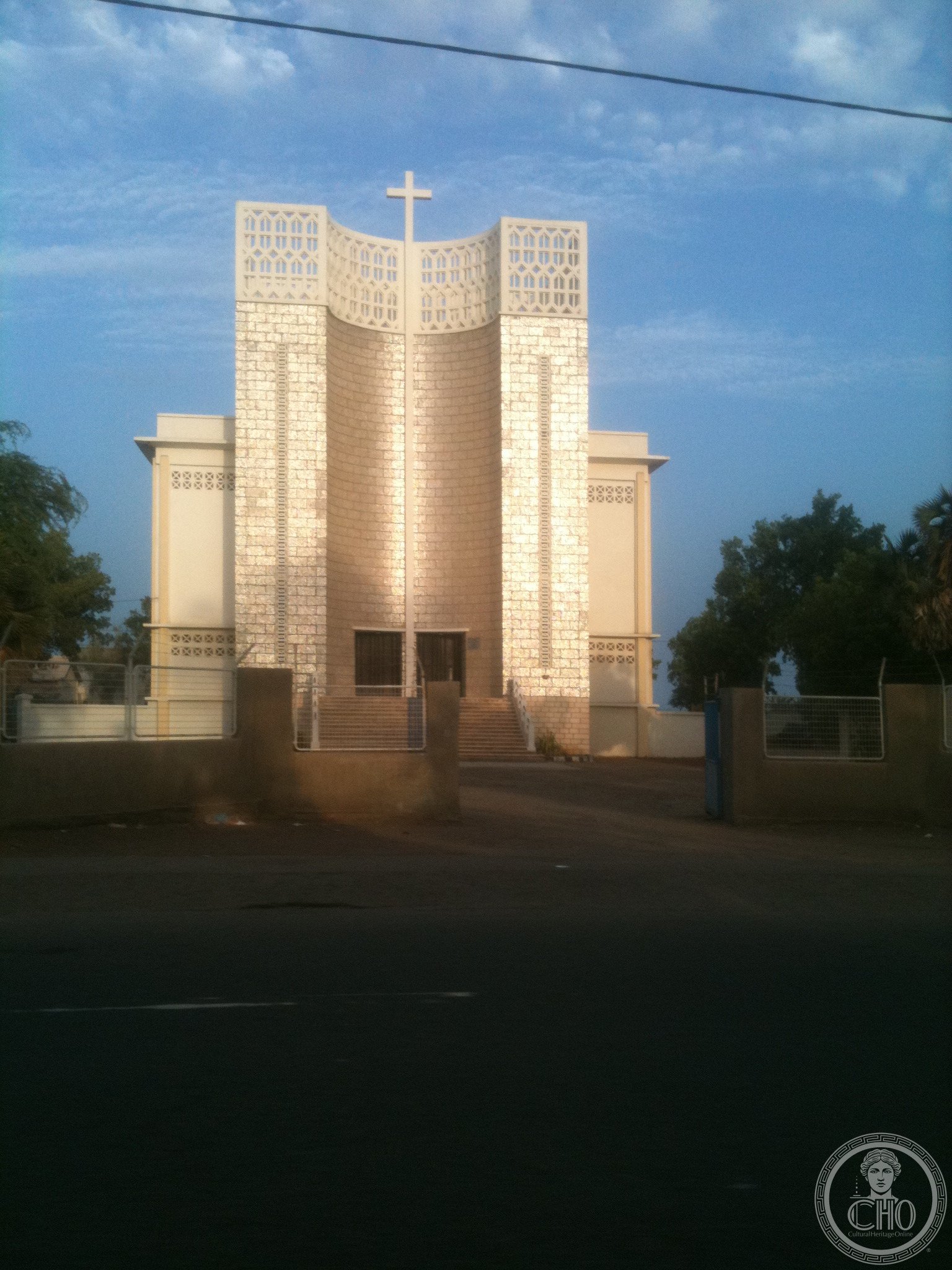
In the centre of Djibouti, capital of the republic of the same name on the Horn of Africa, the cathedral of Notre-Dame-du-Bon-Pasteur stands where a smaller church once was. That church, Sainte-Jeanne-d’Arc, was pulled down because it had become too small. The new building was raised between 1957 and 1964, to a design by the architect Joseph Müller of Colmar, in a modernist style of French and German descent (Neues Bauen), and was dedicated on 12 January 1964 by Cardinal Eugène Tisserant, then dean of the College of Cardinals. An isolated source attributes the actual building work to one «Calcagnile» of Bad Gastein, in Austria, a detail that could not be confirmed by a second independent source. The apostolic prefecture of Djibouti was erected on 28 April 1914, detached from the apostolic vicariate of the Galla in Ethiopia, and was raised to a diocese, directly subject to the Holy See, on 14 September 1955. The present bishop is Jamal Daibes, a Palestinian priest formerly auxiliary bishop of the Latin Patriarchate of Jerusalem, appointed on 13 January 2024 and responsible also for the apostolic administration of Somalia. Catholics are estimated at about 5,300 people out of a population of more than 900,000, less than one per cent, in a country whose constitution declares Islam the religion of State but guarantees, in a separate article, the equality of citizens of every faith and freedom of worship. The widespread idea that Djibouti is, in this respect, more tolerant than its neighbours is not confirmed by direct comparative sources, although it is a reasonable inference given the presence of registered and working churches. The strategic position of Djibouti, which hosts military bases of France, the United States (Camp Lemonnier), China and Japan, had a direct consequence for this cathedral. After a grenade attack claimed by al-Shabaab on a restaurant in the centre in May 2014, American security rules barred the personnel of Camp Lemonnier for three years from attending services in the cathedral, until a joint Mass of reconciliation celebrated in June 2017 by Bishop Giorgio Bertin together with the American military chaplains. No pope has ever visited Djibouti; the Holy See has kept an apostolic delegation there since 1992, raised to a nunciature in 2000, though held by a non-resident nuncio, based in Addis Ababa.
About the Cathedral
Our Lady of the Good Shepherd Cathedral (Cathédrale Notre-Dame-du-Bon-Pasteur) in Djibouti City is the seat of the Roman Catholic Diocese of Djibouti and the only Catholic cathedral in the country. It replaced a smaller church, Sainte-Jeanne-d’Arc, and was built between 1957 and 1964 to designs by architect Joseph Müller of Colmar, France.
Key facts
- 28 April 1914: Apostolic Prefecture of Djibouti erected, split from the Vicariate of Galla, Ethiopia.
- 1957–1964: current cathedral built in modernist “Neues Bauen” style.
- 12 January 1964: dedicated by Cardinal Eugène Tisserant, then Dean of the College of Cardinals.
- 14 September 1955: raised to Diocese of Djibouti, directly subject to the Holy See.
- Catholics number roughly 5,300 of over 900,000 people, under 1% of the population.
- May 2014 – June 2017: Camp Lemonnier personnel barred from cathedral services after an Al-Shabaab-linked grenade attack, resumed with a joint reconciliation Mass.
History
Built at the tail end of French colonial rule over what was then French Somaliland, the cathedral was dedicated in January 1964 by Cardinal Eugène Tisserant, the Catholic Church’s most senior cardinal at the time. Its most documented modern episode came decades later: after a May 2014 grenade attack on a downtown restaurant, claimed by Al-Shabaab, US force-protection rules barred Camp Lemonnier’s Catholic service members from attending Mass at the cathedral for three years, a restriction lifted only in 2017 with a joint service led by Bishop Giorgio Bertin alongside US Navy and Combined Joint Task Force–Horn of Africa chaplains.
What you see
A white concrete modernist facade rises in twin curved, pierced-lattice towers that taper toward a central cross above a staircase entrance, set behind a low perimeter wall and trees — a stark departure from the historicist church architecture more common in the wider region.
Practical information
- Opening hours: generally open daily outside services; check current hours before visiting.
- Address: Boulevard de la République, Djibouti City, Djibouti.
Getting there
The cathedral stands on Boulevard de la République in central Djibouti City. GPS: 11°35′59″N, 43°09′01″E.
Nearby
- Djibouti City center — the compact colonial-era Plateau du Serpent and Boulevard de la République commercial district surrounding the cathedral.
Sources
- Wikipedia (English and French) — “Our Lady of the Good Shepherd Cathedral, Djibouti” and “Roman Catholic Diocese of Djibouti”
- GCatholic.org — Diocese of Djibouti records.
- DVIDS (US Department of Defense news service) — “CJTF-HOA, Djiboutian Catholics reunite in show of faith, partnership,” June 2017.
- Latin Patriarchate of Jerusalem — biography of Bishop Jamal Daibes.
- Wikipedia — “Apostolic Nunciature to Djibouti” and “Foreign military bases in Djibouti”
Find it on the map
See this place and what’s around it →📷 Become a Cultural Heritage Online photographer
Share your photos of places: they stay published under your name as the author. The more they're seen, the more you get noticed — and soon a contest will reward the most appreciated photos.
Log in or sign up free to add a photo