

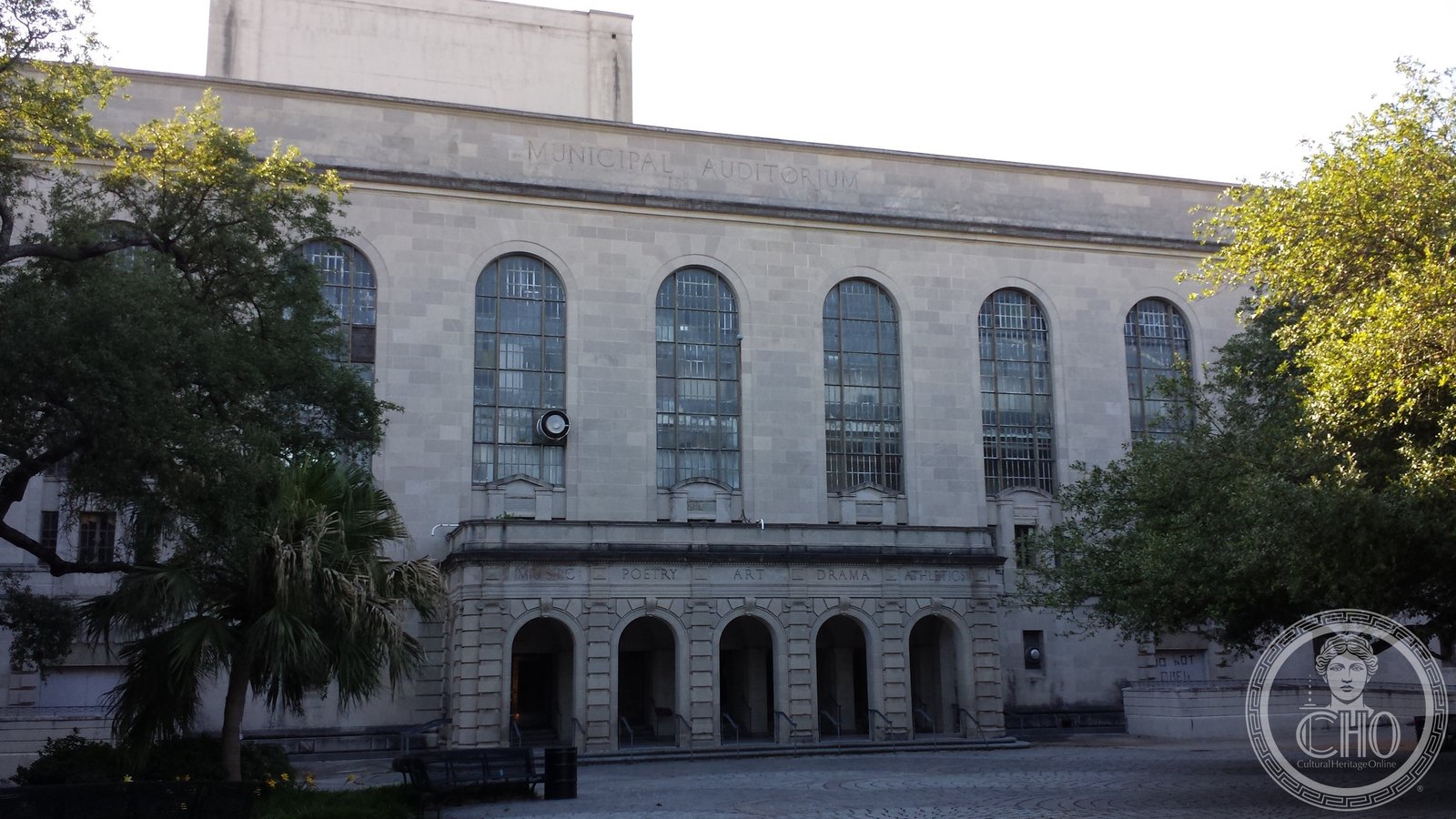
At the edge of Congo Square in the Tremé neighborhood, the New Orleans Municipal Auditorium rose in 1930 as a monument to the city’s civic ambitions — an Art Deco performing arts hall that hosted the Mardi Gras balls, the boxing matches, the wrestling cards, and the jazz concerts that defined New Orleans’s social life in the mid-twentieth century, in a building whose proximity to the birthplace of jazz gave it a musical significance beyond its considerable architectural merit.
At a glance
The New Orleans Municipal Auditorium at the edge of Armstrong Park is one of the defining civic landmarks of New Orleans’s Tremé neighborhood — the oldest African-American neighborhood in the United States and the community most deeply associated with the emergence of jazz. Built in 1930 in the Art Deco style and seating approximately 3,700, it served as New Orleans’s primary indoor public assembly venue for decades, hosting the elaborate Carnival balls that mark New Orleans’s social season, major entertainment events, and political gatherings. The building was severely damaged by Hurricane Katrina in 2005 and has been the subject of ongoing restoration and debate about its future use — a story that encapsulates the larger struggle of the Tremé community to maintain its historic character against the forces of displacement and development.
Key facts
- Address: North Rampart Street at Louis Armstrong Park, New Orleans, LA 70116
- Completed: 1930
- Style: Art Deco
- Capacity: approximately 3,700
- Adjacent to: Louis Armstrong Park / Congo Square, Tremé neighborhood
- Hurricane Katrina damage: 2005 — restoration ongoing
- Designation: National Register of Historic Places
History
The Tremé is the oldest African-American neighborhood in the United States, a community that developed in the late eighteenth and early nineteenth centuries under the particular conditions of New Orleans’s social history: a city where free people of color had broader rights than in most of the South, where the practice of gathering at Congo Square for music and dance on Sundays was tolerated, and where the mixing of African, Caribbean, French, and Spanish cultural traditions created something new. The Sunday gatherings at Congo Square are now understood as one of the foundational events in the emergence of jazz — the place where African musical traditions survived and adapted in an urban American context.
The Municipal Auditorium built adjacent to Congo Square in 1930 brought the civic ambitions of the New Deal era to this historically significant site. The Art Deco building was designed to serve the full range of New Orleans’s public life: the elaborate Mardi Gras balls that were the social peaks of the Carnival season, political conventions and civic gatherings, boxing and wrestling matches, concerts, and graduation ceremonies. For decades it was the largest and most prestigious indoor venue in New Orleans, hosting events that ranged from the most formal Carnival balls to performances by the jazz musicians who lived and worked in the surrounding Tremé.
Hurricane Katrina’s 2005 flooding inundated the Tremé along with much of New Orleans, and the Municipal Auditorium sustained severe flood damage. Its restoration has been complicated by questions about its future use, the economic pressures on the Tremé neighborhood, and the broader challenges of rebuilding New Orleans’s cultural infrastructure in a city that lost a quarter of its population in the storm’s aftermath. The building stands as one of the central sites in the ongoing story of New Orleans’s recovery — a monument to civic ambition whose future remains unresolved.
What you see
The Municipal Auditorium’s Art Deco exterior presents a formal civic character to North Rampart Street: a brick composition with vertical pilasters, ornamental stone panels, and the geometric decorative program characteristic of the style. The scale is that of a major public building — the auditorium was designed to announce the city’s investment in public assembly as a civic value, and the exterior achieves this with the restrained confidence of the best Art Deco civic architecture.
Inside, the main auditorium is a large-volume hall designed for the flexible use that New Orleans’s varied public programming required. The ballroom spaces that hosted the Mardi Gras season reflected the city’s particular relationship to formal social ritual; the main arena configuration served the sports events and large concerts that filled the calendar in between. The damage from Hurricane Katrina has left the interior incomplete, but the bones of the building and its urban presence survive.
Practical information
- Current status: Restoration in progress; check current access status before visiting
- Adjacent to: Louis Armstrong Park, which is open to the public and includes Congo Square; the park is accessible and well-signed
- Tremé neighborhood: The surrounding streets are the heart of the oldest African-American neighborhood in the United States and the birthplace of jazz; cultural exploration on foot is the primary activity
Getting there
The Municipal Auditorium is in Louis Armstrong Park, accessible from North Rampart Street in the Tremé neighborhood of New Orleans. New Orleans Armstrong International Airport (MSY) is 15 miles west. The building is one mile north of the French Quarter and accessible on foot or by public bus. The Regional Transit Authority’s bus routes serve the Tremé.
Nearby
- Louis Armstrong Park and Congo Square — the public park surrounding the Municipal Auditorium, built on the site of the historic Congo Square where enslaved people gathered on Sundays in the eighteenth and early nineteenth centuries; a National Historic Landmark associated with the origins of jazz and a beautiful urban park
- Tremé neighborhood — the historic streets of the oldest African-American community in the United States, surrounding the Municipal Auditorium and Armstrong Park; St. Claude Avenue, Ursulines Avenue, and the streets running toward the French Quarter are lined with the architecture of a neighborhood that has preserved its character through centuries of change
- St. Louis Cemetery No. 1 (1789) — the oldest extant cemetery in New Orleans at the corner of Basin Street and St. Louis Street, known for its above-ground vaults, the cultural practice of whitewashing tombs on All Saints’ Day, and the traditions of New Orleans Creole culture; tours required for access
- French Quarter — the historic heart of New Orleans at the Mississippi River bend, one mile south of the Municipal Auditorium; the oldest urban neighborhood in Louisiana, the site of the original French colonial settlement, and the center of the city’s music and food culture
Sources
- National Register of Historic Places, New Orleans Municipal Auditorium nomination
- Louisiana Division of Historic Preservation records
- New Orleans Times-Picayune archives
- The Historic New Orleans Collection documentation
- New Orleans Redevelopment Authority restoration records
Find it on the map
See this place and what’s around it →Record researched and written by Luigi De Marchi for Cultural Heritage Online, 2026.
📷 Become a Cultural Heritage Online photographer
Share your photos of places: they stay published under your name as the author. The more they're seen, the more you get noticed — and soon a contest will reward the most appreciated photos.
Log in or sign up free to add a photoIs this page about you?
This page is read by travellers and heritage enthusiasts who find it on Google. Tell us how you are connected to this place and we will take it from there.