

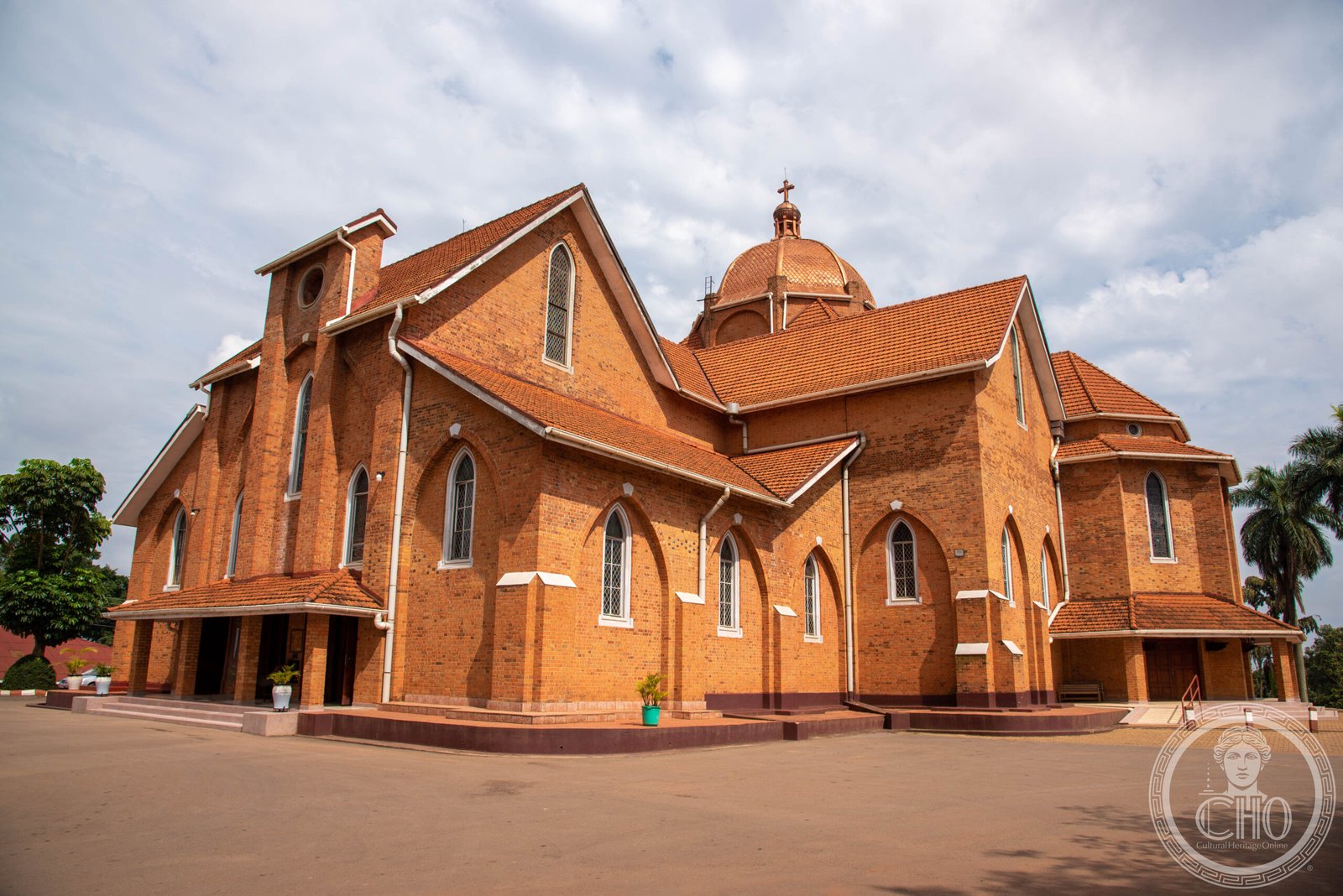
On Namirembe hill, about two kilometres from the centre of Kampala, St. Paul’s Cathedral is the historic seat of the Anglican mission of the Church Missionary Society (CMS) in Buganda, settled on this hill since 1889 on land donated by the kabaka. The present building is the fifth built on the same site. The first, of 1890, was abandoned the following year because of the marshy ground. The second, opened in 1891-92 by the kabaka Mwanga II himself with a capacity of about three thousand people, lost its roof in a storm in October 1894. The third, from the early Nineties of the nineteenth century, was abandoned because of termite damage. The fourth, opened on 21 June 1904 before the young kabaka Daudi Chwa II and a crowd estimated by some sources at ten thousand people, was destroyed by fire on 23 September 1910 after being struck by lightning. The present building, with its characteristic earthen-brick walls and tiles and its central dome, was designed according to some sources by the architect Arthur Beresford Pite at the request of Bishop Alfred Tucker, a detail not fully confirmed by a primary source. The foundation stone was laid on 15 November 1915 and the consecration took place on 13 September 1919 by Bishop Willis, in the presence of the rulers of Buganda, Bunyoro, Tooro, Ankole, Busoga and Kiziba. The Scottish missionary Alexander Mackay, the only CMS missionary left in Buganda during the persecutions of 1885-1887 after the temporary withdrawal of the Catholic White Fathers, died of malaria in 1890 and was reburied here in 1927. Bishop James Hannington, killed on 29 October 1885 on the orders of the kabaka Mwanga II, one of the deaths that opened the period of persecution of the Uganda Martyrs, Catholic and Anglican, was exhumed and buried here on 31 December 1892, remembered today by a memorial chapel in the cathedral. In 1897 the medical missionary Albert Ruskin Cook started on this hill, under a tree, the clinic that became Mengo Hospital; he died in 1951 and was buried in the cathedral cemetery. Namirembe hill, assigned to the British Anglican mission, stood opposite Rubaga hill, entrusted instead to the French Catholic White Fathers: a territorial separation wanted by the rulers of Buganda to contain the conflicts between the two rival missions, which nonetheless did not prevent the outbreak of armed conflict between Catholic and Protestant factions on 24 January 1892.
About the Cathedral
Namirembe Cathedral, on a hilltop roughly two kilometres from central Kampala, is the historic seat of the Church Missionary Society’s Anglican mission in Buganda. The current domed, earthen-brick building — the fifth on this site — was consecrated in 1919 after four predecessor structures were lost to swampy ground, storm damage, termites, and a lightning-sparked fire.
Key facts
- 1889: CMS Anglican mission settles on Namirembe Hill on land donated by the Kabaka.
- 1890–1910: four successive church buildings lost to swampy ground, an 1894 storm, termite damage, and a 1910 lightning-fire.
- 13 September 1919: current cathedral consecrated by Bishop Willis before the assembled kings of the region.
- Missionary Alexander Mackay reinterred here 1927; Bishop James Hannington, killed 1885, reinterred here 1892.
- 1897: Dr. Albert Ruskin Cook opens a clinic on the hill that grows into Mengo Hospital.
- Namirembe Hill (Anglican) and Rubaga Hill (Catholic) were deliberately kept as separate mission territories by Buganda’s kings.
History
Granted to the CMS Anglican mission in 1889, Namirembe Hill saw four church buildings rise and fall to swampy ground, storm, termites and lightning-sparked fire before the current domed cathedral was completed and consecrated in 1919. The hill holds the graves of two figures central to Uganda’s early Anglican history — missionary Alexander Mackay, who kept the CMS presence alive alone during the 1885–1887 persecutions, and Bishop James Hannington, killed by order of Kabaka Mwanga II in 1885 — as well as the origin site of Mengo Hospital, founded by missionary doctor Albert Cook in 1897. Its deliberate territorial separation from the neighboring Catholic mission on Rubaga Hill shaped the religious geography of colonial-era Buganda.
What you see
A red, earthen-brick cathedral with a central dome topped by a cross, its walls and roof tiles made of local brick rather than imported stone, standing on a hilltop with sweeping views over Kampala.
Practical information
- Opening hours: generally open daily outside services; check current hours before visiting.
- Address: Namirembe Hill, Lubaga Division, Kampala, Uganda.
Getting there
The cathedral stands on Namirembe Hill, about 2 km west of central Kampala. GPS: approximately 0.3150°N, 32.5597°E (sources vary by roughly 400 metres; treat as indicative).
Nearby
- Rubaga (Lubaga) Cathedral — Kampala’s Catholic cathedral, on a neighboring hill historically assigned to the rival French White Fathers mission.
- Mengo Hospital — founded on this hill in 1897, now a major Kampala institution.
Sources
- Wikipedia — “Namirembe Cathedral,” “Rubaga Cathedral,” “Alexander Murdoch Mackay,” “James Hannington,” “Uganda Martyrs,” “Albert Ruskin Cook”
- Namirembe Diocese (official site) — cathedral history.
- ChimpReports — “Namirembe Cathedral’s Tedious Inception”
- Mengo Hospital (official site) — institutional history.
- Dictionary of African Christian Biography — entries on Mackay and Cook.
Find it on the map
See this place and what’s around it →📷 Become a Cultural Heritage Online photographer
Share your photos of places: they stay published under your name as the author. The more they're seen, the more you get noticed — and soon a contest will reward the most appreciated photos.
Log in or sign up free to add a photo